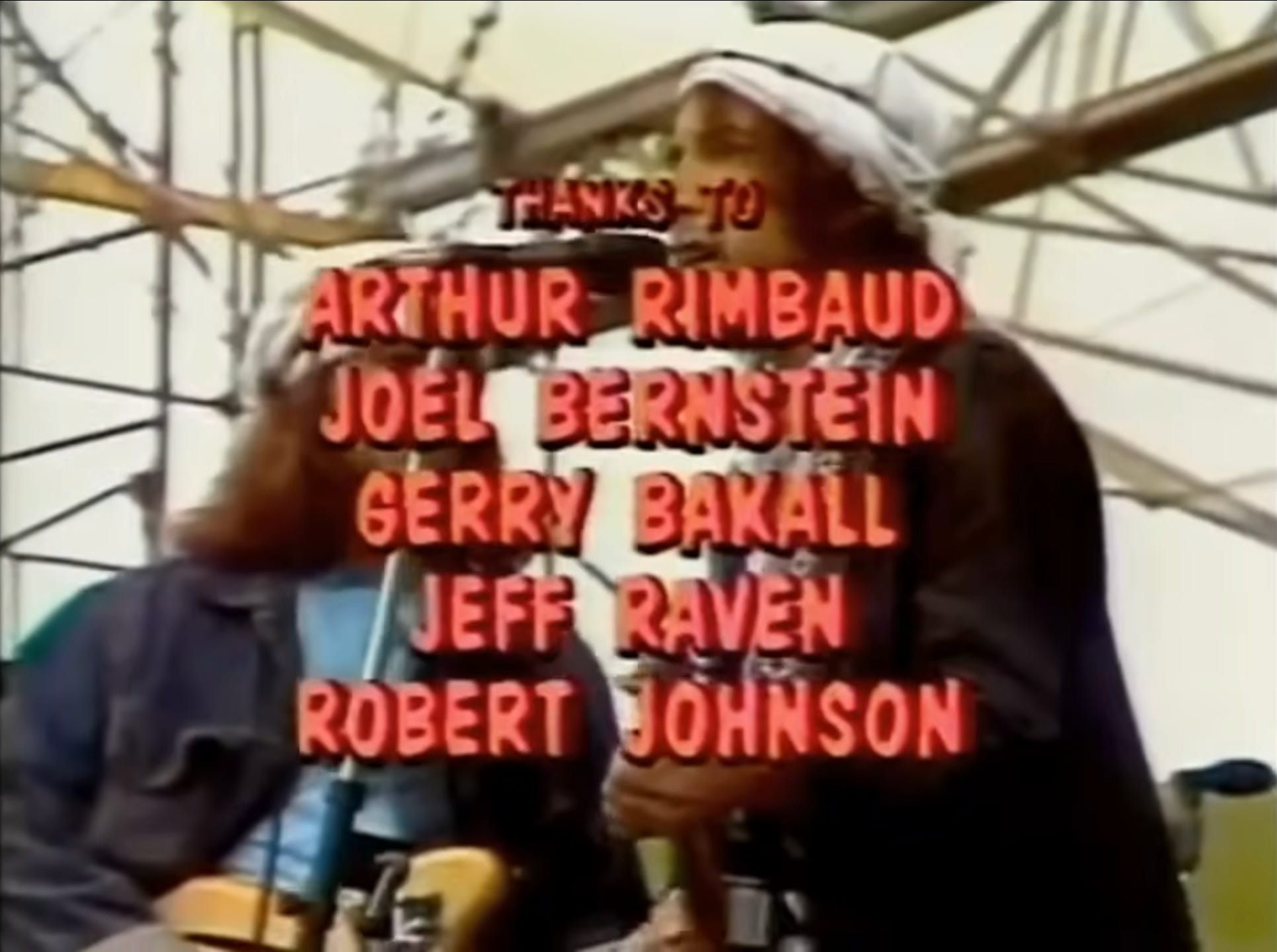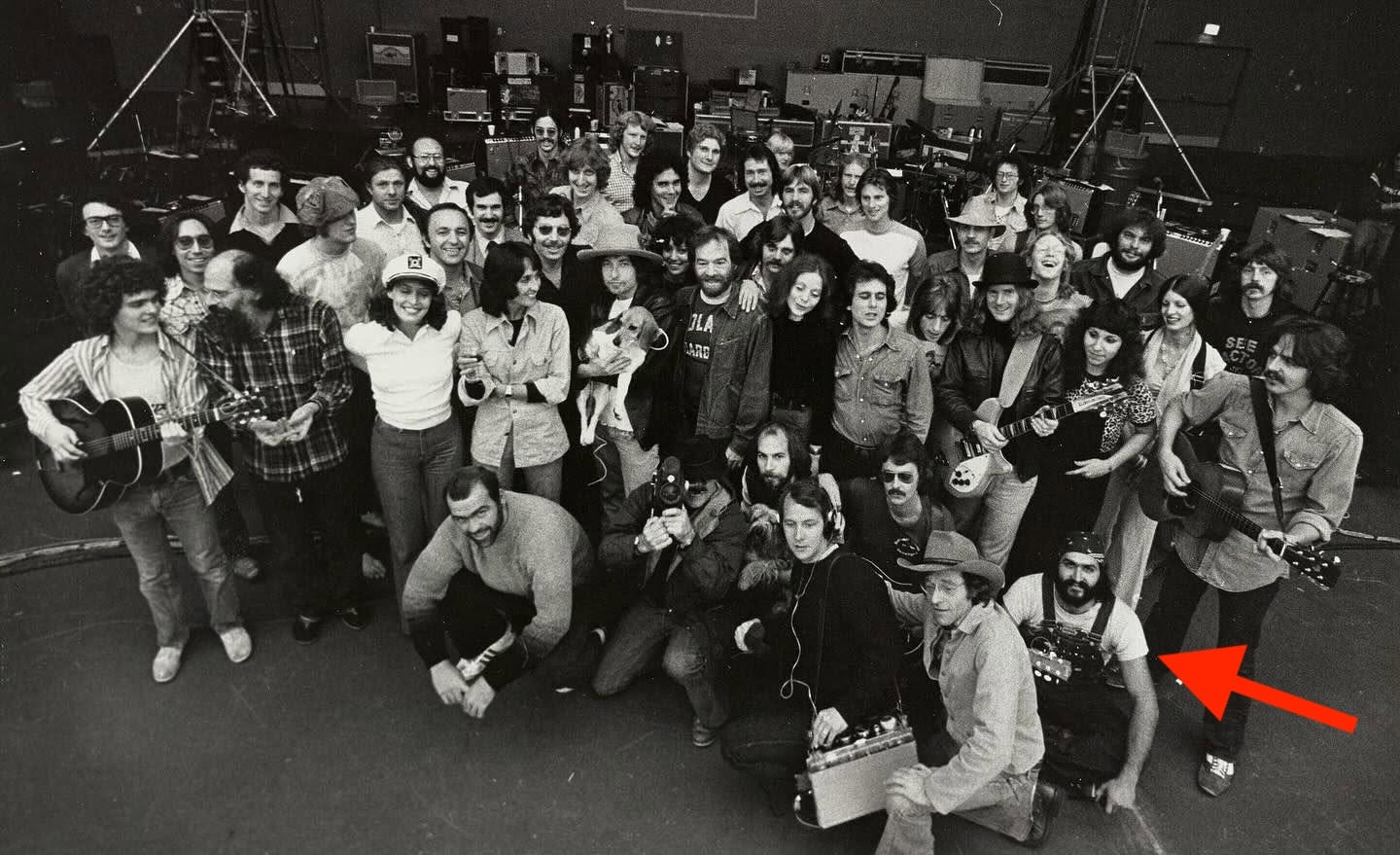
Gerry Bakal was one of the key behind-the-scenes crew people who kept Bob Dylan’s Rolling Thunder rolling. On the 1975 tour, his job was to operate the roll drop—the elaborate carnivalesque stage curtain you can read more about here. He got a promotion in 1976 to stage manager, where he coordinated all the stagehands.
For the second in this fall’s series of five new Rolling Thunder 1976 interviews, I talked to Bakal, who shares behind-the-scenes stories about what life was like on the Rolling Thunder crew.
How did you get involved in Rolling Thunder?
I was working at the Capitol Theatre in Passaic at the time. I got a call from [Rolling Thunder production manager] Michael Ahern. I did some advance work, and one thing led to another.
What was the advance work?
One of the things I had to do was find what’s called tiller rope. This was a rope they would put around the wheel of a ship or boat. It’s got a steel wire center so that it wouldn’t stretch and get you off course. That’s what we used to operate the roll drop.
The roll drop you’re talking about, the moment I know is the big Joan-Bob reveal that’s in one of the documentaries. The curtain goes up and they appear. When else were you putting it up and down during the course of a show?
It was down at the beginning of the show, so it went up when the show started. And then it came down at the end of the first half. Then as you said, Bob and Joan would start the second set, and it would be a reveal for them. And then it came down at the end of the show.
The roll drop (operated by Gerry) going up:
Was that your whole job? Up and down the roll drop a couple times?
I hung it, I took it down, I helped out in the truck. You gotta understand, this was a small tour. We were one truck. Sound, lights, monitors, back line, the roll drop—everything fit into one truck.
So once we get to round two, stage manager, what is your job then?
I connected the stagehands to the crew. Who’s gonna unload the truck, what time we break for lunch. Pretty basic stuff.
Between the two tours, there’s a huge range of venues, from tiny New England theaters to these giant outdoor places. Did your job change based on the venue?
When it got bigger, like when we did Hard Rain, there was a lot more equipment. We had to get extra sound and stuff like that.
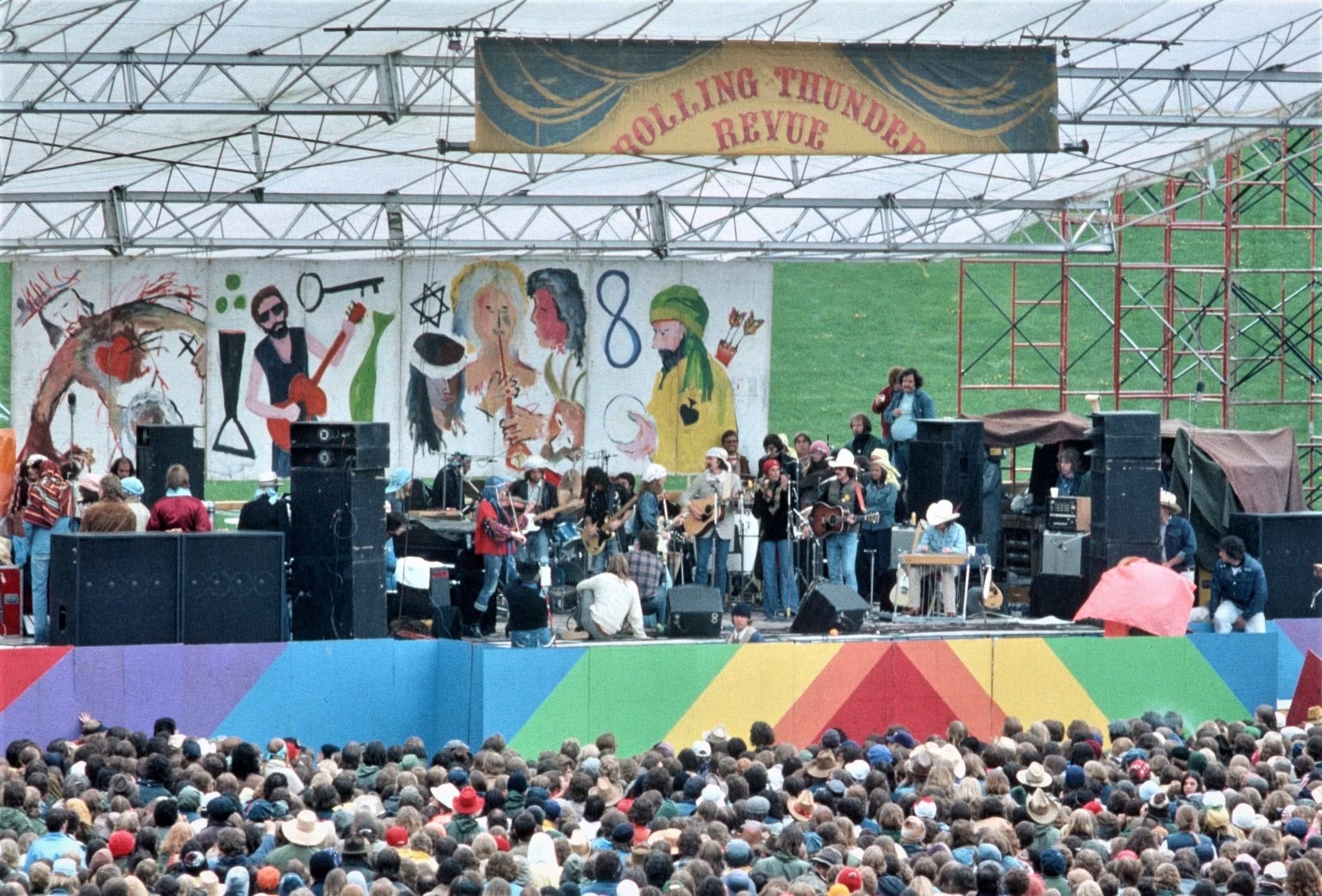
Bob had painted these eight pieces of plywood that I had to hang every day behind the stage, which was challenging. We had them stacked upstage. We were waiting for the stage to get set up before I’d get some stagehands and we’d hang them. I had to keep an eye on ‘em, because I kept saying, “I know they’re still building parts of the stage, and they’re gonna be looking for plywood.” And of course somebody came over and cut like a one-foot-by-two-foot section off of one of Bob’s pieces. I was like, “No!”
So we sent somebody out for some one-by-threes and some glue and short screws. “You gotta put this back on, man!”
Do you think Bob ever noticed?
I don’t think so.
Local concert producer Rick Wurpel’s perspective on this story:
The TV people grabbed our local carpenter. I’d known him since he was 12 years old. They started berating this guy about, they needed some table [built]. He didn’t have any lumber available to build them a little table. They’d seen some scrap lumber around and said he should go get it. They pointed to what they thought was scrap plywood. He cut it all up and built them a little table. Somebody right before showtime, “Wurpel! Wurpel!” “What?” “Who the fuck cut up Bob Dylan’s paintings of Christ?”
Did you have much or any interaction with Dylan himself during all this?
When I was introduced to the tour, we were told by [tour promoter] Barry Imhoff, “Bob is a jewel, and we are creating a setting to showcase this jewel. Don’t talk to Bob. Don’t acknowledge Bob exists. If you see Bob walking down the hallway, melt into the wall.”
That’s what we were told. It was halfway through the second tour before Bob finally got hip to this idea and he started coming out a lot more. Like you’d walk into the hotel, and Bob and Joan would be sitting in the lobby at the bar, inviting anybody and everybody over to have a drink with them. I think he felt so bad that people were told this without his knowledge.
Joan Baez and I became friends. We did a double gig in New Orleans at a funky dive called The Warehouse. Now the crew has to eat between shows. We only had a little while to eat between the end of the first show and the start of the second. The crew went to catering, and the line was long. We had over 90 people on tour. Everybody had a manager and a boyfriend, a girlfriend, maybe one of their kids. Joan’s mother was with us for a while. I don’t mean this in a bad way—this was a big event in their lives, so people would bring their family. Unfortunately, their family got between crew and food in a situation where we didn’t have a whole lot of time.
So the second show’s over. We’re loading up the truck and station wagon. We traveled by station wagon. Four guys to a station wagon. Here comes a station wagon, and out comes Joan and her two handlers. Joan motions to me and says, “Gerry, come here.” “Joan, we’re in the middle of a loadout. What?” “Come on, man. I want to talk you over by the car.” She opens up the back of the car, and there’s boxes of McDonald’s and a case of beer. She says, “Tell everybody to stop. You’re all having dinner with me right now.”
She had found out that the crew didn’t have time to eat, and this was Joan’s way of showing her appreciation for the road crew. Isn’t that sweet?
That is lovely.
As I was walking her to the car and thanking her for what she had done, I said, “By the way, I found out today that the road crews are no longer invited into the green room back at the hotel.”
They’d always have a green room at the hotel every night. There’d be drinks and parties going on all night long. Once the loadout was over, the road crew would go there. Well, it seems that somebody walked by and the room was full of road crew. There was no band, no guests. Somebody took issue, and it came down to me to tell the crew that they’re no longer invited into the green room. I used this opportunity when I was walking Joan back to her car [to tell her].
The next morning, my hotel room phone rings. It’s Joan. She says, “Gerry, tell the crew they’re invited back to the green room. I spoke to Bob about it.”
It’s funny there’s all these mixed messages. Like the whole vibe of the tour is ostensibly camaraderie, let’s put on a show, we’re all in this together, right? That’s what you get in the documentary and stuff. But then there’s these various levels of hierarchy where one person’s saying, don’t look at Bob in the eye, and then\ you’re not allowed in the green room anymore.
Yeah, it was weird. I figured the best person to hip all that information to would be Joan. She’s a people person.
Unlike Dylan. Did you ever speak to him, once he became more social?
Just sitting at the bar having a drink with him and Joan. Nothing more than that.
I’ll tell you a story about a very small conversation with Bob. Near the end of the second leg, we did a show in a rodeo. Like a real rodeo, someplace in the Southwest. We had to lay plywood down to get the stuff over the dirt to the stage. It was the real deal.
After we got set up, I went for a walk into the lobby, and hanging over the door was this really cool sign. It said, “Riders must dismount and walk their horses through the lobby.” Something to that effect. I thought, that would be a cool sign to put next to the stage steps, so everybody would see it when they walked up on stage. So I stole it.
Sometimes the best way to steal something is to just do it blatantly and openly, acting like you know what you’re doing. So there I was in the middle of the afternoon. People are setting up for a concert. I just grabbed a ladder, walked over to the sign, took the four screws out, and put it in the truck. Maybe a show or two later I started hanging it by the stage steps. I put a little light on it. Everybody said, “Oh, how cute.”
One day, one of Bob’s security guys comes up to me. He says, “Is that your sign?” I was like, “Yeah…” “Bob wants your sign.” “Really?” “Yeah. Bob wants your sign.”
I said, “Okay, Bob can have my sign. But he’s got to ask me for it.” The guy’s like, “Come on, Ger. Really?” I was like, “Yeah, he’s got to ask me for it. I want to hear it from him.”
A couple minutes later, the guy says, “Come here.” He walks me into the dressing room. Bob’s sitting there. He said, “Is that your sign?” I said, “Yeah.” “Can I have it?” “Absolutely.” I gave his security guard the sign.
Did you ever see the sign again?
It vanished.
A couple months ago I interviewed Roger McGuinn. Did you have much interaction with him?
At the beginning of the second leg, we were rehearsing at the Belleview Biltmore Hotel. It’s an old, beautiful wooden structure with a lot of outbuildings. It was the end of the line for the railroad cars for the rich and famous. Their private cars would end up down in Florida, and that’s where they would winter.
We pull into the parking lot, and there is a barefoot tuxedo-wearing purple-glasses Roger McGuinn telling people where to park.
I hadn’t heard that one.
Rumor has it there was LSD involved, but I can’t say for sure.
It sounds like you spent a few days at that hotel. I know the musicians were rehearsing. What were you doing to prep?
I had to go find a sailmaker. The roll drop had ripped at the end of the first tour, so I drove around Southern Florida looking for a sailmaker who could repair this thing. We didn’t want anybody to know what it was, but you had to find somebody that could fix a 20-by-30 canvas.
We were told that Midnight Special was gonna come in and film. So they built a scaffolding set all the way around the rehearsal hall that we filled up with kids. We did that for I think two days. Michael Ahern had asked me to go get a stopwatch, so I had to sit with pencil and paper and write down how long all the songs were, so that the film guys would know what to expect.
It was interesting because, the first tour, Rob Stoner was Bob’s guy. Bob would walk out on stage with his electric guitar, then Bob wouldn’t touch anything. Stoner would adjust his guitar volume. He would adjust his amplifier. Bob would never touch it.
The second tour, we were introduced to Bob Dylan, the guitar player. Now Bob was all about his guitar and he kept fucking with the dials on his amp and on his guitar. That along with Bob’s unique individual style of playing and singing and making up time signatures as he literally goes along kept Mr. Stoner extremely busy. I think Rob Stoner is one of the most talented people I’ve ever met, simply based on that he kept that train rolling.
Were you involved in what we might call the special shows, like the ones at the jails?
When we were in Texas, I was flown by the governor’s jet to a boys’ prison. We did a show there. I flew there on a day off and did the advance. Told them how much room we needed, how big the stage was gonna be, how much power we needed, if there were dressing rooms involved and stuff. They gave me a list of things of what to do and not to do.
What do you mean?
Don’t offer the guys cigarettes. Obviously don’t give them a joint, trade drugs with them or anything. We could get them to help and they would hang out with us.
There were certain kids that were not going to be allowed to see the show. The bad of the bad. Bob insisted that everybody sees the show or nobody’s going to see a show.
What do you remember about the show itself? It must have been a different energy.
It was hot. There was no roof. We just walked out on a one, two-foot high stage, did the gig, turned around and left. No roll drop, no lights. It was in the middle of the day.
Did the kids seem into it, or did they not care?
They loved it. First of all, you had a couple of women on stage, so they love that. And just something to do besides the ordinary.
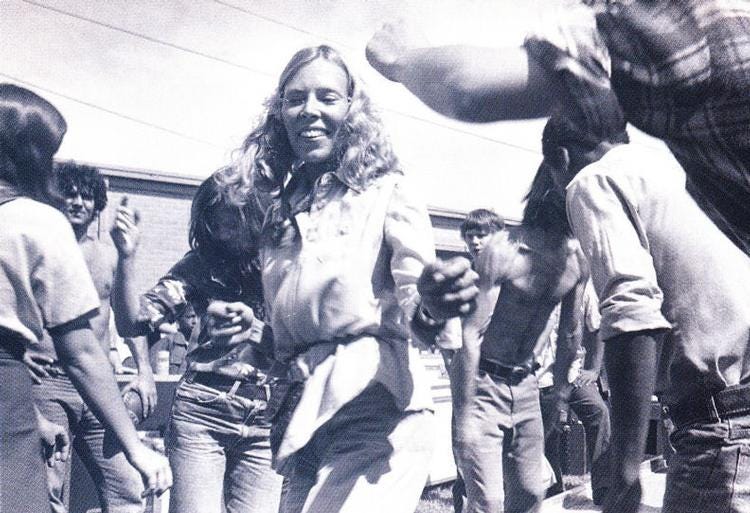
There are some great photos of Joni Mitchell dancing in the crowd amongst all these kids. Did you have much interaction with her?
I did. She had this thing about cops, right? She’s very pretty and very flirtatious. She would find some young cop that had been assigned to backstage and she would walk up to him and introduce herself and say, “Do you mind if I try on your hat?” The poor kid would spend the rest of the day and night trying to get his hat back from Joni Mitchell.
She also collected police patches. She had police patches from all over the country before the tour started and she kept adding to it. She would ask the guys, “Do you have an extra patch?” Somebody that looks and acts like Joni Mitchell walks up to you and asks you? “Yeah, sure!”
The winter tour, we’d go into town and just rent a hall, start selling tickets. In the Northeast, in a college town, in the mid-’70s, you think Bob Dylan and Joan Baez can sell tickets? You couldn’t print them fast enough. Well, they tried the same thing in the Southwest in the spring, and everybody down there is like, “Bob who?”
A few shows even got cancelled on that second tour.
Texas was interesting. They didn’t know who we were. Thank God for Willie Nelson to come and save us.
I remember at one point being called into the office, and they said, “Hey Ger, do you know anybody in Houston?” I was like, “Yeah, I know a few people.” “Here’s a couple hundred tickets. Could you just go out into the bars and hand out tickets?” I got thrown out of a number of bars that night.
Thrown out?
I’d walk in with a fistful of tickets, order a beer, and then start walking around saying, “Hi, you want to go see Bob Dylan tomorrow night? How many? Two, four, six?”
Finally the owner or the bouncer would come up to me and say, “What are you doing?” I’d say, “Well, it’s a Bob Dylan tour, it’s here tomorrow night, and I’m handing out free tickets.”
“Get out.”
They thought you were scamming people?
Yeah. “It’s not a scam. This is legitimate. Look, you want some? How many?” “Get out!”
[For the Hard Rain show], we stayed at this great old hotel in the middle of town. Allegedly it was the Shining hotel. They went out of their way to be super nice to us. They just opened their arms and gave us a big old hug. The laundry room was open 24/7, the bar was open, room service was open. Shopkeepers would come in from town and say, “I own the jewelry store down the street. You guys want to go shopping? I’ll open the store.”
What do you remember about the Hard Rain show itself?
We had the PA up on the third level of scaffolding, and only one forklift backstage that could get that high. So I instructed the stagehands, “Split lunch, split dinner, so we can keep this ball rolling. I don’t want you to shut this machine off.”
Well, somebody shut the machine off, and we couldn’t get it started again. So our truck driver George Travis broke into a rental car that somebody had left behind, stole the alternator out of it, and replaced the alternator in the forklift and got it started.
George Travis is now one of Springsteen’s longtime touring guys. Back then he’s stealing alternators from rental cars.
He was our truck driver. As I said, we would all travel together. It’d be George in his truck, and four or five station wagons following behind like a mother duck and tiny ducklings. We soon discovered that George did not like to be passed. George kept a box of firecrackers next to him, and if you tried to pass him he would throw a firecracker on the hood of your car.
Bob traveled in a Mini Winnie. It looks like a Ford van in the front, but in the back it’s like a miniature Winnebago. He would sit in the back and play guitar. His two minders would take turns driving, and if Bob looked out the window and saw antiques or collectibles or something, he would tell the guys to stop. Rumor has it that he ended up loading up the whole Winnebago with shit he collected.
What else do you remember?
Ginsberg was a lot of fun. He wanted to end the show with a meditation. You know, “ohmmm…” and everybody sitting peacefully. They’re like, “That’s not really an encore.”
Kind of brings the vibe down.
Yeah. They couldn’t figure out what to do for an encore, so we didn’t do an encore. During the last song, Joan would go to the microphone and announce, “This is the last song. Thank you all for coming.” She’d walk off the stage, house lights would go on, and they’d start playing music. Not what people were used to. “Grand Funk Railroad always comes back. Why won’t these guys?”
A few people told me Allen Ginsberg ended up basically being the baggage handler.
I don’t remember that part, but good for him. I think he wanted to be more involved and then, after a while, they were like, “I mean, it’s nice that the guy’s here. He brings a certain presence and a certain validation to what we’re doing. But what do we do with him?”
Thanks Gerry! This is the second of five brand-new Rolling Thunder 1976 interviews I will be running one a week. Catch up on the first one, with multi-instrumentalist David Mansfield, here, and subscribe to get the next three sent straight to your inbox: