
I’m currently going show-by-show through the entire Rolling Thunder 1976 tour for its 50th anniversary. Find all past entries here, and subscribe to get future entries sent right to your email inbox:
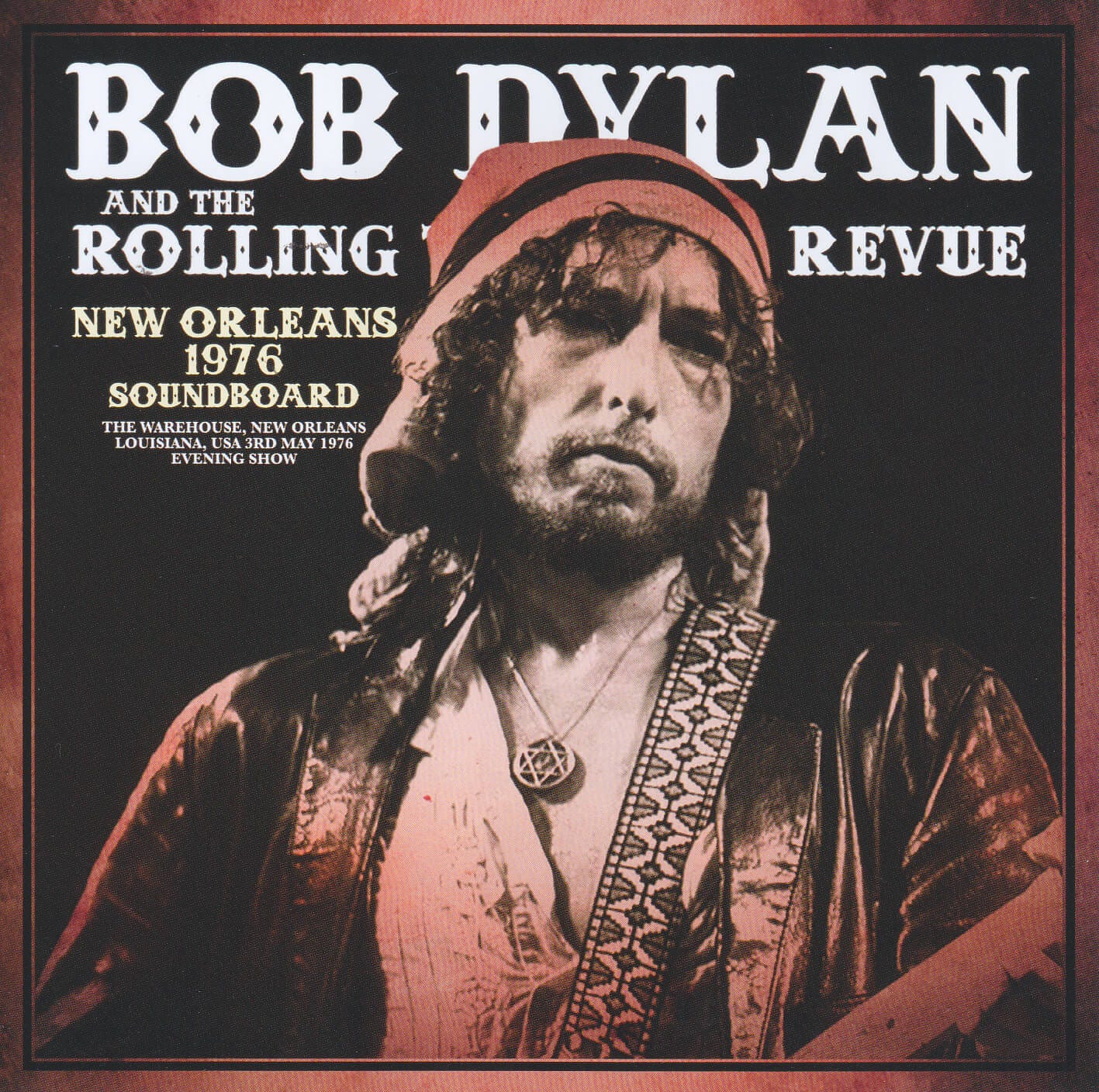
Today’s New Orleans tape—one of two that day—is perhaps the best-known concert we’ve hit so far, in large part due to the stellar soundboard. And we’ll get to that in a minute. But first, I want to talk about where Dylan and the entourage went the night before the show.
Answer: A Tom Waits concert! This syndicated news item ran in the New Orleans Times-Picayune:
Singer-songwriter Tom Waits had some special company during a recent show at Ballinjax Electric Bistro in New Orleans. After his first set, the Rolling Thunder Revue troupe—82 members and hangers-on-strong—strolled in, fresh from a party aboard the steamboat Natchez. All the principals were there—Bob Dylan (attired in turban, shades, black leather jacket and smoking a pipe). Joan Baez, Roger McGuinn and Kinky Friedman—and the latter three commandeered the stage for a stretch. First up was McGuinn, who did 30 minutes’ worth of tunes. Friedman followed with a four-song set, and then Baez—dressed in a two-piece white suit—stepped up to sing a cappella a new tune that she said would be the title song on her next album. A line in the tune drew the biggest cheer of the night: “Women are not equal to men—but you can never tell it by me.” Dylan didn’t budge from his front-row center seat, and he left shortly after Waits finally was able to see his way clear to the stage.
Waits apparently was not amused. He nicknamed them the “Rolling Blunder Revue” and complained to Rolling Stone a few months later, “They got up there for an hour just before I was supposed to begin my set. Nobody even asked me; before I knew it, fuckin’ Roger McGuinn was up there playing guitar and singing and Joan Baez and Kinky were singing. By the time I got onstage the audience was stoked. They were all lookin’ around the room and shit. I don’t need this crap—it was my show. I was drinkin’ too much on top of everything else.”
I guess Tom wished he wasn’t in New Orleans that night!
When I interview Rolling Thunder 1976 participants, the New Orleans shows come up a lot. Maybe more than any other 1976 show outside Fort Collins (which became Hard Rain). People mention them for a fairly wide variety of reasons too.
Soundman David Hendel recalled some special fast food:
One of the shows, in New Orleans, we were at The Warehouse [a famous music venue once located on Tchoupitoulas Street] setting up, and Joan Baez went out and bought lunch for the crew. She personally went out and came back with bags of McDonald’s, just for the setup crew. We were fairly well into the tour by then. It just impressed me that she actually cared about us.
Bassist-bandleader Rob Stoner remembered a special guest showing up for the show:
[Dennis Hopper] just showed up for that show. Probably because he wanted to go to New Orleans since it’s such a great party town. All kinds of movie stars and celebrities would periodically drop in for a gig or two. Hopper was hip enough to know that New Orleans was the one to show up for.
Jacques Levy’s widow Claudia Levy recalled these two shows for more chaotic reasons (which were partly Hopper’s fault):
Jacques hated when you would go to a rock and roll show and you’d have to wait for them to set up [between acts]. That never happened on Rolling Thunder. When the curtain opened on the band, it was like a theatrical opening of the show and they started playing right away. You didn’t want people plugging in and setting up. Only once did that happen, in New Orleans on the second tour, which was really scary. They were playing an old place where they used to do cattle auctions. It was a big round wooden structure with a high ceiling and something happened with the sound system. It wasn’t working right. So they were delayed, a lot. People were getting very restless. And, you know, the North is Bob’s territory. The South, not as much. They weren’t as patient with having to wait. They were stamping and shouting.
Dennis Hopper was there. And Dennis thought the world of himself. He decided that he was going to read a poem and calm everybody down. Jacques was trying to dissuade him from doing that, but Dennis insisted that it was going to change the whole temperature of the place. And he did it. By the time he was done, we were really scared. The place was shaking. Really literally shaking.
Jacques didn’t ruffle. He was not a man who lost his temper or raised his voice. He could figure out how to deal with whatever issues there might be. And he knew that if you had to counter any kind of restiveness, you send out Roger, ‘cause he could do it. So Jacques said to McGuinn, “Okay, Roger, hit the beaches.” And Roger went out and started playing “Eight Miles High.” That did the trick.
Last year I brought up that story to McGuinn himself. He said, “I don’t remember that specifically, but Jacques was very calm. I miss him.”
Advance man and sometimes security guard Mike Evans remembers a different sort of drama: A food fight at the hotel:
The tables are turned over. Pitchers of orange juice are being sent like mortar shells over the top. Neuwirth is leading one charge. Food is flying around. I can’t say Bob was involved because I don’t think he went up, but everybody else was there in the food fight. Baez was there. Animal House hadn’t come out yet. I hate this word: I was triggered when I saw Animal House. That was what it looked like. Just this over-the-top food fight.
So these would be memorable shows even if we didn’t happen to have one of the best tapes of the tour from it. You can even hear Dennis Hopper up there reciting his audience-enraging poem, Rudyard Kipling’s “If”:
None of those people, however, mentioned what stands out most on this tape to me: The live debut of “Rita May”! Actually, the debut of “Rita May” period. The song wouldn’t get released until that fall, as the b-side to the Hard Rain version of “Stuck Inside of Mobile.” So no one would have known it on this, its debut outing. This was the only time he ever played it live too.
One other song stood out to me on this tape, but it’s not during Dylan’s set. It was the solo song by Donna Weiss, who had joined the 1976 tour to serve loosely as Ronee Blakley’s vocal replacement (minus the acting part, since they weren’t filming a movie this time). She sings a song labeled on this tape as “Sweet Amarillo, Tears On My Pillow.”
I really liked the song, so I decided to look it up. What I didn’t realize is that “Sweet Amarillo” is sort of a Bob Dylan song.
It originated in the Pat Garrett and Billy the Kid soundtrack sessions. You can hear a minute-long outtake on the 1973 copyright collection:
It sounds very unfinished, but has the bones of that chorus. The two backing singers you hear very prominently in that tape are Weiss and a woman named Brenda Patterson. When Dylan didn’t release the song himself, he apparently gave it to them. Weiss finished writing it, and Patterson released it on her own album the next year (with Dylan not credited as a writer for some reason, just Weiss).
(That same year, 1974, another singer, Jackie DeShannon, recorded another Donna Weiss composition: “Bette Davis Eyes.” The song wouldn’t make much impact though until Kim Carnes covered it in 1981, turning it into a number one hit and Donna Weiss’s biggest claim to fame).
Now, three years after Pat Garrett, here Weiss is singing “Sweet Amarillo” at a Dylan show.
That 1974 Patterson version made no dent, Weiss never recorded it, and Dylan never released it beyond that obscure copyright dump. So that was the end of the story for “Sweet Amarillo” right? Wrong!
Fast-forward almost 50 years…
In 2004, the Americana band Old Crow Medicine Show takes a half-baked Pat Garrett outtake titled “Rock Me Mama” and turns it into “Wagon Wheel.” The song is an enormous hit, certified three times platinum (meaning it sold three million copies). It becomes the band’s biggest song by far. Then in 2013, Darius Rucker, the Hootie and the Blowfish frontman gone country, covers it and makes it an even bigger hit. Forget three times platinum; this new version goes diamond: 10 million copies sold.
Dylan’s people were stoked. This forgotten Pat Garrett outtake is suddenly one of the biggest songs he ever (partially) wrote. It has over one billion streams between the Rucker and Old Crow versions. That’s far more than any actual Dylan recording does. (Adele’s cover of “Make You Feel My Love” still tops it, barely.) After Rucker’s version went to number one, Old Crow Medicine Show frontman Ketch Secor told CMT, “We got an email from Bob Dylan’s manager saying congratulations… It’s not every day that country music recognizes this great pioneer and huge influence, Bob Dylan. Bob doesn’t have many No. 1 songs in any genres. So it was a big deal to get one.”
Could lightning strike twice? Worth finding out. So Dylan and his people promptly dug up another half-finished Pat Garrett outtake to give Old Crow Medicine Show. It was, yes, “Sweet Amarillo.” Weiss and Patterson’s finished version was clearly forgotten. Old Crow finished Dylan’s demo a different way, Dylan himself apparently gave them notes (he wanted Secor to play fiddle instead of harmonica and suggested the chorus come in at the eighth bar, not the 16th), and Old Crow released it in 2014, ten years after “Wagon Wheel.”
Alas, Old Crow’s second completed Pat Garrett song hasn’t yet had a fraction of the success of the first. Maybe Darius Rucker needs to cover it. Though, to be honest, I still prefer the Donna Weiss version she sings at today’s Rolling Thunder show.
The May 3 NOLA show is also notable for being the first time "Rita May" (Dylan-Levy) had been heard in public.
The song was a Desire outtake, later released as a single's B side of RTR's live "Memphis Blues Again." The latter song was recorded at a Fort Worth gig.
On "Rita May", Bob and I sang it as a duet, with me covering Emmylou's harmony part, as I did with all the Desire material on RTR.
Thank you for sharing this. I loved the TV concert and have a grey area CD of the entire concert as well as Hard Rain on vinyl and CD. It is great to have another good quality record of that tour. I also have the UK 'Rita May' picture sleeve single, do it is great to have the only live version, to date.