
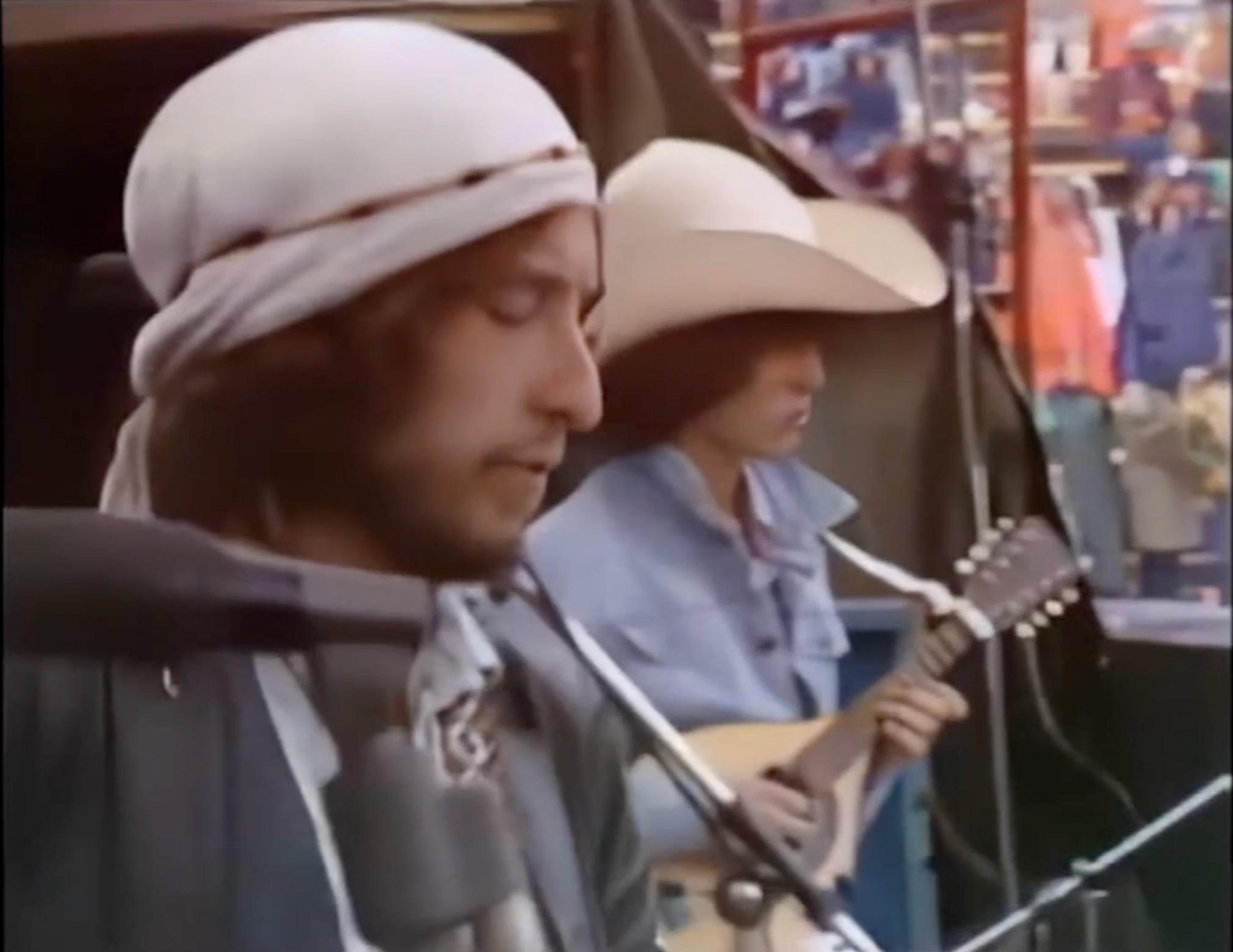
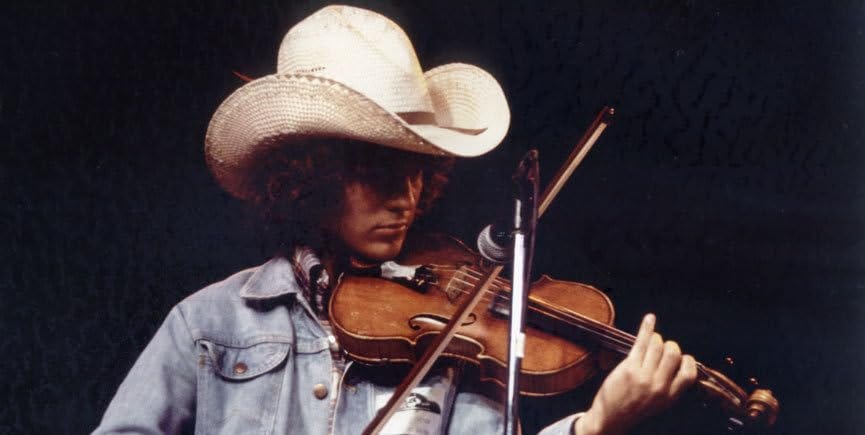
Six years ago, David Mansfield was one of the very first musicians I interviewed for this newsletter. Mansfield played pedal steel, mandolin, violin, and a host of other stringed instruments for Bob Dylan during both legs of Rolling Thunder and 1978 too. Joan Baez introduces him as “Little Davy” a couple times on the new box set, and she wasn’t exaggerating—he was only 19 years old at the time, the youngest member of the band by some distance.
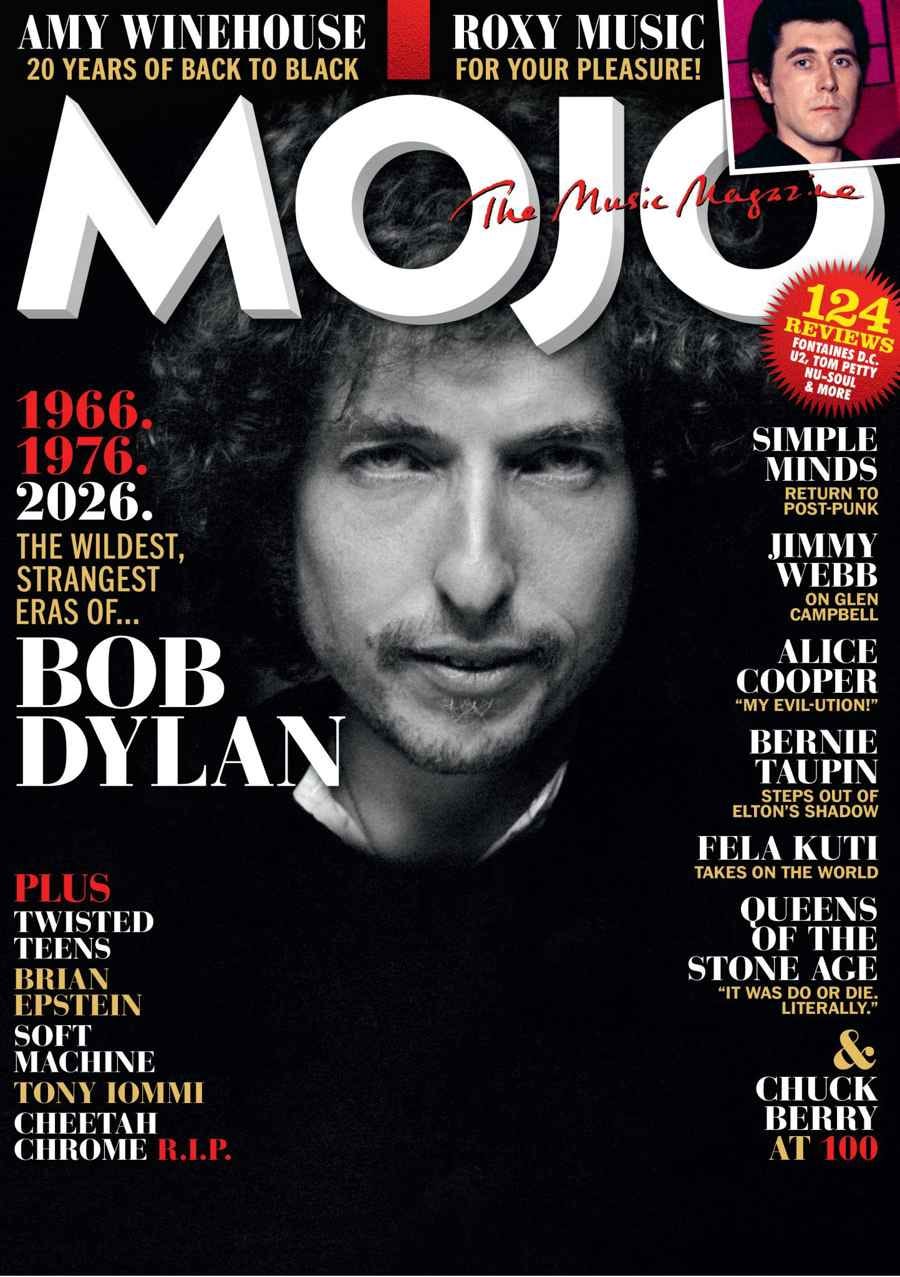
Our first interview, though, was exclusively focused on Rolling Thunder 1975, then celebrating its 45th anniversary. So, for my recent MOJO cover story on Rolling Thunder 1976 (still on stands!), I wanted to reconnect with Mansfield to talk about the second leg of Rolling Thunder. I used a half-dozen quotes in that MOJO article, but there was so much great stuff left on the cutting room floor. So here is the extended version of my conversation with Mansfield a few months back.
If you can’t find the new issue of MOJO on a newsstand, you can buy it online here. Read a short sample from it here.
Okay, on to my new interview with Rolling Thunder multi-instrumentalist David Mansfield…
I want to start before Clearwater. It’s not on the box set, but 1976 technically kicked off in January with the second Night of the Hurricane benefit show, in Houston.
There are certain things I remember. One thing is that it was a large entourage. We rented a plane to get there from LA, and we had so many people on the damn plane that, even at cruising altitude, we never leveled out. We were dragging tail the whole way there. The plane flew at a diagonal from LAX to Houston.
Was this everyone who was playing? Stephen Stills and Ringo Starr, etc.
I know Ringo was there, because that was when I got to meet him. Of course, he doesn’t remember a thing because he was still drinking in those days. We’ve been working together now for a couple of years on his new records. After we finished [Rolling Thunder], I used to go to parties at his house. He has no memory of that.
What was he there for? He didn’t do his own set, right?
He played drums with us. He sat in.
That must have been cool.
I was thrilled, because I was not a Dylan baby. I was a Beatlemaniac. I was still 19 at the time.
The other thing I remember is how awful a venue the Astrodome was. It’s a gigantic, massive stadium, so you’re very far removed from the people. The echoes were so long that every time that Howie [Wyeth] hit the kick drum, it would come back a half a second later, as loud as what we were playing. Trying to play in that environment was crazy. And we were ragtag anyway. God knows what it must have sounded like to the audience, but on stage, it was cacophony.
Would that continue to be a problem? Because one big narrative of 1976 is a lot of the places you’re playing are a lot bigger.
There’s nothing wrong with playing an arena. You’re going to get a little bit of slap back, but playing a sports stadium—especially the Astrodome, which was massive—what you get from that is a horse of a different color. The one band that seemed totally unfazed by it was [Stevie Wonder’s group] Wonderlove. They played perfectly. They were probably like the Beatles, used to playing without hearing each other. Maybe Stevie was just such a great bandleader that they just blew through it. They sounded incredible. But the rest of us were suffering.
So then how does the tour proper start? You show up in Clearwater, Florida at this old school hotel to rehearse…
Bob was really keeping to himself. I mean, we never spoke. I can’t remember if it started in rehearsal, but it seemed like he was going around with a black cloud over his head, which in hindsight was perfectly reasonable, being that his marriage was falling apart.
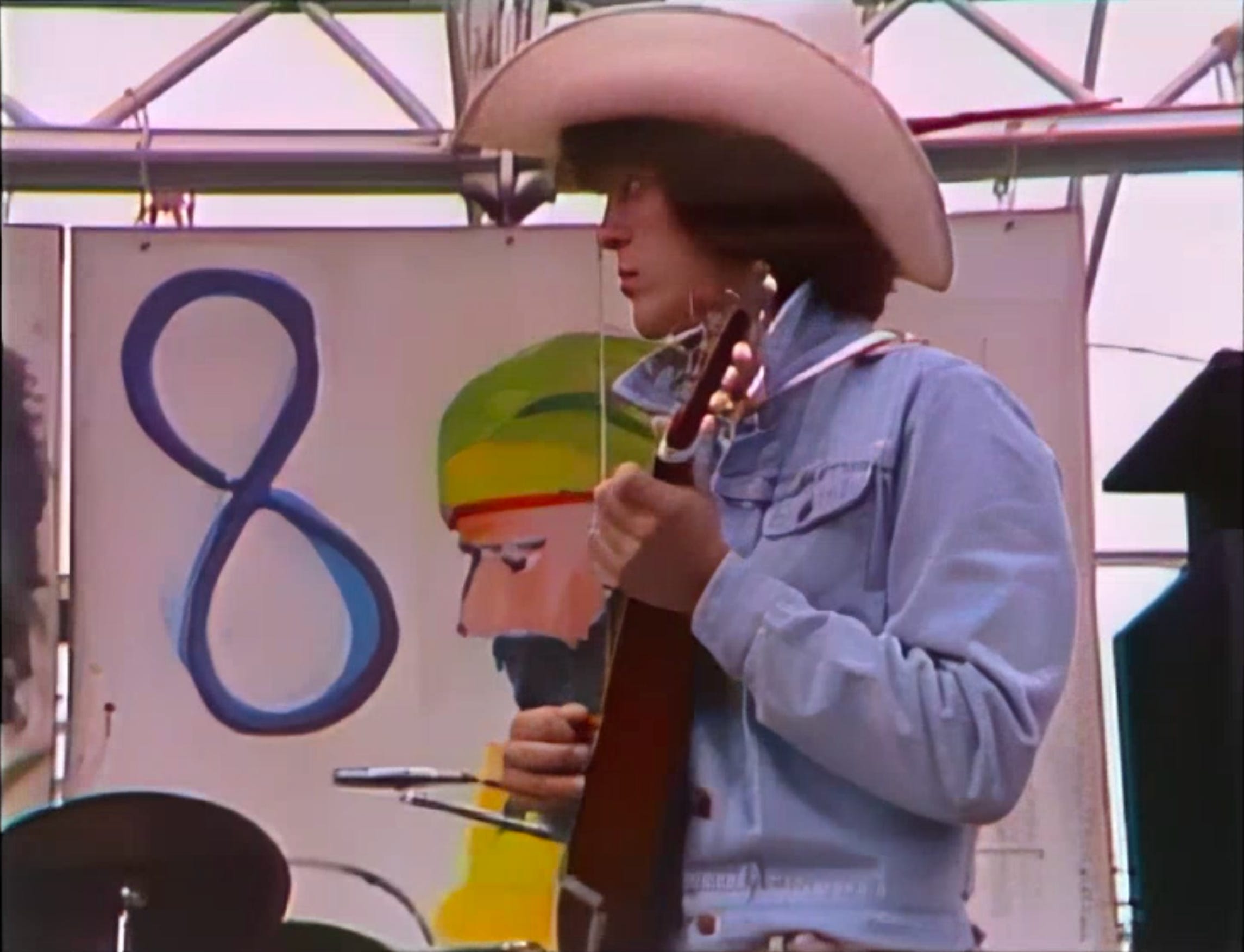
You do a couple warm-up shows, then you do this first TV taping, this Burt Sugarman thing. What do you remember about that? It’s the one with people sitting all around you—
With their legs dangling over scaffolding. Who knows why Bob hated it, but that could have easily been the reason. I mean, staging-wise, it was reminiscent of Elvis’s comeback special or something.
That’s the third comparison I’ve gotten. One person told me it looked like the Monkees, and one person said it looked like John Denver.
Yeah, it was corny. But, musically, my memory is that it was great. You know, Bob pushed a lot of things musically on that tour, but he hadn’t pushed them all completely out of shape yet.
What do you mean by that?
I mean he started doing what he always does: reinventing songs. But the more radical surgery happened as the tour progressed.
One of them was “Maggie’s Farm,” which was a pentatonic blues riff he played that went on in between every verse. So it ended up being a 15-minute song or something. He would do these radical rubato sort of stops, like it would go out of tempo and slow down. “I Pity the Poor Immigrant” was one of those. Then he started making up new lyrics to “Lay Lady Lay.”
Much less romantic lyrics.
It was the anti-“Lay Lady Lay.” All that stuff intensified as the tour progressed. At the very beginning, when we taped that special, it was closer to what we had done earlier. It hadn’t gotten quite as intense in terms of the yelling vocals. Which were very powerful. My favorite song to play in the whole thing ended up being “Idiot Wind,” because what he unleashed in that performance was just stunning. But that hadn’t fully developed at the beginning.
Do you have a theory about why the sound and the set list and everything changed so much between tours? Because you’re in totally different markets than the fall. One could envision a scenario where you bring basically the same show to these new places.
I only toured with Bob in the ’70s, but I’ve had lots of friends who have continued to play with him since then. All of us in Bob-Anon. That’s just what he’s always done and continued to do. I remember one time, maybe in the early ’80s, I went to one of Bob’s shows in New York City. I was there with T Bone [Burnett] and Allen Ginsberg. The three of us were listening to this show and could not identify a single song for about 40 minutes.
On the second tour, he also started playing electric guitar for the first time. Well, he always played electric, but on [the first] Rolling Thunder, he just strummed it like an acoustic guitar. It wasn’t up very loud in the mix. In ’76, he started playing fills, he started playing leads, the guitar was loud. It was a whole different thing.
What was your opinion about that?
It was rough. He later became a much better electric guitar player, but at that time, he tended to pull the strings out of tune. So it was quite abrasive. On one hand, it sort of worked with the general ethos and vibe of the tour. But it took some getting used to.
Not only that, but on a couple of the songs—”Shelter from the Storm,” “I Threw It All Away”—he’s playing slide guitar. Which, as far as I’m aware, is not a thing he’s done before or since.
Actually, some of the slide playing was better than some of the lead playing, because the guitar is tuned to a chord. All you gotta do is slide up to the fret, and you can get a good sound. He wasn’t trying to play “Dust My Broom” or anything. He’s not Bonnie Raitt.
I’ve been listening to this box set, which has pretty much every show. The slide guitar playing the first couple shows is rough because he’s not at the right spot, so it’s out of tune. By the end, it still sounds amateurish, but in a way that I think works.
Exactly. That was true with all of his guitar playing. At the beginning, it was really hard to listen to, but it got better and it fit the tenor of the whole thing by the end. It was abrasive in a way that worked.
Are there any other particular songs from round two that you remember enjoying?
The steel guitar that I did on some of the songs that were very forceful. Like “Idiot Wind” was great fun. And “Tonight I’ll Be Staying Here with You.” I mean, it’s a “Country Pie” thing on Nashville Skyline, but it was electrifying with what he ended up doing to it on that tour.
On “Masterpiece,” you get a cool mandolin solo.
We did that on the first tour as well. I used to love playing that, because I would do all this tremolo stuff. I was sort of trying to be Garth [Hudson] on the mandolin, playing a lot of chromatic sixths riffs. I don’t know if that’s what anybody else got out of listening to it, but it was fun for me.
Bob started out kind of playfully. In that Burt Sugarman special, I’m taking a solo and Bob goes over to my mandolin and pantomimes twisting the tuning pegs. It’s like a Three Stooges, poke-in-the-eye routine.
Something like that goes against what most people say was the general vibe from Bob on that tour, which was fairly dour and standoffish. A black cloud, you said earlier.
That intensified as the tour went on. Early on, he was still making patter and jokes. I listened to a track where he’s introducing Neuwirth, and he says, “Here’s my good friend Bobby Neuwirth from Canton, Ohio. I’ve known him a million years.” And then he says again, “Here’s my good friend Bobby Neuwirth. He just flew in from Paris.” You know, he was fooling around, and it was fun. That went by the wayside eventually.
What was it like for you in the midst of this as things go south?
Well, it’s not like he ever took it out on the band. And one of the results of it going south was these incredibly high-octane versions of Nashville Skyline tunes or “Idiot Wind.” He might have been miserable, but we all got the benefit of it.
To the degree I have a thesis in this article, it’s something to the effect that by all accounts, the vibes were worse, especially from Dylan, but not only was the music great in spite of that—it was sort of great because of that.
It was just different, as opposed to better or worse. I mean, we were all reuniting, but it was a slightly different group of people. For one thing, Jack Elliott was no longer with us. Kinky Friedman was, and he’s almost as big a character — or was — as Bob is.
I talked to Kinky maybe two years before he died. It was a wild conversation, as I gather any conversation with him was.
I loved him. I made a record with him before he died. It’s really beautiful. Parkinson’s was setting in, and his cognitive stuff was beginning to go, so I had to be really creative in how I worked with him to get everything down on tape. But we got one last beautiful record from Kinky before he died. It’s called Poet of Motel 6. The poet of Motel 6 is Billy Joe Shaver, his good buddy.
Any particular Kinky story you remember from this tour specifically?
The only one I could repeat would be, Kinky had a song that he wrote called “Old Man Lucas.” The lyrics were “Old Man Lucas had a lot of mucus coming right out of his nose. He picked and picked till it made him sick, but back again it grows.” And Jesse Dylan [Bob’s son], who was probably around 10 at the time, thought this was the funniest thing he’d ever heard in his life. Jesse used to run up and down the hall screaming, “Old man Lucas had a lot of mucus!” He was Kinky’s target demographic.
We also had Donna Weiss, who no one ever talks about. Great writer, great singer. People generally don’t know that our piano tech, Kevin Crossley from New Zealand, played piano with us a bunch.
I keep hearing piano on these tapes, and I never know who it is. I know Howie occasionally would switch over.
Howie would switch over to piano, and [percussionist] Gary Burke would switch over to the kit. But there were other ones when Howie would stay on the kit and Gary would stay on percussion and Kevin would come and play piano with us.
God, you’re jogging my memory, but I think I even played piano on a few things. I might have played piano on “One Too Many Mornings.” Which I can’t play, but I muddled my way.
I saw a photo of T Bone on piano too. Dylan’s not in it, so I’m not sure whether it’s his song.
Yeah, that was his song. Bob made him play this wonderful song he wrote called “Silver Mantis.” T Bone used to play that on the piano. We recorded that on the second Alpha Band record. The two main characters are Seito and Sashiko. It’s basically Romeo and Juliet set in the days of Shoguns in medieval Japan.
It’s a song right in the middle of the Dylan set. From what I can tell, I think Dylan might have even stayed on stage playing it.
He did. I think he played guitar on it. Luckily not slide guitar. Bob just loved it. The way that he loved some of Kinky’s songs.
As the tour progresses, are there any shows, venues, moments that stick out?
For various reasons, New Orleans. The Warehouse, the venue, the ceiling was really low. There were these beams, and the stage lights were just a few feet above our heads. What I remember from that night was Dennis Hopper coming out and reading Rudyard Kipling’s “If” because it was electrifying and fun. Honestly, though, why he had Dennis reading “If” and not Allen reading anything? I’ll never know the answer to that one.
Do you know why Dennis was there?
Hopper and Neuwirth were very close. As painters, for one thing. Dennis used to have a studio down in Venice Beach back in those days. I mean, I’m sure he was close with Dylan too, but he and Neuwirth were thick as thieves.
Speaking of painters, Bob and Neuwirth do that song “Vincent Van Gogh” every night. Which he didn’t write. Neuwirth claims his art teacher wrote it.
When I met Neuwirth, he used to play that solo all the time. His delivery on it—when he does it with Bob, they’re just screaming it, but hearing Bobby do it in a club like The Bitter End was hysterical.
He had another one that he wrote about Philippe Petit, the high-wire artist who walked between the World Trade Center. It was called “Don’t Fall Down.” So that was an aspect of Bobby. In a club, where he’s just singing quietly with the folk guitar, it was great stuff.
It’s funny listening to all these tapes. Dylan comes on, he does two acoustic songs. Then the band joins and the first song they do every night is not a Dylan song. It’s “Vincent Van Gogh.”
When Dylan asked Bobby to come with him, I think it might have been to England [in the ’60s]. He said, “Come on the road, I’ll buy you all the paints you want.” And Bobby said, “I’m in.”
Another gig that I remember, we played Hofheinz Pavilion in Texas. Double bill with Willie Nelson. The audience loved it, and they showed their love by throwing empty bottles of Jack Black at us. I remember doing our set, and there’s this glass shattering on the stage. I thought, God, do they hate us? Then I found out later: no, that’s because they liked you. I mean, we needed chicken wire.
Jack Black?
That’s one of the levels of Jack Daniel’s. All the musicians used to call it Jack Black.
Did any hit you?
No, but some shards skittered right under my pedal steel. If someone had been struck, it would have taken them out.
Yeah, those are glass bottles.
Fifths of whiskey. The ballistics on those things are pretty fierce.
Any other moments of chaos that you remember?
The absurdity that the motif of the tour were these durags or keffiyehs that everybody wore. It was a game of Simon Says or something.
It seems as the tour goes on, more and more people are wearing them, to the point where by Hard Rain it’s pretty much all of you.
I never did. In Austin, I had my own hat made at the famous Texas Hatters. I also had a straw hat that was sort of like a Tom Mix hat with a crease down the middle. I wore that all the time instead of the keffiyeh. In fact, at one point during the tour, I guess Bob thought it was really cool because he goes, “Hey, David, I really like that hat.” And I didn’t react. And he goes, “Hey, man, I really like that hat…” He was hinting for me to give it to him, which I did. So that’s why I don’t have it anymore.
Did you ever see it again?
No. I wish I had. You can see fleeting glimpses of me wearing it in the Hard Rain special. But [TV special producers] TVTV, the way they did their guerrilla thing is they really focused tight on Bob’s face for 90% of the show. So you don’t see much of anybody else. But that’s the hat I was wearing on that show.
So let’s talk Hard Rain, Fort Collins. One of the more memorable shows, it sounds like a bit challenging due to the weather.
That’s a big memory for me, not specifically about the music, but just how oppressive it was to play in that weather. It was drizzling, the audience were in ponchos, and the stage was like half-covered. It was so cold that when I played pedal steel, my foot would be shaking on the volume pedal. I couldn’t hold it steady. When we did “Maggie’s Farm,” Mick Ronson took one of his Lonesome Guitar Strangler solos. And he starts out one fret too high. So at the beginning of his solo, it’s like the wrongest notes that you can play. I think he probably couldn’t feel his fingers.
We were all like that. Also the elevation is very high. But somehow the fact that that was so oppressive kind of added to it. The way that everybody played, we were all as crazed as Bob was on that show.
One thing that’s cool about listening to the full show is that you’re busting a few songs that you’d never played before like “Tangled Up in Blue,” which is this crazy arrangement. It’s like five arrangements in one.
That was the kind of thing that Bob was doing. Like you might start the thing at one tempo and then it turns into a slow blues shuffle and then it turns into a boogaloo and then there’s a rubato section. All bets were off.
As a musician, how are you following these abrupt changes?
I did the same thing that I did on the first tour. Because even though the first tour didn’t have this level of energy and intensity, the unpredictable part of it was still very much there. And not just with Bob. I mean, Jack Elliott is from what Neuwirth used to call the Great American Folk Scare. You change the note when you’re ready to change the note. You just learn how to listen really carefully, position yourself somewhere where you can see the performer’s fingers and their lips.
I had to really work hard on that on the first tour. By the time the second tour came along, I just watched like a hawk. Joan had to do the same thing. She had to read his lips all the time to guess how he was going to phrase. You can hear on various tracks, especially in ’76, Joan stumbling just a tiny bit to get the beginning of a phrase of his. She always had to just read his lips and try and stay in sync.
She’s a master at that. Their duets are some of my favorite things of the whole set.
Me too. I loved every night listening to them do “Deportee.” Or the Child Ballad stuff, like “Railroad Boy.” I mean, I didn’t know this stuff. I got my folk education on those Rolling Thunder Revue tours.
I was in the house band for the opening of the Springsteen Center recently. We did a little trio—him with acoustic guitar, Rosanne Cash on harmony, and me on fiddle doing “Deportee.” Bruce started the thing with a speech about Delaney Hall [Detention Facility] in Newark. What a sad thing it is that this song is so relevant right this second.
What do you remember about the final show? Hard Rain is the second-to-last show, and then there’s one weird little tag-on show in Salt Lake City, which seems like a somewhat random place for this whole Rolling Thunder thing to end.
You can’t get a drink. I remember this from when I recorded a small orchestra in Salt Lake City. What you would do is that you would go into a place that was called a “private club.” You would fill out a form to join the private club, and then you were a member and you could drink. That’s how they got around the law.
Do you remember if you had to do that in ’76? Was the whole crew going to private clubs?
I don’t remember. The biggest alcohol memory I have is, at one point we had a show that got canceled. We took the bus and loaded up and went to Bobby Charles’ house in the bayou near Abbeville.
There were bottles of mezcal on the table. It was kind of a lost weekend. And there was this guy named Bird. I don’t know what his real name was, but everyone called him Bird. Skinny, wiry guy with a big-ass hunting knife strapped to his belt. Supposedly, he was the one that had gone into the bayou and brought us the gator tails that we were barbecuing. So it’s mezcal and gator tail. Neuwirth takes a bite of this barbecued gator tail, and he goes, “Mmm, tastes like dinosaur.”
We spent the weekend listening to recordings of the Louisiana Aces, who I’d never heard before.
Who are they?
This is the best Cajun music ever. One other record that was on the turntable was Joe Cocker, The Jealous Kind, where Stuff was the backup band. We were listening to it because Bobby had written that song. That was one of his.
What was Bobby Charles like?
Just the best. He had a thick Louisiana drawl, and he and Bobby Neuwirth were very close, because he had that whole Bearsville period. That wonderful record he made with Amos Garrett and all those Woodstock guys.
Most of The Band is on that record.
Yeah. “Small Town Talk,” that record. Amazing.
When Bobby Charles would hear something memorable that he thought would make a great song title, he would go [in Louisiana drawl], “Pencil and paper! Pencil and paper!” By the second day, he was calling me King David. That was his nickname for me. He was very colorful and very warm.
The second day? This is a multiple-day thing at Bobby Charles’ place?
Yeah, it was at least two days—unless it was actually one day that felt like 48 hours. I’m not sure unless God made the sun stand still at Bobby’s, which is entirely possible.
Maybe people didn’t go to sleep. Maybe it just rolled on.
That would have been more the case. They didn’t go to sleep; they’d pass out and then wake up again. I think of it as being a weekend, but maybe it wasn’t.
The first tour had so many memorable offstage outings, in part because you’re filming them for Renaldo & Clara. There’s no movie here, but do you remember any others?
I remember a party at the famous Fort Worth Mexican place, Joe T. Garcia’s. Hazel Burnett, T Bone’s mom, was there. I just remember it being so colorful and so much fun.
Kinky Friedman told me he threw some sort of party in Austin too.
Kinky loved Austin, and his ranch is in hill country, maybe a two-hour drive from Austin. I don’t remember the party unfortunately. Occasionally there were things that I didn’t go to. Like, on the first tour, I kicked myself, but I didn’t go to Gordon Lightfoot’s that night that Joni started singing “Coyote.” That evening ended with a completely wasted Bobby Neuwirth taking Gordon’s down coat and throwing it in the fireplace. So I missed that too.
So how does the whole thing end? After Salt Lake City, did you know it was over?
Very quickly, I found out that Bob was in his basement with Howard Alk editing the footage from the first tour and that he was not going to emerge any time soon.
People were trying to see what they could do to sort of carry this thing on. Me, Mick Ronson, Rob Stoner, Howie Wyeth, and Roger McGuinn tried to form a band. We rehearsed at Howie’s apartment for quite a long time. It never gelled. It sounded like Mick being backed up by the rest of us, then it sounded like Rob being backed up by the rest of us, then it sounded like Roger being backed up by the rest of us. As opposed to really becoming a band.
Was this Thunderbyrd?
Yeah, he was going to call it Thunderbyrd. After that didn’t happen, he had a commitment to deliver a record for CBS, so we all went to LA and made Cardiff Rose.
Yeah, I asked Roger about it, Thunderbyrd sort of morphed into just a Roger McGuinn album.
We had a great time doing that. And everybody else involved with sort of trying to put something together. I heard on Rolling Thunder, the joke was, who’s going to snake Mansfield after the tour? I was hoping it would be Joan because I had a crush on her.
After that petered out, that’s when Steven Soles, T Bone, and I got together with the idea of doing this band thing that became the Alpha Band. That was still in ’76.
So that’s all in between Rolling Thunder ending and you joining up for this massive ’78 tour with Dylan again?
That’s three albums worth of a band career all in those years. ’76, ’77, ’78, three [Alpha Band] records.
Did you have any interaction with Dylan between Rolling Thunder’s final show and getting the call to do ’78?
None. Although in ’78, again, things were totally different. He was so friendly, so chatty. Made jokes from the stage, hung out with the band after the set at the bar. As different from the ’76 Rolling Thunder tour as is possible to be.
Did you have more interaction with him in ’78 than you would have in ’75, the first tour?
Well yes, like a lot as opposed to none. [laughs]
So ’75, you also didn’t have any interaction with him?
No. He probably didn’t say a word to me. The idea when I came in was that I was in Bobby Neuwirth’s band. And then Bobby Neuwirth’s band ended up being the house band.
Oh, so the original idea that was like Bobby would have his own band for his own sets?
Yes. The Guam set was not that different from what Bobby had been doing that summer at The Other End, which is the name they called The Bitter End when Paul Colby lost the rights for a while. That show of Bobby’s at the club, that’s basically what the whole Rolling Thunder Revue was. T Bone, Stephen, Mick, Rob, Howie, we were all there on that tiny little stage.
Would people be doing their own songs?
That was Bobby’s thing. Part of it, I think, was his insecurity. If he got a gig and got an advance from the promoter, the first thing he’d do is send plane tickets to his songwriter friends. During that show, T Bone would do a song, Steven would do a song. He made me do a violin solo—I just had met the guy.
The Guam set on that tour was this really fun pastiche of friends of ours’ songs. T Bone used to do a song called “Hula Hoop” that Kristofferson once recorded. We opened a thing called “Good Love is Hard to Find,” which was a song from a band called The Tidbits that Steven Soles and Ned Albright wrote. I knew The Tidbits because we used to play back-to-back sets at Max’s Kansas City in the early 70s.
“Good Love Is Hard to Find” — Bob Neuwirth & Guam, Austin, TX, May 12 1976
“Hula Hoop” — T Bone Burnett & Guam, Austin, TX, May 12 1976
Most embarrassingly—thank God this box is so Bob-centric, because somehow Neuwirth talked me into playing my own song in that set. I did the “Flint Hill Special,” the Earl Scruggs tune, blisteringly fast. There were so many clams in it, I should have made linguini.
“Flint Hill Special”— David Mansfield & Guam, Austin, TX, May 12 1976
I always love on those Guam sets that the song Mick Ronson does is “Is There Life on Mars?” which is not the famous Bowie song with a similar title he played on.
That was written by our good friend Roscoe West, who is just one of the funniest, smartest songwriters you’ll ever never hear of. Roscoe and T Bone were old Fort Worth buddies.
“Is There Life on Mars?” — Mick Ronson & Guam, Austin, TX, May 12 1976
You said you wrote down some notes before we talked. Anything else in there we didn’t hit on yet?
The changes were not always for the best. Sometimes they were really cool, but, like, “Isis” was electrifying on the first tour. He did a change to it where he sort of barked out the phrases in very short bursts, so it was no longer an expressive vocal, and he picked up the tempo, and the band just played like a million notes. It just was not good. So there were the occasional misses.
Another thing that was wild is that, on the first tour, he played a sunburst Telecaster. On the second tour, for some reason, he played a National with Valco pickups. It was white and black and shaped like a map of the United States.
It looks insane.
That’s an insane guitar. I think T Bone has one. Maybe he was the one who gave him that, for all I know. That’s the kind of thing that you could imagine Ray Sharpe doing “Linda Lou” with at some club in Fort Worth. It was so twangy.
It’s a strange choice, but it is iconic. I still see that guitar in my mind’s eye.
Thanks David! Keep up on everything he’s got coming up (new T Bone Burnett record, new Sam Shepard adaptation) at his website or Instagram.
This is the first of five brand-new Rolling Thunder 1976 interviews I will be running one a week. Subscribe to get the next four sent straight to your inbox: