
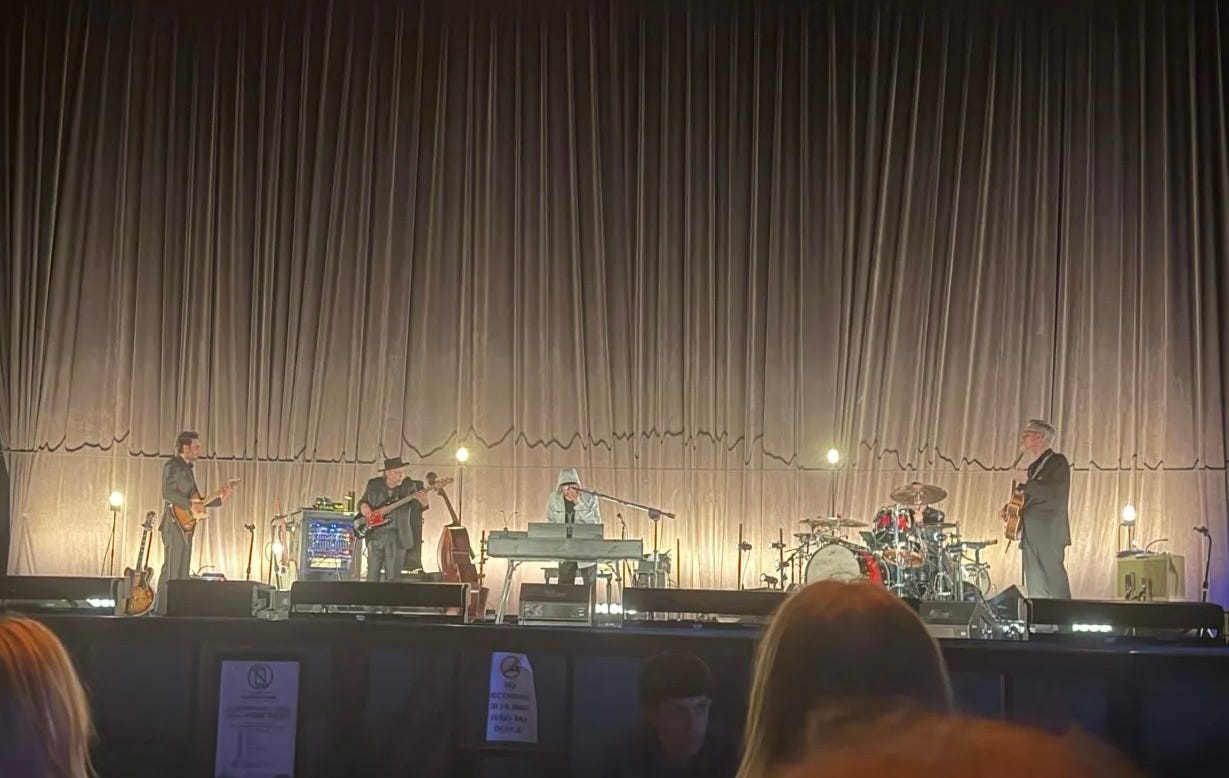
Last night, the Long Hot Summer Tour touched down in Chicago. Since our last dispatch, jazz favorite Julian Lage has returned to the band, now sharing guitar duties with local Chicago boy Joel Paterson. But Lage has European dates this coming weekend, so presumably he’ll be gone again by Cincinnati tomorrow night. We’ll have a dispatch from there, but first, to report on the goings on from the new two-guitarists lineup, is Steven Rings.
Last fall, Rings, a musicologist at the University of Chicago, published the truly excellent book What Did You Hear? The Music of Bob Dylan. You can read an excerpt from it here. Today, he tells us what did he hear, last night at a former airport in Chicago. Here’s Steven Rings:
Next weekend I’ll finally be reporting myself, from Boston and Gilford! Hope to see some you there. We’ll have one or two more guest dispatches before then. As always, subscribe to get them sent to you:
Mention Northerly Island to any Chicagoan of a certain age, and you’ll likely hear about Meigs Field. In the 1990s, mayor Richard M. Daley wanted Meigs—a little airport—gone. Its heyday of heavy prop-plane traffic was in the past, and Daley wanted to raze it and turn Northerly into a park. Negotiations stalled and Daley got impatient. So around midnight on March 30/31, 2003*, he sent city bulldozers onto Northerly to destroy the runways by carving large Xs onto them. Chicago residents—and the rest of the world—wouldn’t find out until the sun came up. That, friends, is Chicago politics.
[* Ray note: I was in high school in Chicago in 2003 and I remember this. It was a huge deal! Still can’t believe that happened.]
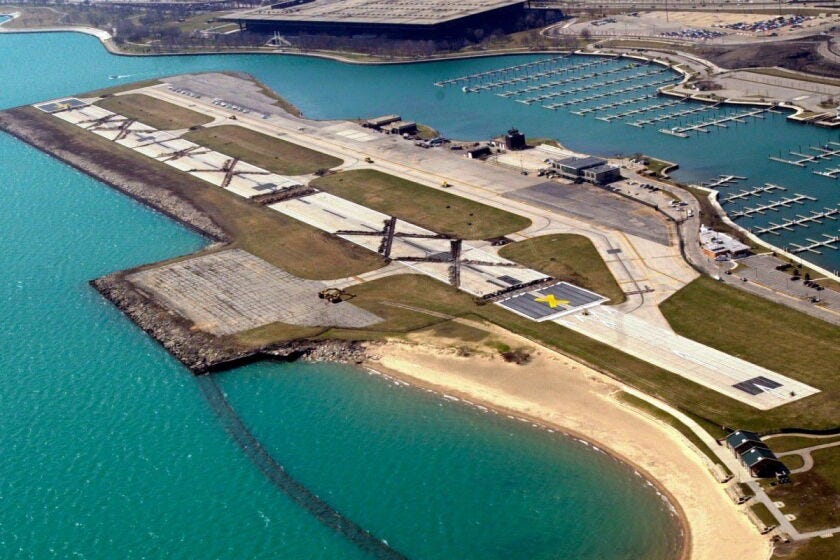
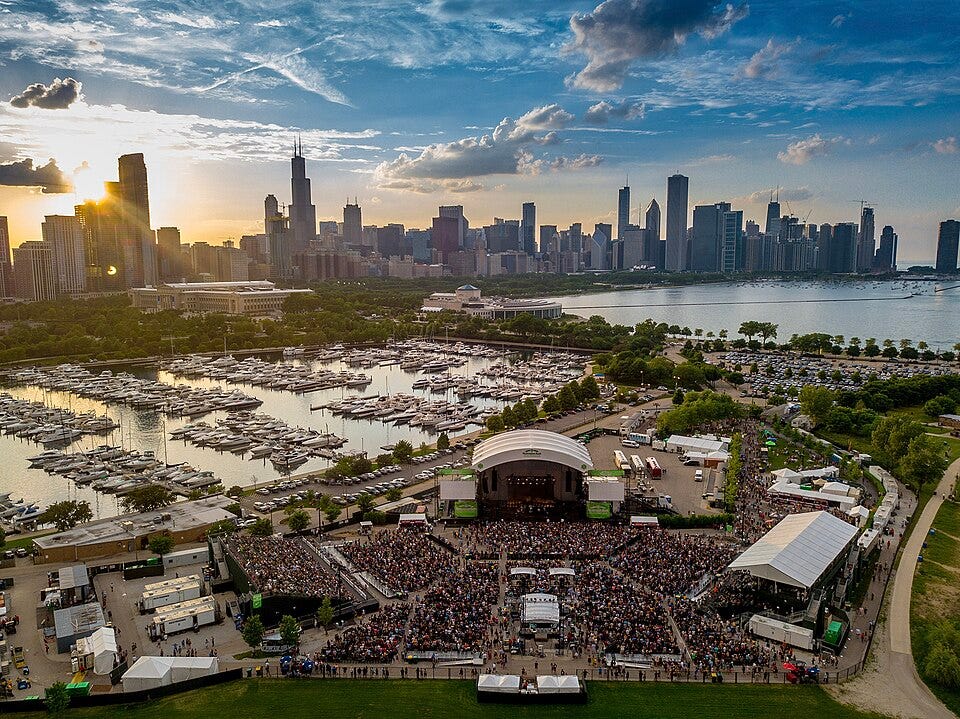
But last night it was hard not to be grateful for Daley’s audacity when strolling through Northerly on the way to the show. It’s a gorgeous park. The vibe was festive and the weather was perfect: blue sky, 70s, low humidity. As Adam Selzer put it when we were chatting before Lucinda Williams’s set, the whole scene had the relaxed, happy feel of a state fair, a welcome contrast to corporate arenas. The route to the performance venue was lined with pedicabs blasting Dylan and musicians playing the same, cases open. Dylan was in the air everywhere you pointed your ears—harmonicas, guitars, greatest hits. The venue itself looks toward Chicago’s downtown (the Loop, to locals), which was at its most fetching, its lights shining brighter as the sky dimmed. Pretty magical.

I missed the John Doe Folk Trio, but was there for all of Lucinda Williams, who sang a powerful, mesmerizing set. She has to be helped to the mic these days, but she stood to sing all eight songs. Dressed entirely in black, which set off her trademark shock of blonde hair, she was an almost spectral presence, standing still to sing. But her voice has aged little and was instantly recognizable. She sang with intensity and focus throughout, bringing a grizzled pathos to Skip James’ “Hard Time Killing Floor Blues” and roaring through Neil Young’s “Rockin’ in the Free World” to close the set, getting a large chunk of the audience to its feet, fists pumping. But her originals really carried the night, from the weary-but-anthemic “Car Wheels on a Gravel Road” to the lowdown threats of “Joy.” And threaded throughout was a message. Before the defiant “You Can’t Rule Me” she mentioned Trump—on the nose but potent. And after her Neil Young cover: “Don’t give up the fight.”
Dylan’s set was a revelation—with just one disappointment. The revelation was the two-guitar lineup with Julian Lage and Joel Paterson. Lage had joined the Paterson lineup for the first time in Shakopee, MN two nights prior; this was their second show together. Paterson was on the right of the stage, playing a Gibson archtop, while Lage was to our left, with a Telecaster. They were a study in contrasts. Lage, one of the hottest jazz players in the world right now, tended toward the abstract and the cerebral, but with impeccable taste. The chordal passages in his solos—played with pick and fingers of his right hand—were butter, with just the right amount of “out” playing to call to mind luminaries like Bill Frisell and John Scofield. (Jazzers talk about playing “out” when they stray from the key, playing strategically sour notes.) Paterson, by contrast, brought the Chicago blues. His pinched leads often bore an uncanny resemblance to Buddy Guy or Hubert Sumlin.