
Flagging Down the Double E’s is an email newsletter exploring Bob Dylan performances throughout history. Some installments are free, some are for paid subscribers only. Sign up here:
Five years ago, I compiled an oral history of one of Bob Dylan’s most famous concerts ever: May 23, 1976 in Fort Collins, Colorado. This giant outdoor show, held in the pouring rain at the tail end of the Rolling Thunder tour, was televised as Hard Rain and used for half of the live album of the same name (the other half came from Fort Worth). It was in many ways the culmination of the entire Rolling Thunder Revue.
In the five years since that piece ran, I’ve interviewed many more of the key participants, both the musicians onstage and the people making the show happen behind the scenes. So, to celebrate the 50th anniversary of this historic show—and the penultimate entry in our Rolling Thunder 1976 show-by-show series—I am dramatically expanding that oral history with a whole bunch more quotes from interviews I’ve done subsequently.
Note: All the newly-added quotes come from original interviews I’ve conducted myself, but some of the quotes in the original version did not. I’ve linked to the original sources, whether that’s me or someone else, at the end of every quote.
An Oral History of Hard Rain
1. They first try (and fail) to tape a TV special early in the tour
Gerry Bakal, stage manager: “We were rehearsing at the Bellevue Biltmore Hotel [in Clearwater, Florida]. It’s an old, beautiful wooden structure. We pull into the parking lot, and there is a barefoot tuxedo-wearing purple-glasses Roger McGuinn telling people where to park. Rumor has it there was LSD involved.” (via forthcoming interview)
Gary Burke, percussion: “One day we were told, instead of going to where we’re rehearsing, go to this old-school ballroom they had. We were going to shoot a show for Burt Sugarman, the man behind Midnight Special. Bob was the MC; he would introduce different segments of the show. He was obviously very uncomfortable doing that. I remember one time he put his glasses on to read the lyrics, because there were so many verses he couldn’t remember them all. Someone handed him a book of Bob Dylan songs to read from, which I thought was really funny.” (via)
Howie Wyeth, drums: “The rehearsals sucked. Then we did the concerts and they were filming it and it happened. That was the first day that the music started feeling right again. Bob did a really hip version of ‘Like A Rolling Stone’. He did some tunes that he hadn’t done at all.” (via)
T Bone Burnett, guitar: “They built these rafters all around and there were all these kids sitting in them, with their legs dangling down. The backdrop was all these dangling legs and we just took one look at it and thought, ‘[surely] this isn’t what we’re doing.’” (via)
David Mansfield, multi-instrumentalist: “I don’t want to put words in [Bob’s] mouth, but I imagine it seemed too sort of staged and pedestrian in terms of approach. It was right after rehearsals and things hadn’t quite gelled yet.” (via)
Paul Goldsmith, cameraman: “It could have been John Denver on that stage, because the visual style overcame Bob’s qualities. Which is hard to do, but if you put enough filters on the camera and you film wide, it’s possible.” (via)
Howie Wyeth: “Bob got into a fight with [one of] the guys that were doing [the Clearwater special]. He got into a big argument with the guy over the dinner table one night after we’d already done half of it. And then he said, ‘No! We’re not going to do it. Fuck it!’ So he decided that wasn’t the way we were going to do it, and then they decided to record it at the end [of the tour].” (via)
Rob Stoner, bassist and bandleader: “I think the deal was that Bob had the right of refusal if he didn’t like the videotape, but the terms were that he had to make good on it, at his expense, by doing his own thing to deliver to NBC.” (via)
Gary Burke: “It wasn’t exactly his cup of tea. It felt a little showbiz-y. The word came back the next day that he canned it. I heard he bought it back from Burt Sugarman for a million bucks, never to be shown.” (via)
Scarlet Rivera, violin: “The first attempt to capture it live for whatever reason didn’t work. I’m really not privy to know what those reasons were. They were technical reasons, from sound equipment [which] had to be brought in. Maybe they had problems with feedback. That whole effort was never released. It forced us to do one final try to capture Hard Rain, which was the Colorado show.” (via)
2. The second Rolling Thunder tour continues through the South, winding towards Colorado
Bob Neuwirth, guitar: “When we did the second edition of it down south, we approached it slightly wrong and it wasn’t as fresh. The New England magic wasn’t there.” (via)
Gerry Bakal: “The winter tour, we’d go into town and just rent a hall, start selling tickets. In the Northeast, in a college town in the mid-70s, you think Bob Dylan and Joan Baez can sell tickets? You couldn’t print them fast enough. Well, they tried the same thing in the South in the spring, and everybody down there is like, ‘Bob who?’” (via forthcoming interview)
Mike Evans, advance man: “The attitude was to go bigger in the South. Quite frankly, at that point in time, it’s not the new South we have now. It was the old South. The whole concept of Rolling Thunder Revue didn’t mean as much as it did up north.” (via)
Chris O’Dell, co-tour manager: “It shouldn’t have happened, honestly. A good thing happened and then they tried to recreate it in a different space and it didn’t work. It just wasn’t the same. Nobody felt the same way about it. They should have stopped and just left it at the one.” (via)
Scarlet Rivera: “There was a magic to the first leg of the tour. There was a great sense of harmony amongst all the players. Although the music was as good on the second leg, I think it was a little bit less harmonious. Some element of tension wove itself in that wasn’t there in the first one. Perhaps it was because Bob was going through his divorce. I don’t know. There was a little bit less of that magic fairydust glow on the second one for me.” (via)
Roger McGuinn, singer: “There was less camaraderie. First part, we were all hanging out and loving each other, and it was like a big family. The second half was more like a commercial tour.” (via)
Claudia Levy, tour director Jacques Levy’s partner: “The first part of the tour, there were no drugs. People weren’t doing coke or anything like that. The second part of the tour—there was a different color to things, if you will.” (via)
Gary Burke: “I got the feeling that things had changed from the fall. You’re trading stories with people, and they would tell you about what they did on the first tour. I’m thinking to myself, that’s a lot different than what we’re going through.” (via)
Rob Stoner: “All of that mood stuff in the band is always set by the main guy. The train follows the locomotive. And the locomotive was dragging, discouraged.” (via)
David Mansfield: “Bob kind of had a black cloud over his head during that [1976] tour and that infected everything.” (via)
Mike Evans: “We sat around talking about finances much more [in ‘76]. I don’t know in the first leg if anyone ever said, ‘Oh, what does that cost?’ You can sell out Plymouth Auditorium twice in a night and you’re not going to pay your catering bill. The attitude was just, do it. On the second leg it was, ‘What’s it going to cost, and how much do we need to do it?’ That pretty much tells you everything.” (via)
Louie Kemp, Rolling Thunder producer: “It was a totally different atmosphere, but the shows were great.” (via)
Kinky Friedman, singer: “Those shows went very well. The crowds particularly liked [my songs] ‘Proud to be an Asshole from El Paso,’ ‘They Ain’t Making Jews Like Jesus Anymore,’ and ‘Get Your Biscuits in the Oven and Your Buns in the Bed.’ Sometimes a light hand on the tiller works really well. I thought for a moment that I was going to lose my job because they were laughing so hard. I think Bob had not expected that.” (via)
3. The tour arrives in Colorado to prep for the big show
David Hill, attendee: “Dylan and company spent a few days at the Stanley Hotel in Estes Park rehearsing. The Stanley is a famous old hotel in the mountains where Stephen King came up with the idea for The Shining. It was perhaps a bit run down in 1976—it’s since been spiffed up. There’s a small auditorium, which is likely where the Rolling Thunder Revue rehearsed.” (via email)
Patricia Maher, local resident: “Estes Park was a very conservative town, and while some of its citizens knew who Bob was, many didn’t - or didn’t care. It was a very small mountain community, which is why Dylan came up there to rehearse in the first place. They knew there wouldn’t be tons of fans hanging out. They’d have been swamped if they rehearsed in Fort Collins.” (via)
Gerry Bakal: “They went out of their way to be super, super nice to us. They just opened their arms and gave us a big old hug. The laundry room was open 24-7, the bar was open, room service was open. Shopkeepers would come in from town and say, “I own the jewelry store down the street. You guys want to go shopping? I’ll open the store.’” (via forthcoming interview)
Howie Wyeth: “All of a sudden they said we got four days off before we do Fort Collins and the record. They said, ‘You’re gonna love this. We got you in this dude ranch up in the mountains.’ And it was raining so you couldn’t go riding and it was up in the mountains so you couldn’t breathe. There was nothing to do. And we were all stuck up there... It was dreary.” (via)
Mike Evans: “We were staying at this…hotel up in the mountains that is real famous, with the old clawfoot bathtubs and stuff. I remember sitting in the bathtubs drinking brandy and things just trying to get warm.” (via)
Rob Stoner: “Bob was really hitting the bottle. That was a terrible fuckin’ weekend.” (via)
Gary Burke: “At the last minute we heard, ‘Bob wants to rehearse. Get down to the ballroom.’ They were scrambling to get gear set up. I remember all we did was we played ‘Tangled Up in Blue’ for about two hours!” (via)
Patricia Maher: “The night before the show, we all went up to the Stanley to listen to them rehearse in the concert room and music hall. We were able to watch them, because it was almost impossible to close off a public room in the Stanley. They were so loud, they literally shook the place.” (via)
4. Bob’s wife Sara shows up
Joan Baez, singer: “Sara showed up late in the tour, wafting in from a plane looking like a mad woman, carrying baskets of wrinkled clothes, her hair wild and dark rings around her eyes... Bob was ignoring her, and had picked up a curly headed Mopsy who perched on the piano during his rehearsals in a ballroom off the main hotel lobby. Sara appeared airily at the front door dressed in deerskin, wearing her emerald green necklace and some oppressively strong and sweet oils. She greeted me with a reserved hello and talked distantly about nothing in particular, all the while eyeing the closed door to the ballroom. I had the impression that she had her magic powers set upon that room, and that whatever plans Bob had would soon be foiled. The door to the room opened and Mopsy tumbled out. ‘Who’s that?’ said Sara, looking at the girl sideways with her big, lazy, suspicious eyes. ‘Some groupie. No one likes her,’ I answered. It was true. We liked the tightrope walker, who vanished quietly when Sara was around.” (via)
Mike Evans: “She was Bob's slack wire instructor. We’d have to set it up every stop.” (via)
Gary Burke: “Where I was set up [at the back of the stage playing percussion], I would turn around and there was Sara, his wife, who showed up the night before. She’s sitting there in a chair, very regal, with her sons around her. She had on this tiara and just sat there very stone-faced the whole show. I thought, what is going on? So I asked Bob, and he said, ‘She’s just reminding everybody who the matriarch is.’ I guess even Bob! Yeah, things were a little rough at that point.” (via)
Rob Stoner: “I don’t know what the fuck came over him... It was a big void in his life. The marriage was falling apart and this thing which had seemed so exciting and promising—Rolling Thunder—that wasn’t [working] and he couldn’t figure out why, I don’t think... It was like a mid-life crisis. He was confused and he was searching. He tried a lot of chicks; he tried one chick; he tried [every] kind of chick.” (via)
Dave Sharrett, local resident: “My wife Vicki worked as a cocktail waitress at the Stanley Hotel. One of the hotel managers came to Vicki and told her she wasn’t allowed to be in the kitchen after hours. Someone had apparently seen her going through a refrigerator looking for food. She told him she had never gone into the kitchen, and that she must have been mistaken for someone else… The evening of the show, after having finished her shift, she was getting ready to go back to her room when someone tapped her on the shoulder. She turned around and there was Bob Dylan. He looked at her and said, ‘Oops, wrong woman!’ and quickly made an exit. The episode with the manager about the kitchen then made sense. As it turned out, Dylan had a mistress who looked very similar to Vick.” (via email)
Joan Baez: “That night we had a disjointed party for him complete with a cake, but he got drunk and looked dead tired. I decided to walk him to his room. He started flirting ever so slightly, and I told him to wait right where he was and dashed off to find Sara and delivered her to Bob. They both laughed sheepishly and looked mildly pleased, and I said ‘Happy Birthday,’ and went back to my room quite proud of myself.” (via)
Joel Bernstein, guitar tech and photographer: “Sara and the kids came to the Fort Collins show—I seem to recall that even she had a turban on.” (via)
5. The stories (plural) behind the turbans
Joel Bernstein: “When he first showed up at rehearsals he was wearing a yarmulka [sic]. It wasn’t part of a look, it definitely wasn’t wardrobe, it was a religious thing. It wasn’t a bandana, it was a yarmulka.” (via)
T Bone Burnett, guitar: “Just before Dylan left on the second leg of the tour, he was putting a brick wall round his house and all the bricklayers had those rags ‘round their heads to stop them getting concrete and various bits of plaster or whatever in their hair. Dylan went out there to help the guys and out of that we got the babushka headdress, or whatever [the] hell it’s called, and then he just kept it on for the road.” (via)
Arthur Rosato: “It was a personal thing he never talked about it. And then pretty soon all of the musicians were wearing them.” (via)
Gary Burke: “Bob’s headgear for the tour had been that white durag he wore. It was like a prison durag with a sort of Arab twist to it. By the end of the tour, there were a number of wives and girlfriends around. These women cajoled us into wearing them, a goof on Bob and his headgear. Much to our chagrin, at first, but everybody got into it after a while. That concert was [the day before] Bob’s birthday. It was a combination of party hats and giving it to the boss a little bit.” (via)
Joan Baez: “Everybody was wandering around with bandanas and torn sheets tied around their heads. I didn’t succumb until the end of the tour, and then only with an eight-foot-long red silk scarf from Spain, wrapped into a turban and adorned with a gaudy brooch over the center of my forehead, the spot where rajahs stuck their royal jewels.” (via)
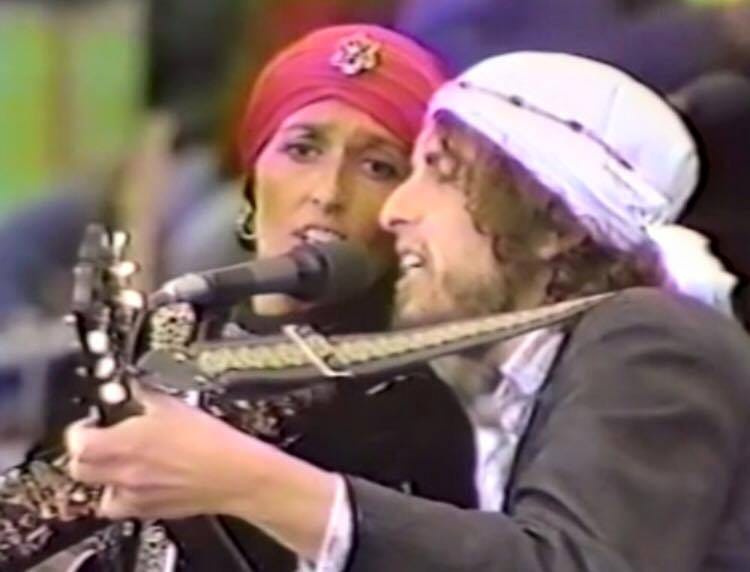
T Bone Burnett: “The story goes that when [the Hard Rain footage] finally was sent to New York City, for the network to look at, the head of the company saw the footage and said, ‘I can tell you one thing: he is no Cary Grant.’ There, on some executive’s TV screen, was this guy with a rag tied ‘round his head! By that time, the ’76 tour had become Rag Rock.” (via)
6. A hard rain falls
Rob Stoner: “We were supposed to do the gig [on] two or three consecutive days—each time the rain date was supposed to be the next day—but it was pouring for days and days and, meanwhile, it’s costing Bob a lot of bread. Everybody’s holed up in this little hotel up in the mountains in the middle of nowhere, with nothing to do except get drunk… The boss is getting in a progressively shittier mood… Eventually they just decided to go and do it in the rain.” (via)
Paul Goldsmith: “They were thinking about canceling the performance. It was raining, and there had been a show in Canada a week earlier where a guitarist had been electrocuted and died because of the electricity going to his guitar. So there was concern that this could be dangerous to perform in the rain. And everybody was exhausted and it could easily have been canceled. But it wasn’t.” (via)
Louie Kemp: “It had been a pretty miserable morning. We had a big film crew from NBC there to tape the concert, but the rain just would not let up. I paced around, nervous that the whole thing would be a washout. But when I looked out at the crowd forming in front of the stage, I could see that everyone was having a blast! They were sliding around in the mud and dancing in the rain. By the time Bobby took the stage, the rain had slowed to a drizzle and the energy was electric.” (via)
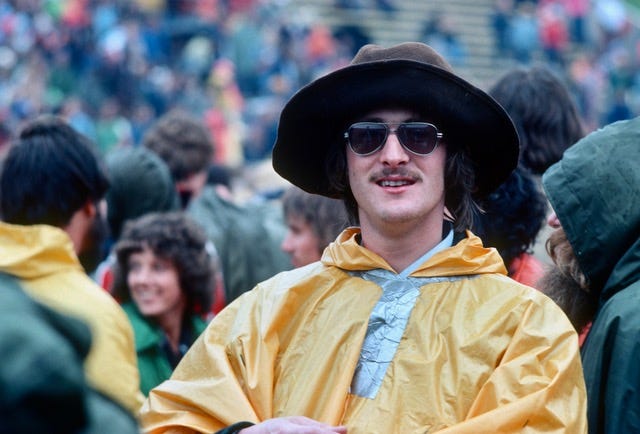
Patricia Maher: “The concert started at 1:00 PM and it poured rain for the next eight hours. After much dismay, we just gave up and let the rain roll down our faces. Hour after hour, you’d think, ‘This is insane. Go out to the van. This is crazy.’ But the fascination with Bob and his band was just incredible. There was no way in heck that you were going to leave.” (via)
David Mansfield: “Bob was in a pretty awful state of mind, and on top of it all, the physical conditions of the concert were grueling. Because it wasn’t just raining, it was also freezing… I remember playing steel guitar and it was so cold that my foot was shaking on the volume pedal and I couldn’t get a smooth tone.” (via)
Roger McGuinn: “It wasn’t my favorite show. It was cold and rainy and 5,000 feet and we couldn’t breathe.” (via)
Gary Burke: “I remember looking out, and people were dropping. Usually, it’s from heat exhaustion, but in this case, it was exposure. I remember one time looking up and they’re carrying this guy in a stretcher.” (via)
David Hendel, soundman: “We had a speaker blow over and get impaled by a piece of scaffolding.” (via)
Rick Wurpel, local producer: “The roof came with the tour. The rigger had assured me that this roof stage cover was well-designed. Unfortunately, when he showed up with it, in this layman’s opinion, it was not structurally sound at all. There were welds that were breaking. It leaked like a sieve.” (via)
Rob Stoner: “Everybody’s soaked, the canopy’s leaking, the musicians are getting shocks from the water on the stage. The instruments are going out of tune because of the humidity. It was awful. So everybody is playing and singing for their lives, and that is the spirit that you hear on that record.” (via)
David Hill: “I was a senior in high school in Littleton, Colo., at the time. I drove up with my sister and two school friends… It was pouring rain when we got to the stadium, but as I recall, the skies cleared as we waited, and by the time the concert began, I think the rain had stopped… I was a photographer on my high school newspaper, so I took my camera and shot a bunch of color slides, mostly crowd shots.” (via email)

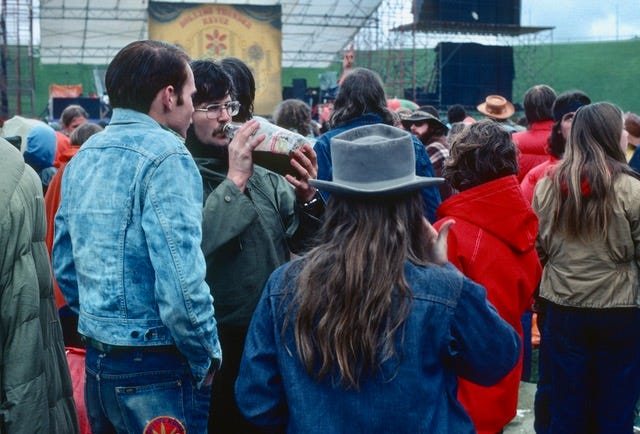
Joan Baez: “Ten thousand people sang [happy birthday] to him in a stadium in the rain. He stuck his face into his amplifier until the song was over, and then plowed into ‘A Hard Rain’s A-Gonna Fall.’” (via)
Rob Stoner: “The rain cleared up on the last fuckin’ song—it was the first time that the sun had shone in a week.” (via)
7. Filming for the TV special
Scarlet Rivera: “There was a lot of pressure on that day to get that filmed [and recorded]… This was the last possible moment for this recording to be made, and it was under the worst circumstances.” (via)
Paul Goldsmith: “It must have been a decision on Bob’s part at the last minute that he wanted to record it, because I got a call three days before the concert.” (via)
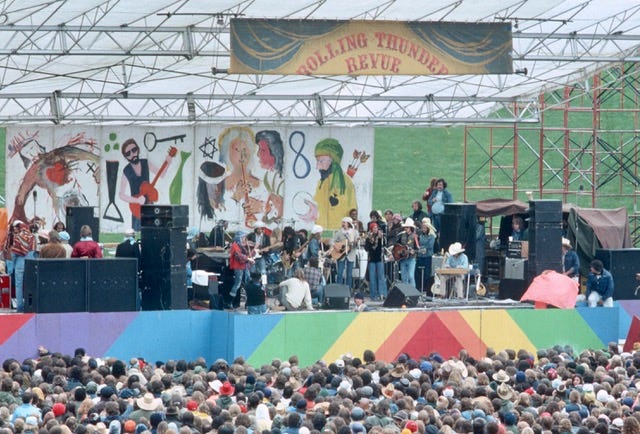
Gerry Bakal: “Bob had painted these four-by-eight pieces of plywood that I had to hang every day behind the stage, which was challenging. We had them stacked upstage, waiting for the stage to get set up before I’d get some stagehands and hang them. I had to keep an eye on ‘em because I kept saying, ‘I know they’re still building parts of the stage, and they’re gonna be looking for plywood.’ And of course somebody came over and cut like a one foot by two foot section off of one of Bob’s pieces.” (via forthcoming interview)
Rick Wurpel: “He had painted these pictures of Christ on four-by-eight sheets of scrap plywood. My carpenter, under the pressure of the TV people, grabbed that scrap plywood and cut it up and made a table of it. Somebody ran up to me right before showtime, ‘Wurpel! Wurpel!’ ‘What?’ ‘Who the fuck cut up Bob Dylan’s paintings of Christ?’” (via)
Gerry Bakal: “We sent somebody out for some one-by-threes and some glue and screws. ‘You gotta put this back on!’” (via forthcoming interview)
Paul Goldsmith: “There was an intermission where Allen Ginsberg recited Howl. I wish I’d filmed that, but we were at that moment kind of regrouping, figuring out what we were going to do next. I would have loved to have had a camera shooting that. He came alone on the stage, shouting out Howl to 22,000 college kids in Colorado.” (via)
Allen Ginsberg, poet: “[Dylan] was dubious about my singing but he kept pushing me to recite poetry, till finally in Fort Collins, I did… I couldn’t figure what you could say to 27,000 people, what could engage the minds of that many people in the hysteria of a giant rock and roll thing. One day in Fort Collins as Dylan came off in the intermission, casually over the shoulder he said, ‘Why don’t you go out there and read a poem?’ So I went out there and read a very brief poem called ‘On Neal Cassidy’s Ashes’ because that’s Denver area… I wasn’t announced, I just went out and bellowed words out over a microphone and when I got off Roger McGuinn shouted my name and then the band went into their thing.” (via)
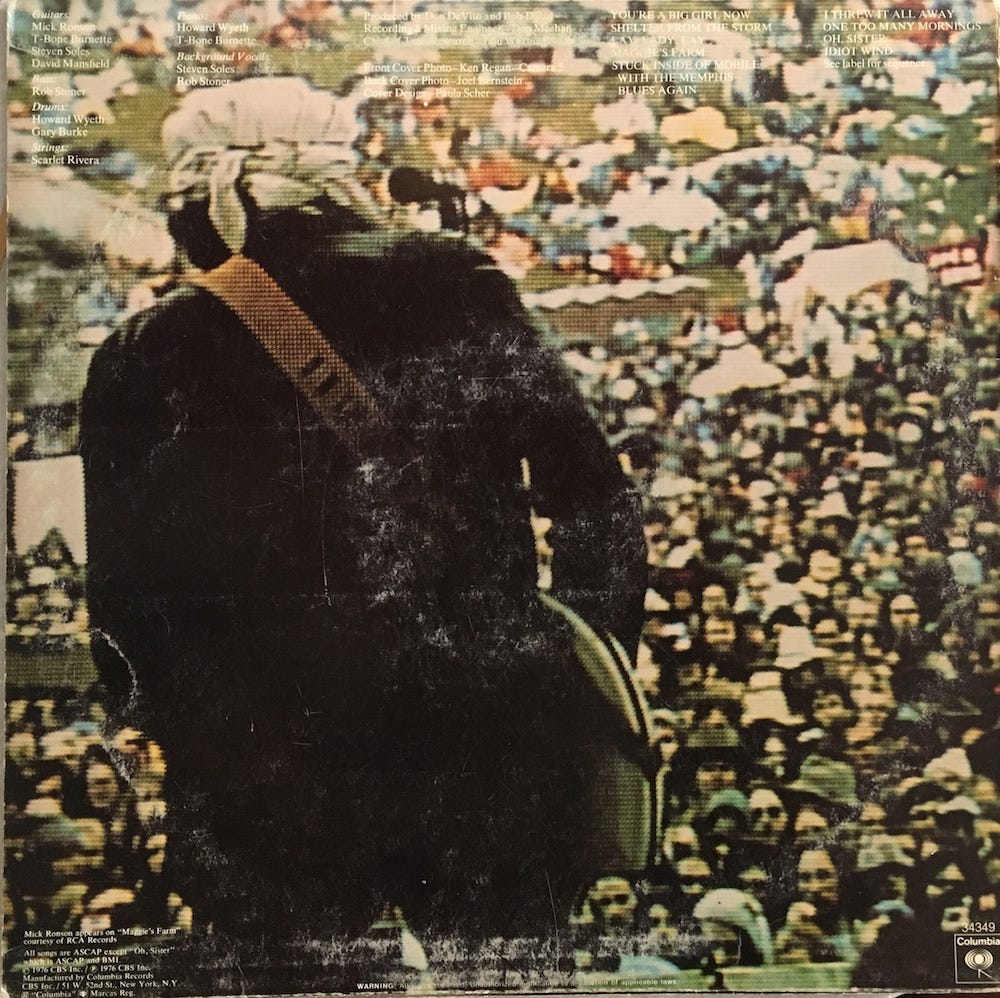
Joel Bernstein: “They wanted to have some shots of Bob from the video of Fort Collins for the [Hard Rain] LP sleeve and I had come up with this technique of photographing from video using still frame... I’d shot a lot from the front, but the background was very cluttered with all the scaffolding and the paintings... The shot from the back just happened to be the one that I stopped at. I never thought it would be used.” (via)
Gary Burke: “If you look at the footage, you’ll see that everybody is just laser-locked on him when they’re playing. He would expect you to go there and be with him. We did work off a set list, but they were more suggestions than locked in. Instead of the Ten Commandments, it was the Ten Suggestions.” (via)
Rick Wurpel: “He did play a little longer, because of the crowd being in the rain and having been there forever. My understanding was that he wanted to play a lot longer. It was a torn thing, because the band was also cold and wet because the roof leaked. And this was not the days of wireless everything. This was the days where you were wired. So there’s also, in the back of your mind, the knowledge that electricity and water does not mix.” (via)
Louie Kemp: “The footage from the Hard Rain concert in Colorado, I think is amazing footage, just amazing. The intensity of the singing and everything. I think that tour, the performances were in some cases more intense than they were relaxed.” (via)
Paul Goldsmith: “You’ve probably had the experience in your life where you’re not sure whether you want to do something or not, and then, when you decide to do it, you just go hell’s bells for it. As you can see in Hard Rain, they just rocked and rolled the whole show. You could just feel the energy. Everyone on the stage was obviously letting loose. There was no constraint. There was no sense of being careful.” (via)
Rob Stoner: “There was a lot of stuff that makes Hard Rain an extraordinary snapshot—like a punk record or something. It’s got such energy and such anger.” (via)
8. The morning after
Rick Wurpel, local producer: “I took the athletic department and the head coach and they saw the field. There was not a blade of grass left. There was nothing but mud. Not only is it thigh-deep mud, but there’s boots, there’s shoes, there’s garbage. I hate to use the term right now, but it looks like a war zone. The athletic director and the coach, they were both in tears. They were devastated. This is hallowed ground. It’s all about football here. They were like, ‘There will never be another concert in this building.’ I’m not sure there ever has been another one there.” (via)
1976-05-23, Hughes Stadium, Fort Collins, CO - concert minus officially-released tracks
Ray, you really are a force to be reckoned with. I’m constantly so impressed by your efforts. Huge thanks for all you do for we Dylanophiles.
The Hard Rain tv show is what got me into Dylan. I loved it. Thanks so much for this background info. I visited the Stanley Hotel on a trip to Colorado last summer. It was cool to know Bib and the band had stayed there.