
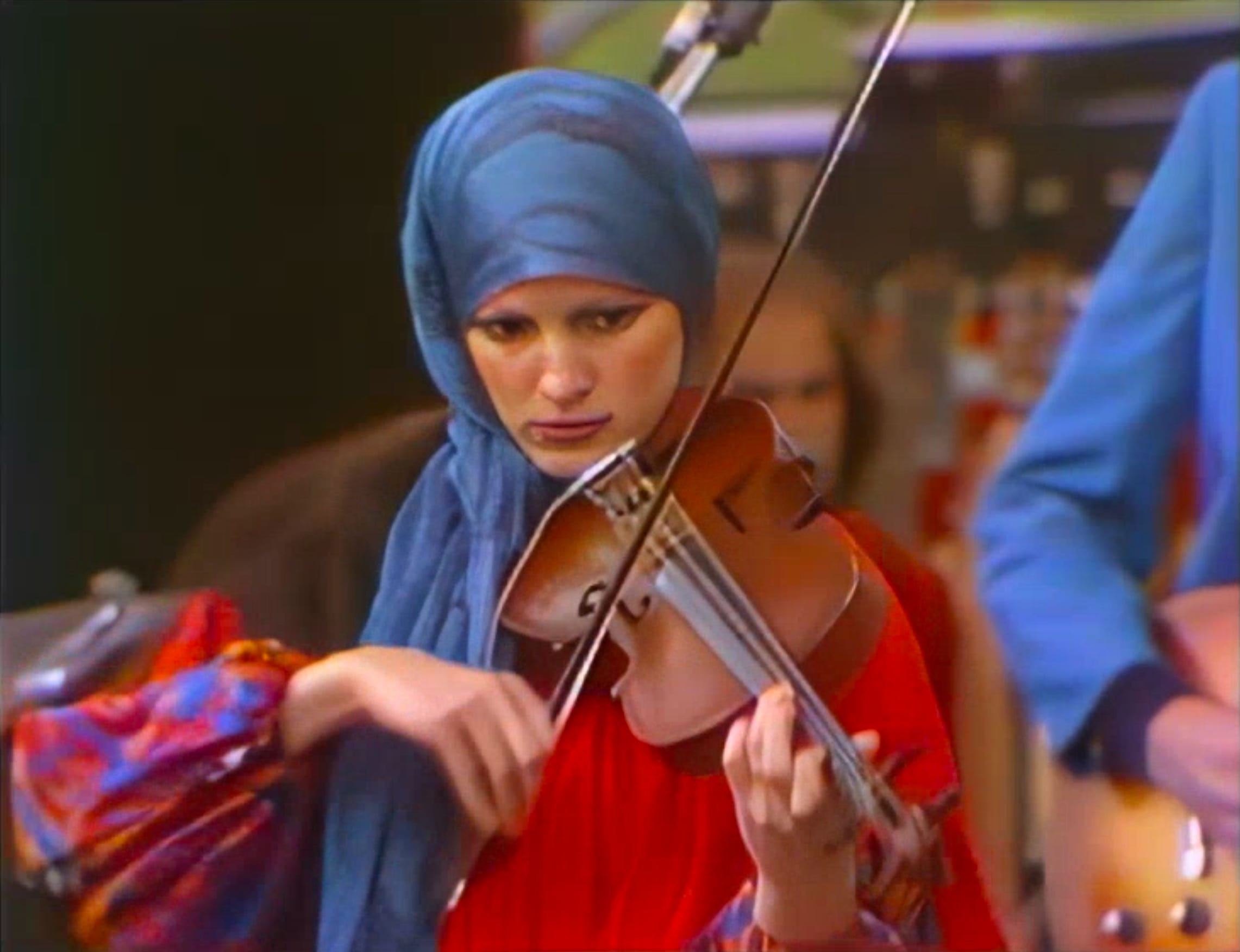
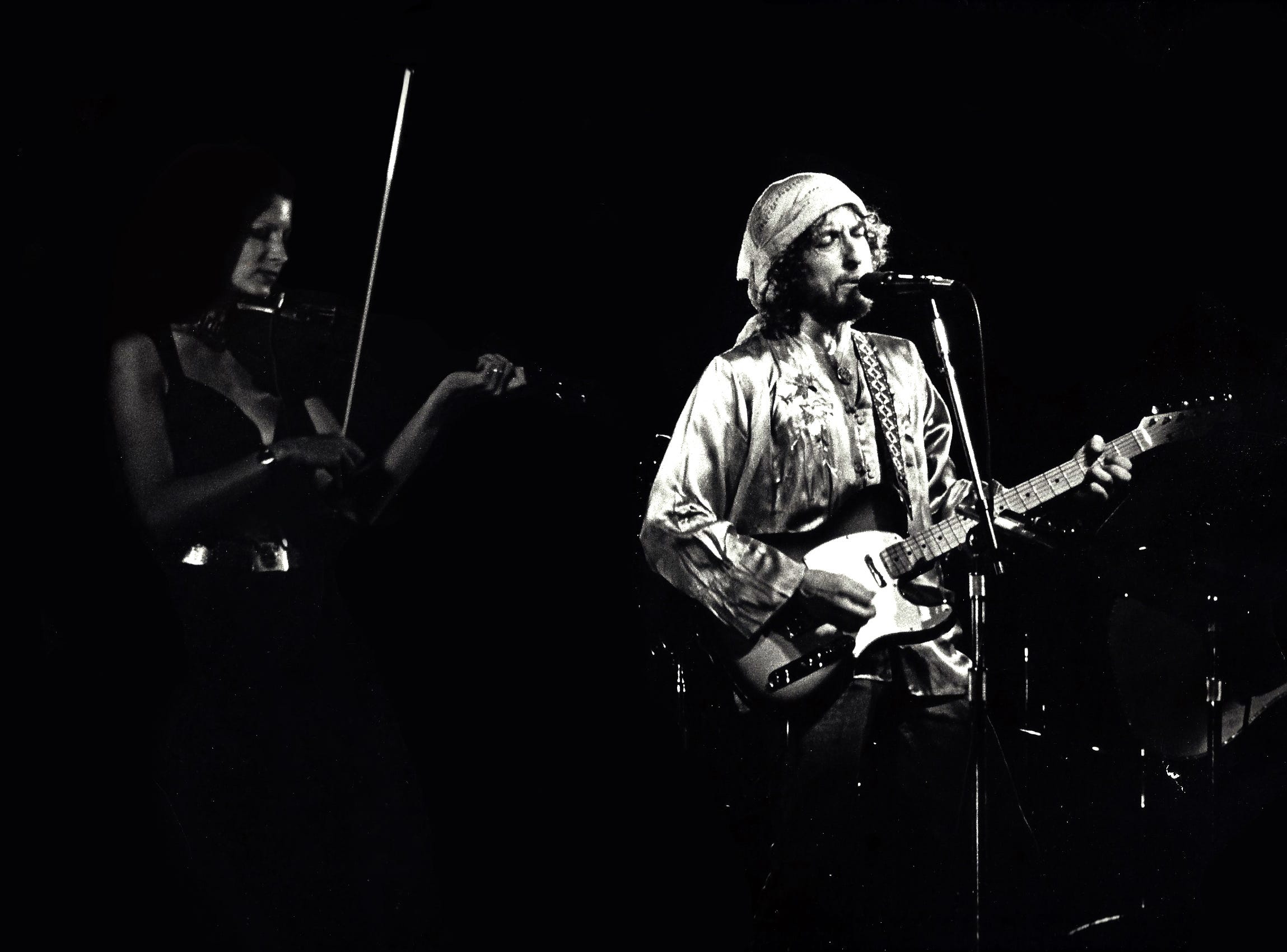
Scarlet Rivera is, of course, the iconic violinist Bob Dylan played with on Rolling Thunder. Her look defined that era almost as much as the sound of her violin. But when you think of Scarlet Rivera, you probably first think of Desire and the 1975 leg of Rolling Thunder (that’s the one with the face paint). But she was just as important to the 1976 leg, which we’ve been celebrating all year on its 50th anniversary.
I interviewed Rivera a few years ago, but our conversation back then primarily focused on Rolling Thunder 1975. For my new MOJO cover story, I wanted to reconnect with her to ask her more about 1976 specifically. As in 1975, she did not play on every song, but the songs she did play on—“Going Going Gone,” “One Too Many Mornings,” “You’re a Big Girl Now,” of course all the Desire numbers—would not sound the same without her violin.
Here’s the extended version of my recent interview with Scarlet Rivera about Rolling Thunder 1976.
(This is the third in a series of five new interviews about Rolling Thunder 1976—catch up on them all here, and subscribe to get the next two.)
Does Rolling Thunder feel like one continuous tour for you, or like two totally different tours?
Like two different tours. The second tour was a little more wild and uncontained. The band stepped out a bit more. We took liberties to play with more pizzazz and more gusto.
How did that express itself in your playing?
Well, I always followed the band. If the band vibe was going to be a very rocky version, I was of course able to do it. I showed myself to be a very versatile player from the get-go.
You know, Bob allowed for this evolution. If Bob didn’t like it, it wouldn’t have happened, believe me. He doesn’t like playing the same thing over and over the same way for years. He will want to find a way of adding something that changes it.
I think of 1975 as being a little folky and 1976 as being a little more, as you say, rocking, a little harder-edged. Did you have any favorite songs to play on that second round?
I was amazed I got to play “Going Going Gone” live and “Seven Days.” I love the lyrics of “Seven Days” especially. It’s very different than any other song of his. It’s a different kind of story. And “Isis” got a lot more wild live. The tempo is more aggressive and energetic.
You start down in Florida, there’s some rehearsals in Clearwater at this old hotel, and then there’s a TV taping at this same hotel.
That’s the one that never got released. It was a full production. We had these tiers where people sat. It’s amazing that it got canned because they put serious effort into it.
Did you feel like it was a good representation of the show?
Yeah, I do. I never understood why it got canned. I think it had to do with legalities. Some paperwork got screwed up somewhere along the line.
Are there other shows or venues that stand out from that early run?
The big shows. The roar of the crowd was just unbelievable. We didn’t get that kind of feeling in the small theaters. It was just a massive surge of energy coming at you. I’m glad we didn’t start that way, because I probably would have been terrified. I mean, people came and found us on the first leg, obviously, but I didn’t hear the overwhelming roar like I did on the second one.
Did you have any memorable interactions or conversations with Dylan on this leg specifically?
Not that I can put in this magazine.
There must be one that’s printable!
Well, in the show in New Orleans, there was a concert promoter. I don’t remember his name, and I don’t want to remember his name. But I had encountered him when I went to New Orleans with a boyfriend a couple years earlier. I was a nobody, and this guy was a chauvinist…well, I probably shouldn’t use that language. That mofo treated women very bad, treated me very badly. I didn’t say anything about it. I couldn’t do anything about it. The guy made a permanent impression on me.
I showed up at this venue [again, in 1976]. This guy came around the corner and I froze. I went to the security guards and I said, “Don’t let that guy anywhere near me.” That information got to Bob Dylan, and he wanted to know why. So I told him the story.
Apparently they had a card game that night. They took this guy for everything he had. Bob said something to the effect of, “You need to learn how to treat a woman.”
How did that make you feel?
It made me feel wonderful.
Was that guy gone?
He certainly kept his distance from me.
Did you have any other interactions with Dylan during those few months? The consensus I hear is that the vibe was not the same as it had been.
No, it wasn’t. You know, the face paint was gone. I didn’t feel like doing it anymore. Whatever sparked me to do it—and by the way, I’m the one that started the face painting—the muse that came to me to tell me what to put on my face that night was gone. I just didn’t have it. And I never painted my face again.
What did you attribute that muse being gone to?
This was a different kind of a tour. It had a different emotional vibe to it. He gave me a lot of liberty still, but that “all for one and one for all,” it wasn’t quite there.
How would you describe the emotional vibe?
A little more chaotic, a little more distanced.
It all builds to Hard Rain in Fort Collins. What do you remember about that show?
I thought that people weren’t going to like the music because we were out of tune because of the rain. We were drinking to stay warm. So I’m thrilled to know that people actually love the Hard Rain album for what it is.
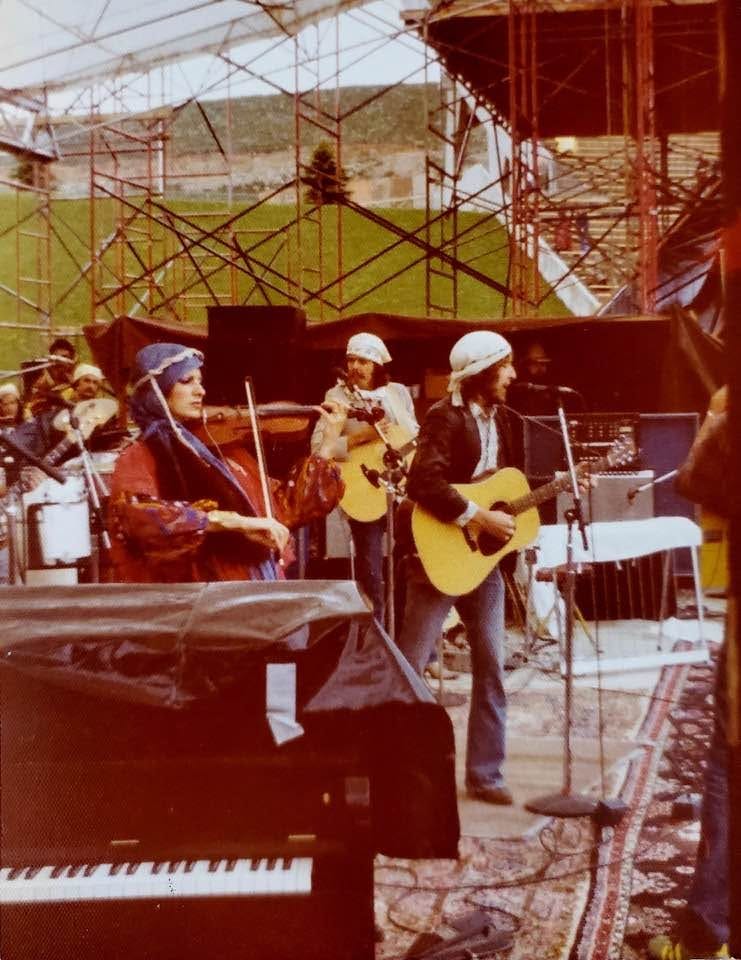
The video too. Most of you are wearing those headscarves.
Because it was pouring. This wasn’t just, “Here, dress up like this.” It was because of the rain. I happened to have a nice interesting colored one.
One other special show for me was the Houston Astrodome. It was a spectacular place to play. We all flew in a private jet to Houston with Bob. Ringo was on the plane as well, so I was able to talk to him.
I heard that Ringo was actually making a move on you.
He did say he loved the way I moved and asked me to sit with him.
Not everyone can say they were hit on by a Beatle.
I know!
At the show, Willie Nelson’s bodyguards—he usually hired people out of prison because he wanted to give them a second chance, which I commend. However, those guys were scary and the backstage was vast, and you didn’t see many people walking around. So I was on my own and Willie Nelson’s bodyguards were tailing me. I started to get freaked out. I was afraid of them. I’m trying to figure out, how do I get back to the dressing room?
Apparently that also got back to Bob and Willie Nelson, that I was afraid of his bodyguards. I got two dozen yellow roses in my hotel the next day from Willie.
What other shows do you remember?
I recall playing the Texas Juvenile Prison. I really thought a lot of Bob for doing it. It was a sweet thing to do. I just remember walking through their locker room and getting a glimpse of what life would be like if you were locked in there. I thought we made a really good impression on them.
You did another prison gig for Hurricane in 1975. Did it feel similar to that?
No, no. This is a kid’s prison, so it’s definitely not of that caliber. Not a maximum security kind of thing.
Did you get the sense that the kids liked the music? Did they know who Bob Dylan was?
Absolutely they did. I got the feeling they were really grateful that we were there. And probably very surprised.
There was a bomb threat in Tallahassee, and Bob talks about it quite a bit on stage. Does that ring a bell?
It does, because I remember the show where they were scanning the whole place. I occasionally got letters from fans that I would want to give to him. He goes, “Nope. Don’t read them.”
You mean letters written to him that they would hand you?
Yeah. “They said they were a friend of yours.” “You read it and you tell me.” I read one, and it showed me why I would never hand him one again.
What did it say?
It was like, “I’m gonna shoot you after the show ‘cause you slept with my wife.” There were people talking about, “I knew you when I was the Queen of Sheba.” Crazy people writing him crazy letters.
And they’d give them to you to ferry onward. Yikes.
Well, it didn’t happen for long because I learned very quickly to throw them in the trash.
How does it all end?
We had a final band meeting and he asked us all what we wanted to do. Did they want to carry on? I think he pretty much already knew what he wanted to do, which was end it.
Would you have wanted to keep going if it had kept going?
Of course.
Is there anything else we haven’t talked about that we should?
Every show, I loved playing “One More Cup of Coffee” and “Hurricane,” and the remarkable thing is that people around the world still want to hear “One More Cup of Coffee” and “Hurricane” to this day.
Were those two of the more popular during your recent tour with Rob Stoner?
Yeah. I didn’t realize that people knew them to this day. And that means younger generations are finding the music. It’s not just people in their 70s.
I’m somewhat younger, and I know fans who are way younger than me, and my impression is Desire and the whole Rolling Thunder period rank high.
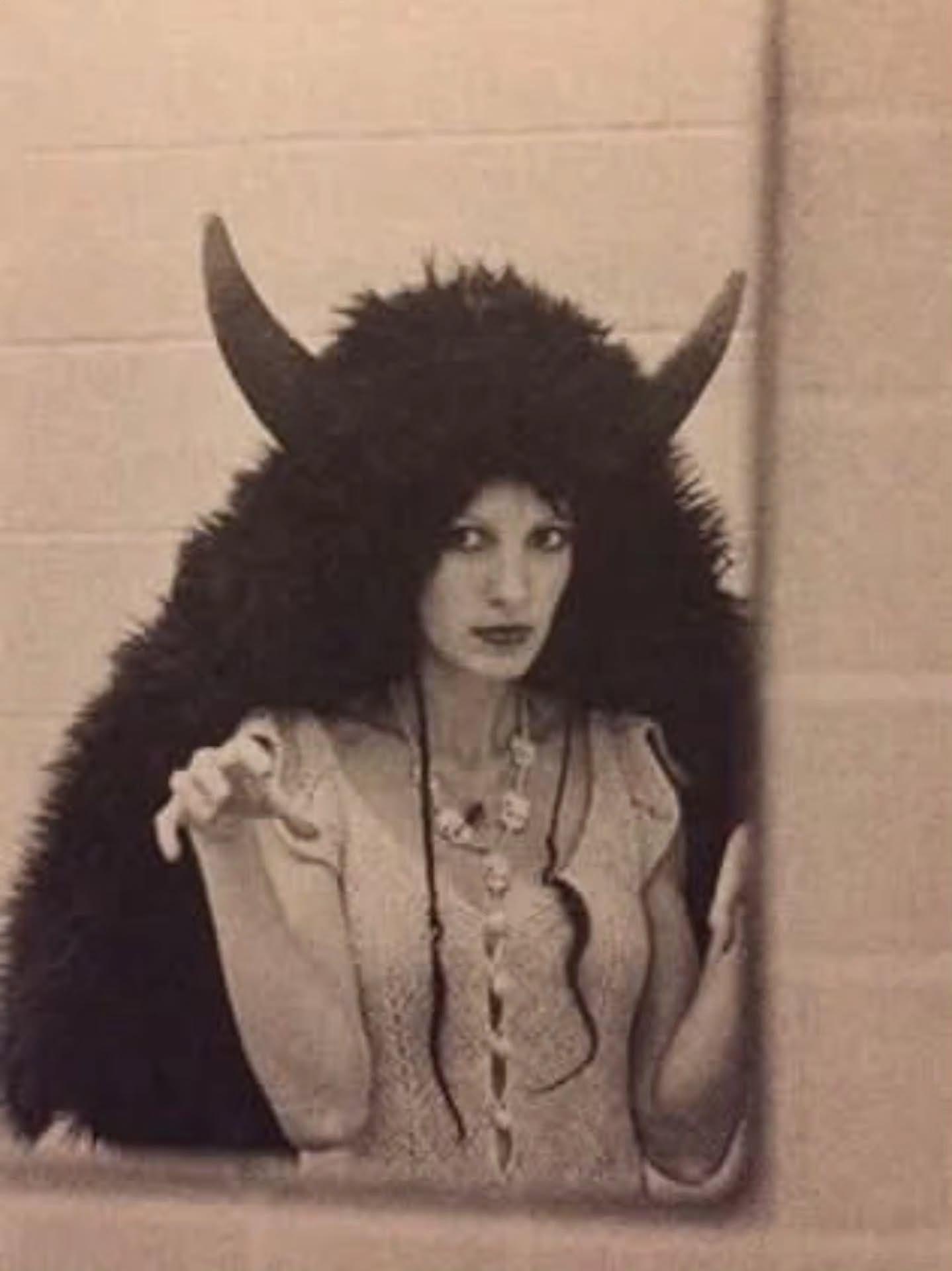
I found out that girls to this day are dressing up with my face paint. Girls in their 20s, and even younger, like 15 years old. Who would have thought?
Thanks Scarlet! Keep up on everything she’s got coming up at her website or Instagram.
This is the third of five brand-new Rolling Thunder 1976 interviews I will be running one a week. Subscribe to get the next batch sent straight to your inbox:
Great interview Ray. Thanks for all your great work. I thought we’d heard it all. Keep digging!
Great to hear her recollections!