
Flagging Down the Double E’s is an email newsletter exploring Bob Dylan performances throughout history. Some installments are free, some are for paid subscribers only. Sign up here:
Ten. That’s how many songs Dylan got into his first Rolling Thunder 1976 show before he repeated a single song he’d played on Rolling Thunder 1975. Five of those first ten songs were live debuts. In the end, only three of the 22 songs Dylan played that night were holdovers from the previous fall.
The tours may have run under the same name, but, from the very first show, it was clear Rolling Thunder 1976 was going to be very different from Rolling Thunder 1975.
Everything about Rolling Thunder 2.0 was different. The music, certainly, as we’ll explore in depth in this series—both the songs themselves, and just as importantly, the energy. The jolly gypsy carnival feel was long gone. Rage, passion, and volume feel more like the vibe of 1976.
Offstage, too, things had changed. They no longer had a camera crew tagging along filming a movie, so the offstage shenanigans got cut way down (give or take an alligator barbecue—we’ll get there). They were playing much larger venues in areas of the country where Dylan was less popular, so the mad scramble for tickets vanished; several shows were actually cancelled due to low ticket sales. Dylan, now in the middle of his marriage collapsing, proved more distant and standoffish.
Every participant I’ve spoken to who was on both Rolling Thunder tours says some version of the same thing: The music remained great, but the camaraderie was gone. A few examples:
There was a magic to the first leg of the tour. There was a great sense of harmony amongst all the players. Although the music was as good on the second leg, I think it was a little bit less harmonious. Some element of tension wove itself in that wasn’t there in the first one. Perhaps it was because Bob was going through his divorce or maybe there was some more tension with the guitar players and the band. I don’t know. There was a little bit less of that magic fairydust glow on the second one for me. - Violinist Scarlet Rivera
All of that mood stuff in the band is always set by the main guy. The train follows the locomotive. And the locomotive was dragging, discouraged. - Bandleader Rob Stoner
The first part of the tour was unbelievable. It was idyllic. It was romantic. We were all having a wonderful time, and Bob was very happy. The second part of the tour, he was like a different person. I mean, he was great on stage. There was no point in time that he wasn’t really good. But he wasn’t a happy camper. You know, everything starts at the top, and it filters through. And that was the case on the second tour. - Jacques Levy’s partner Claudia Levy
It shouldn’t have happened, honestly. A good thing happened and then they tried to recreate it in a different space and it didn’t work. It just wasn’t the same. Nobody felt the same way about it. They should have stopped and just left it at the one. - Tour Manager Chris O’Dell
It was a totally different vibe. Bob was very serious and he was totally into it… I think that tour, the performances were in some cases more intense than they were relaxed. It was a different atmosphere, but the shows were great. - Producer Louie Kemp
But, as Kemp says: The shows were great! I know some people who actually prefer ’76 to ’75. Certainly it’s more exciting for a setlist-watcher, with more changes and surprises night-to-night.
So, like I did for Rolling Thunder 1975, I’m going to be going show-by-show through Rolling Thunder 1976 over the next month and a half for its 50th anniversary. Starting today and going all the way through Hard Rain and the lost Salt Lake City finale.
As is always the case for these show-by-show series, two out of every three entries will go to paid subscribers only. So if you want to follow along and haven’t upgraded already, now’s a great time to do so.
Rolling Thunder II: The Return of Rolling Thunder (not the official name) kicked off in Lakeland, Florida, on April 18, 1976. The band had been camped out in Florida for several days rehearsing in a hotel ballroom (Rob Stoner talks more about those rehearsals in our first interview). They even taped a TV special in that same hotel ballroom a few days after this kickoff show, but Bob scrapped it. We’ll get to that too.
In total, opening night had ten live debuts! Almost half of Bob’s set was songs he’d never performed live. This included three from Blood on the Tracks: “If You See Her Say Hello,” done solo acoustic after “Visions of Johanna” (what an opening two-pack!); “Shelter From the Storm,” with Dylan’s wild slide guitar; and “Idiot Wind,” with the new extra-biting lyrics.
It’s funny, the fall tour was so devoted to Desire, at a time when no one in the audience would know that material. Now that the album is actually out, and people do know the Desire songs, he practically ignores them. “Mozambique” (another live debut) is the only one he plays on opening night. A few others would return occasionally, but Rolling Thunder 1976 is like the Blood on the Tracks promo tour that never happened. Only the songs don’t sound much like Blood on the Tracks anymore.
One thing that hasn’t changed from Rolling Thunder 1975 is that these shows were a group affair. Thankfully, we have a complete tape* of opening night, and there are 16 songs performed before Bob even steps onstage. That includes songs by newcomers Kinky Friedman, taking the Ramblin’ Jack Elliott slot (Jack told me he didn’t know why he wasn’t invited back), and singer Donna Weiss, subbing in for Ronee Blakley (who told me she needed to leave for Nashville promo duties).
* About that tape: It’s listenable, but not up to the standards we’re accustomed to from Rolling Thunder 1975. This will unfortunately be a trend this tour. Another downside of playing outside of his core markets is that the top Dylan tapers of the time were in less evidence. I’m hoping for some sort of 1976 Live Recordings box set this year that might unearth some new soundboards (I unearthed a couple myself a while back). But until then, we take what we can get.
Though Dylan’s mood may have been dour this tour, the vibe looks jovial enough onstage on opening night. Dylan debuted his famous headscarf, but that was not this show’s boldest sartorial decision. Check on the opening-night outfits on T Bone Burnett and Kinky Friedman:
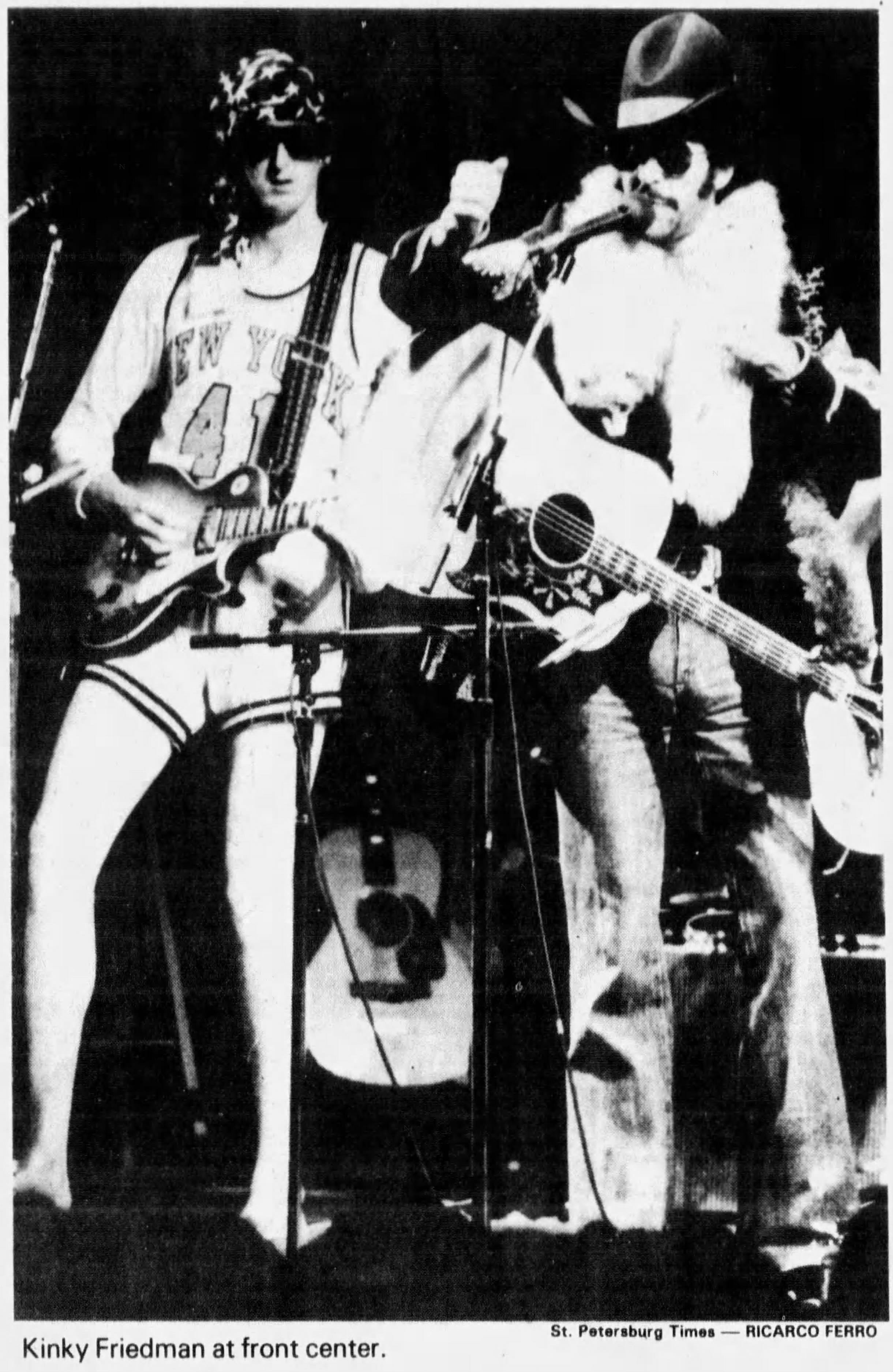
In a St. Petersburg Times article, reporter Peter Gallagher describes a funny moment at this show, after Dylan and Baez sang “Blowin’ in the Wind” together:
The crowd roar was deafening, equal to the applause when Dylan first walks on stage. Dylan suddenly whirled, did a deep knee-bend, and pointed quickly out to the crowd—it was three hours into the concert and the first time he had acknowledged the crowd—a wierd [sic] movement, not a hand wave or a nod like other performers. It was as if he had burst from his shell at the feeling of it all and for a person who is uncomfortable on stage, it was the first natural reaction which came up.
Today’s show took place on April 18th. Just another day most years, but a special day in 1976. What day? It was Easter Sunday!
To celebrate, Dylan performed a ragged and raw “Just Like Tom Thumb’s Blues,” full of barrelhouse piano and scorching slide guitar (slide played by Dylan himself, just as he would on “Shelter from the Storm”). It was the only time they played the song the whole tour. And if you think the timing was maybe just coincidental, at the end Bob repeated the opening line again, just to make sure the crowd hadn’t missed it: “When you’re lost in the rain in Juarez and it’s Easter time too.”
Throughout the fall tour, the all-hands-on-deck singalong that closed every show was “This Land Is Your Land.” That was jettisoned for 1976. Instead, they swapped it for “Gotta Travel On,” a Weavers and Paul Clayton song that Dylan had carried with him for years. He’d likely seen Buddy Holly perform it in 1959; on that tour that so impressed a teenage Dylan, Holly was opening his sets with it. Dylan himself first performed it the year after, on the 1960 home tape Karen Wallace recorded. A decade later, he recorded a version for Self-Portrait.
Six years further on from that, the song achieves its final form. Everyone who was onstage that night got a verse, with Joan Baez throwing to ‘em with what sounds like no warning. Kinky Friedman steals the show here. From the recordings I’ve listened to so far, it sounds like Friedman improvises a new verse every night. Tonight, following Joan Baez, Kinky sings:
Joanie sang it first (x4)
I tried to sing it better
I only sung it worse
Take this fucker home
And rehearse!
They wouldn’t rehearse though, not for quite a while. This motley crew’s rehearsals would be mostly onstage. Songs would come and go much more frequently than in the fall, for a wild and ramshackle spring run through half-empty football stadiums across the South. Rolling Thunder ’76 doesn’t have the same mystique as Rolling Thunder ’75. But I suspect it will be every bit as fun to follow along with.
1976-04-18, Civic Center, Lakeland, FL
PS. If you want even more on this historic first show, a few years ago, for its measly 45th anniversary, I went through it song-by-song.
PPS. You can find the entire Rolling Thunder 1976 series as it develops here. Next entry in two days.
Hello the first 1976 Rolling Thunder Revue was Houston in the Astrodome January 25th, 1976. I photographed the whole show photos will be used in an upcoming Bootleg series release. Several have been used in previous Dylan box sets. Several special guests like Stevie Wonder, Richie Havens, Rick Danko, Stephen Stills, Carlos Santana, etc. The usual suspects were there T-Bone who used one of my photos, Roger McGuinn, Kinky Friedman, Stoner, Neuwirth and more....
there was a hockey game or skating thing going on so the floor was covered by cardboard. in the middle of the floor there were some hippies who managed to bring in a small camper and were sitting in fold out chairs and demanding that all those in front of them sit down. the crowd didnt get much into it.