
It has been a dramatic few weeks for Bob Dylan and his band. To catch up anyone who needs it, here’s the timeline:
June 4: The summer tour begins in Troutdale, Oregon (here’s a review by Death Cab for Cutie’s Dave Depper). The band lineup at this point is the same he’s had for several years now, featuring Doug Lancio and Bob Britt on guitars. They play the first six shows together although, by the end, Bob Britt is not entering until a few songs into the set. Foreshadowing!
June 17: With no announcement or explanation, Doug Lancio is gone after five years. Appearing onstage in his place that night is Julian Lage, one of the most famous jazz guitarists working today. Fans wonder if Lancio will return, but he doesn’t. Lage remains for seven shows, playing guitar alongside Britt, but anyone looking at his website can see he has other commitments beginning June 29 (last night).
June 27: Bob Britt announces on Facebook that he has quit. He has been with Dylan for seven years. The next show on the calendar, two days later in Austin, Lage will not be able to play either. He’s got an event in New York. In the span of 10 days, Dylan has gone from two guitarists, both of whom have been with him for years, to zero.
Which brings us to last night. The Dylan-nerd corners of the internet were abuzz with curiosity. Not about the setlist, but about who would play guitar in Dylan’s band. Who could—or, given the murky circumstances surrounding two dramatic mid-tour departures, would—jump in on extremely short notice?
Luckily, we had a man on the ground to report in and tell us what went down. Danny Golden is an Austin-based musician who just released his new album The Big Blue last week. The album was inspired by a pilgrimage he took to Leonard Cohen’s house in Greece. He’s a Dylan and Cohen superfan, and posts hilarious Reels on Instagram about both artists. This one’s maybe my favorite (it happened to me recently listening to John Wesley Harding):
But today, Danny Golden wears another hat: our dedicated Austin-show correspondent. Take it away Danny! (Bonus: There’s already a beautiful-sounding tape too, link at the bottom.)
The addition of jazz virtuoso Julian Lage to Bob Dylan’s touring band came as a surprise not only to me and the rest of Dylan fandom, but also possibly to the current members of his band. I, for one, was beyond excited at the prospect that my favorite jazz guitarist, who until about a week ago had no connection to my greatest hero, Bob Dylan, might be appearing on stage with him in my city of Austin, Texas, on June 29th. The show I was already planning to see had suddenly become elevated to mythical proportions.
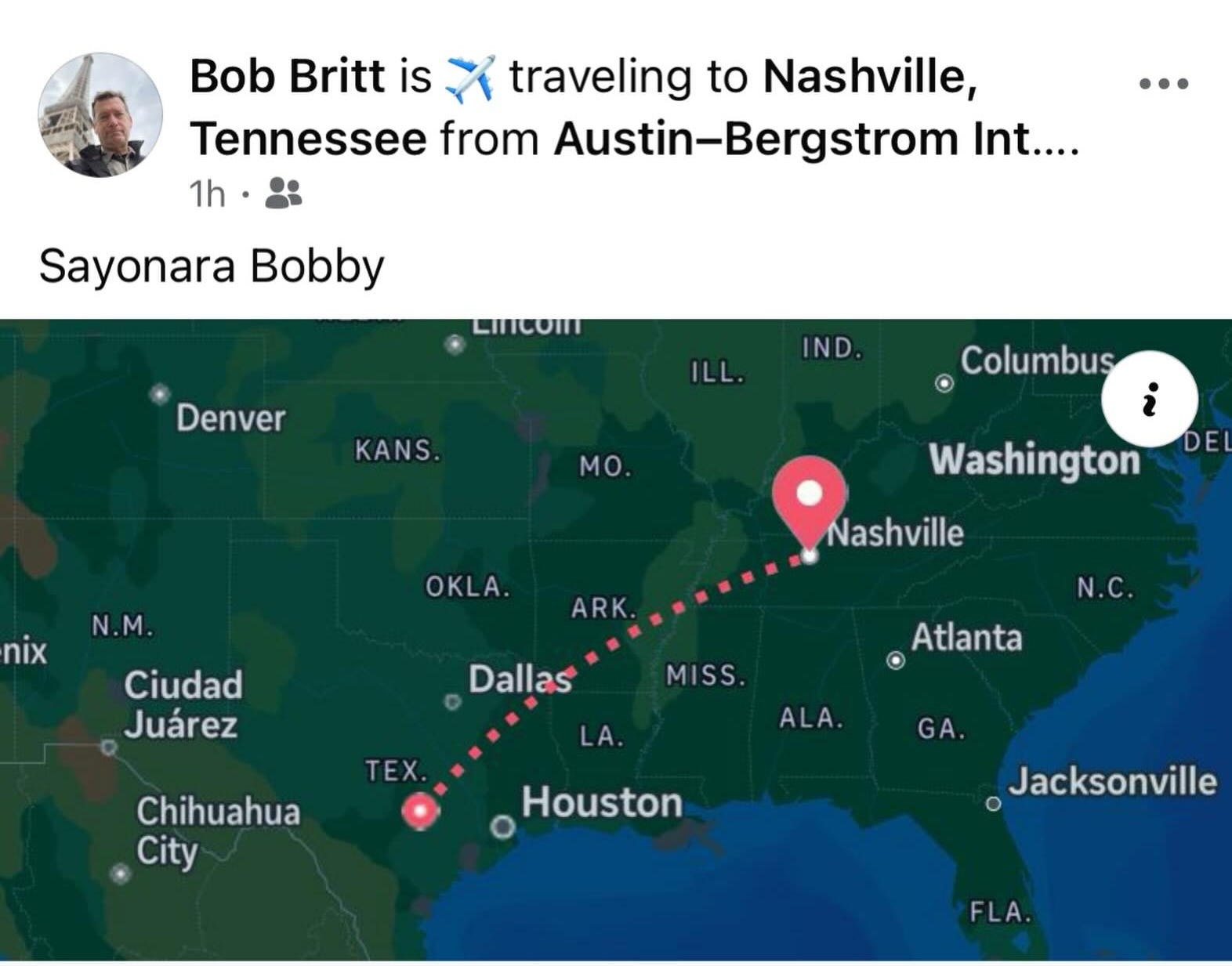
Well, it wouldn’t play out that way. Julian Lage had a prior engagement in New York City that night. Okay, so I’m going to see Bob with his usual band, that’s great too! Not so fast… Two days before the show, Dylan’s longtime guitarist Bob Britt posted a Facebook status update traveling from Austin back to Nashville with a simple two-word caption: “Sayonara Bobby.”
Suddenly, there was no guitar player in Bob Dylan’s band. Bob world was now atwitter with talk of who would play guitar for the Austin show. Maybe Austin’s own Charlie Sexton would make a return, or perhaps Jimmie Vaughan would fill in. The guitarist question was on everyone’s mind as the Monday night show approached.
I filed in toward the main entrance to the Moody Amphitheater through one of the longest lines I’ve ever stood in, catching several songs from the John Doe Folk Trio as I shuffled along the queue, including a surprising and heartwarming rendition of “Somewhere Over the Rainbow.” By the time I made it into the venue, Lucinda Williams was on stage with her band of badass players, dropping into the opening riff of “Car Wheels on a Gravel Road”.
The chaos of the discursive queue was contrasted by an air of civility once inside the venue. The crowd was respectful, organized, and well-behaved. There was very little security presence. We were essentially policing ourselves, which gave me a feeling of hope in a society that seems to be falling more and more into disrepair by the day. It felt less like a rock show atmosphere and more like Shakespeare in the park.
Lucinda’s set included many highlights. “Drunken Angel,” a nod to Austin’s Blaze Foley, was an early crowd favorite. “Low Life,” a brand new tune, won the crowd over quickly with images of hurricanes (the drink, Lucinda clarified before the song) in a dark New Orleans bar. “Joy” erupted into an Allman Brothers-esque two-guitar solo with a Led Zeppelin tease worked into it. Between songs, Lucinda graciously thanked her crew as well as Bob Dylan for having her, while also noting the similarity between the title of her newest album, World’s Gone Wrong, and Dylan’s 1993 album World Gone Wrong. “Any time I try to write anything, he’s already been there, he’s already grabbed it, dammit!”
She addressed the current president and the state of the world a few times and finished out her set with a sing-along cover of Neil Young’s “Rockin’ in the Free World,” inspiring an otherwise sedate audience to pump their fists and sing despite the 95-degree heat. Lucinda’s closing remarks to the audience were: “Thank you for singing with me. We have to stick together. Music is our best weapon against all this evil and madness.”
During the changeover between sets, I thought about how I was about to occupy the same physical space as the artist Leonard Cohen had once called “God’s puppet.” I thought about Bob Dylan, the man, and Bob Dylan, The Myth. I don’t think it’s possible to dive down the rabbit hole of becoming a fan without buying into the hero worship at some point: the poetic giant, the elusive artist, the pioneering musician, the Homer of our time. There is no denying that Dylan is a once-in-a-many-generation genius.
But at the same time, he is a real person, and a flawed one at that. A person who is probably hard to work for, and who is probably not easy to socialize with. I’ve never heard a normal-sounding story about the guy. The same genius that has attracted some of the greatest talent in the world also likely played a role in Bob Britt leaving his band, and now the genius needed a new guitar player.
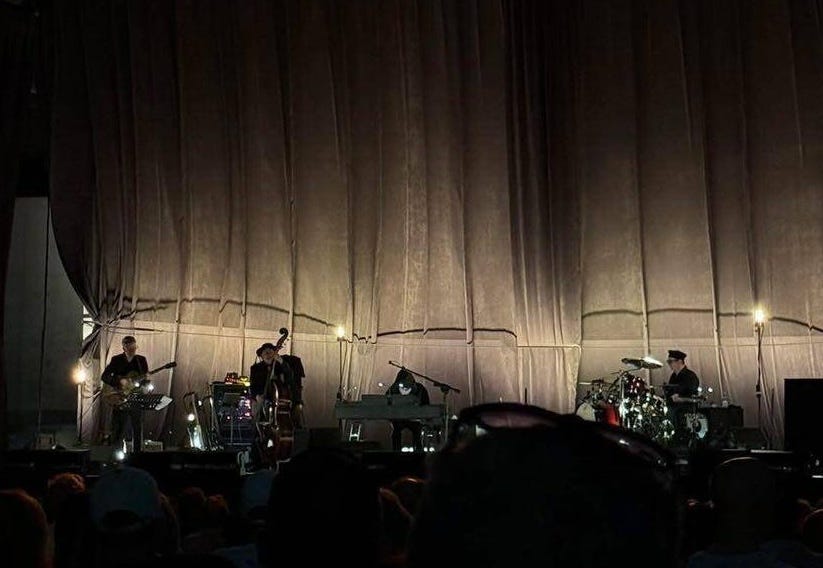
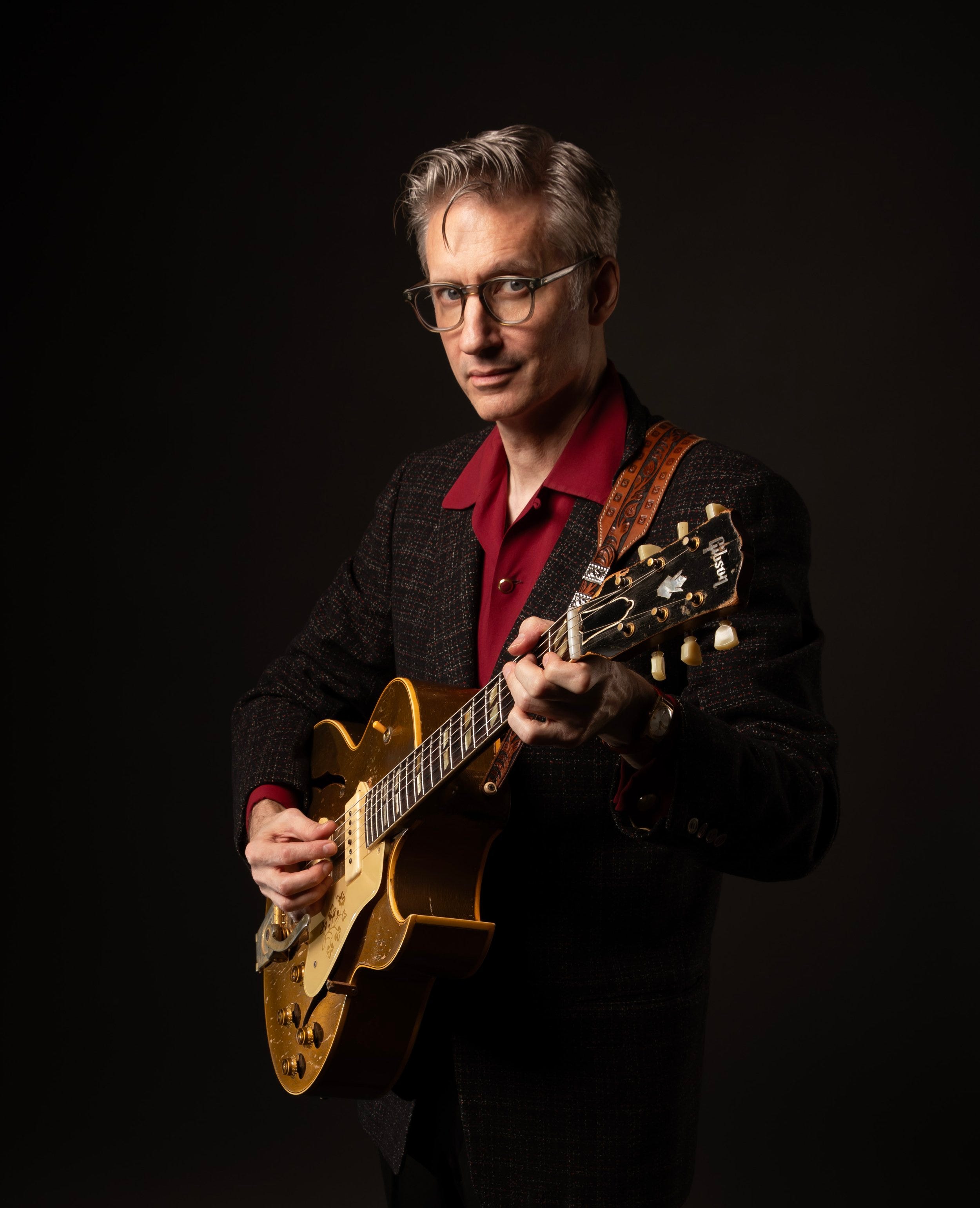
The lights went down and four figures dressed in black marched onto the stage. Tonight’s mystery guitarist was tall and slender like Charlie Sexton, but that was not Charlie. It was Chicago-based jazz guitarist Joel Paterson!
The band opened with “Watching the River Flow,” which would be the most recognizable tune of the night, relative to its original version. Bob’s endless rearrangement of songs, maligned by many, I believe serves to expand the meaning of the songs. It pulls the audience further into the world of the song and shows us things in a different light. It lets us into his creative process. Anyone can go take a look at Guernica, but not many get to say they watched Picasso paint.
The jumbo screens to either side of the stage, which had projected giant simulcast images of Lucinda Williams and John Doe during their respective sets, were noticeably turned off for Dylan’s. The audience was left with just the music, four small dark figures on a black billowy-curtained stage, and our own imaginations.
“Man in the Long Black Coat” followed, drawing an obvious connection to Dylan’s black North Face, hood up always, which has become a new signature on-stage look. This song makes me think about how its album Oh Mercy is the only album he talks about in any depth in his Chronicles: Volume One autobiography. Always leave them wanting more, Bob.
Next up was a Motown-feeling groove that, after a few lines of lyrics, became discernible as Dylan’s timeless early anthem “It Ain’t Me Babe.” This rendition came to life and gave us Joel Paterson’s first guitar solo of the night. He found some really nice lines with a flurry of hammer-ons and pull-offs that juxtaposed a Blonde on Blonde-era feel atop the, let’s say, non-blonde on non-blonde arrangement.
Dylan then dipped into Time Out of Mind material for a well-received “Trying to Get to Heaven” before wrestling with his own myth in “False Prophet,” which included some devilish-sounding key modulations for Paterson to solo over.
Bob couldn’t resist a Bo Diddley moment and followed that up with his spin on Diddley’s “I Can Tell.” “Black Rider” came next as a breeze picked up and the night finally began to cool down, at least a little bit. Then it was back to cover territory with “Share Your Love With Me,” a song that has been done beautifully by Aretha Franklin, Bobby “Blue” Bland, and The Band. Unlike these graceful versions, Bob’s rendition tonight felt more evocative of wistfulness and regret from the singer. It’s moments like these that I am reminded of Bob Dylan, the man, and the cost that his myth has had over his ability to live any normal kind of life.
The most unrecognizable song of the night award goes to “When I Paint My Masterpiece,” which was delivered in a minor key with a Latin twist. A few lyrics were changed from the recording that I recall (including no mention of a popular American soda beverage). The minor key adaptation placed the song in a macabre world. Whereas the original version feels fun and hopeful, the subtext of this version seemed to be that this titular masterpiece ain’t ever getting painted, or maybe it was painted and she broke her promise about being there with him when it happened. I started to imagine Bob holed up in the Venetian mansion where he appeared in a 2004 Victoria’s Secret ad, scowling at a lingerie-clad Adriana Lima. There is something so misanthropic about octogenarian Bob Dylan, and during this rendition of the song I felt it.
Then it was back for another hit of remorse with a cover of Jerry Lee Lewis’s “I’ll Make It All Up to You,” before a particularly engaging “Crossing the Rubicon” that incorporated full-band swells and brought us even further into the palm of Bob’s hand. “Soon After Midnight” from Tempest came next, timing the rise of tonight’s full moon perfectly opposite the stage with Bob’s delivery of the lyric, “It’s soon after midnight, and the moon is in my eye.”
“Under the Red Sky” gave us the first harmonica solo of the night, which was everything you could want in a Bob Dylan harmonica solo: shrill, beautiful, impatient, and clumsily cuing the band that it was time to end the song.
In this fan’s opinion, there is a major difference between a sitting Dylan concert and a standing one. The standing show involves a more active listening experience and seems to produce the most engaged crowds. The sitting show becomes passive, and especially on a hot Texas evening in June, can result in a noticeably enervated crowd, particularly after two opening bands and a run of a few deep cuts. Hence, the minor exodus that began around this time of people ready to beat the traffic on the way home.
“I’ve Made Up My Mind to Give Myself to You” was next, a song I’ve always seen as a statement of Dylan’s commitment to his highest purpose: sharing his gift with the world. The song included some beautiful chord inversions in Paterson’s comping, adding a wonderful warmth to the already sweet song.
One final Rough and Rowdy Ways pit stop with “Goodbye Jimmy Reed” led us to the final song of the night, “Every Grain of Sand,” sending us off with some overt spiritual wisdom and a final harmonica solo.
Exiting the amphitheater under the full moon, dawdling among the genteel crowd, I began to reflect on the arc of the setlist. With Bob at 85, the shows have a tangible arc through artistic eras, stations of love and loss, optimism and despair, life and death. Bob, the man, has moved in and out of these things like any human does, searching for what is real and meaningful. Bob, The Myth, has, like Odysseus, retained the gifts of each of these adventures and continues to share them with us in the way he feels called to transmit. He is a man who has moved in and out of styles, philosophies, and religions searching for something that we are all looking for, and he has found more than most, and his genius (God only knows where it came from) has allowed him to communicate it to us for over half a century. He’s been expanding minds and alienating friends and audiences since the mid-1960s with the double-edged sword of his artistic vision.
Bob Dylan, The Myth, has never stopped affecting the world with his work and by being unapologetically himself. Bob Dylan, the man, has won and lost again and again and ruffled a lot of feathers in that pursuit. You don’t get one without the other.
Sayonara, Bobby.
2026-06-29, Moody Amphitheater, Austin, TX
Thanks Danny! Stream his new album The Big Blue below or wherever you listen to music, and pick up a signed vinyl copy here.
A lot of nice lines in this review:
" - Anyone can go take a look at Guernica, but not many get to say they watched Picasso paint. "
Well, I'm going to be cogitating on that Picasso line for days to come. Nice. The version of that my buddy came up with when we saw Dylan 2 nights in a row at a small venue back in 2004 was that seeing Dylan is like seeing Old Glory out of the museum case, unfurled, flapping in the wind. I still love that metaphor. Now I'm adding in this one.
" - I’ve never heard a normal-sounding story about the guy. "
" - It’s moments like these that I am reminded of Bob Dylan, the man, and the cost that his myth has had over his ability to live any normal kind of life. "
Those two lines in the review remind me of one of my favorite quotes about Dylan by other musicians. Jerry Garcia said something to the effect of, "Imagine what kinds of voices Dylan must have in his head all the time, to be able to write songs like that."
So yes, he's not dwelling in a "normal" state of mind.
Beautiful, immersive review of what sounds like a perfectly chill summer show. Can't wait to see what band he brings to Philly in a couple weeks!