
Flagging Down the Double E’s is an email newsletter exploring Bob Dylan performances throughout history. Some installments are free, some are for paid subscribers only. Sign up here:
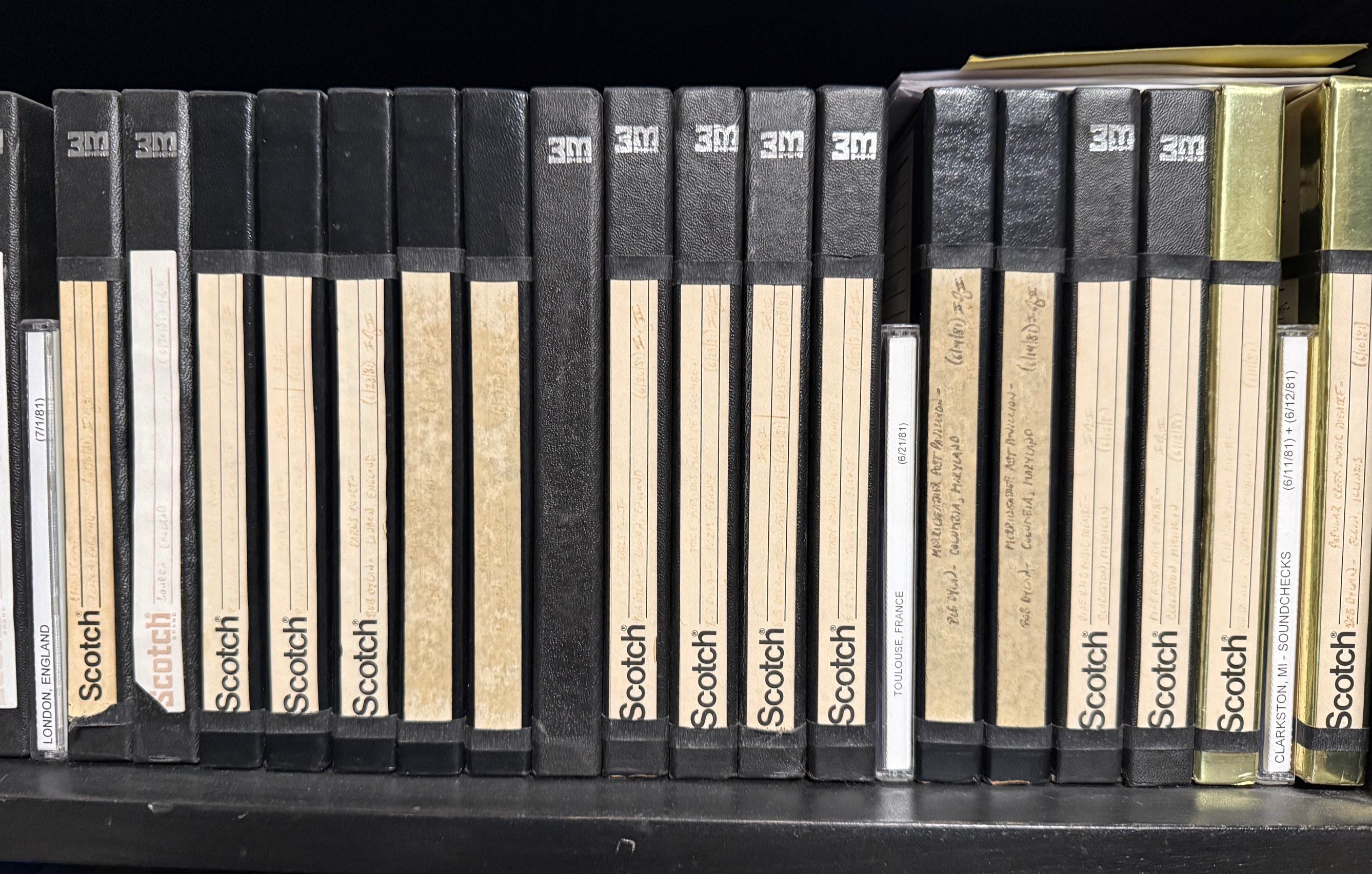
Jeff Friedman is a longtime Bob Dylan taper and archivist. If you peruse the Bootleg Series liner notes, or the fine print at the Bob Dylan Center in Tulsa, his name pops up again and again. He’s quietly played a key role in many of the audio tapes we listen to, whether tracking them down in someone’s dusty basement or taping them himself (you can thank him for Toad’s Place, for one). Several of the tapes on the latest Bootleg Series we wouldn’t have without Friedman, like the never-before-heard “Lonesome Death of Hattie Carroll” performed at a Los Angeles apartment in 1963.
We spoke a few months ago on the eve of Through the Open Window’s release. Friedman tells me his story, how his life as a clandestine taper led to a more official role helping preserve many of the Dylan office’s tapes, and all about the world of early Dylan collectors.
Housekeeping note! I’m doing a year-end reader survey. What would you like to see in the newsletter next year? Who should I try to interview? That sort of thing. Take it here:
To me, there are two prongs to discuss, one your work as a taper and the other your collecting.
Yeah, and of course each one has its own stems. Also, not that I can talk a lot about it, but the stuff that I have been doing for over 10 years now, quote-unquote officially. To me, the lifelong goal has been reached. But we can get there.
Which came first, taping or collecting?
Definitely the collecting. So 1972-ish, I’m obsessed, right? We all come to that point eventually. I’m young, obviously. And I make the discovery—it must have been through a bootleg record—that there’s this material that exists that isn’t available. It’s like this secret society. I was so intrigued by that.
Do you know what the bootleg might have been?
The first bootleg that I got was at a record shop called FreeBeing, which was on Second Avenue off of St. Mark’s Place. That was like the first used record shop that I ever encountered. I must have been 14 or 15 at the time.
It was a white cover, and handwritten on the white cover, it said “Motorcycle.” I was like, what the fuck is this? I think that one side was Basement Tapes and one side was one of the early Minnesota recordings, the one with “Stealin’” on it.
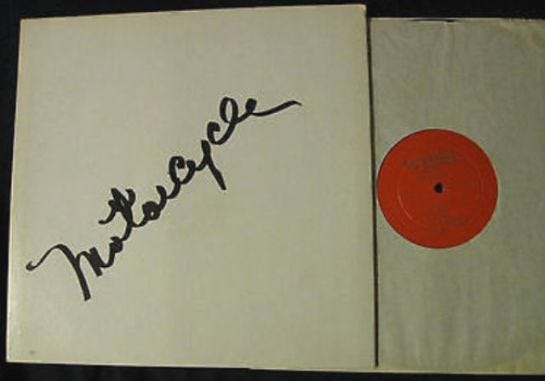
That sounds like Great White Wonder.
Yeah, but bootlegs were bootlegging bootlegs.
Somehow I got in touch with the great Sandy Gant, who never gets enough credit. He was self-publishing this listing of these unreleased Bob Dylan recordings. I wrote to Sandy, and he put me in touch with [AJ] Weberman, who at that time was selling Shamrock brand open-reel tapes. For a dollar each, he put some of these recordings on there. I was like, “Holy shit.”
Buying bootleg tapes from AJ Weberman. Wild.
Absolutely. Sandy was the one who discovered all these early unknown recordings and collected them, so to speak. How he was connected with Weberman—he knew he was a nut, let me put it that way.
The first time I saw Bob, I was blessed to be at The Band Rock of Ages New Year’s Eve show with a bunch of my friends, and Bob showed up.
I love that album.
For years it was my most sought-after recording for obvious reasons, because it was the first time I saw him.
So fast forward. I’m collecting these tapes. I’m making check marks on Sandy’s dot-matrix printable thing. Then the ’74 tour happens. Here was an epiphany that for the first time, instead of seeking out these recordings, I could actually create my own. It was an amazing discovery.
So that’s what I did with the five New York shows—except I only saw four of them because my parents wouldn’t let me go to the fifth one. They didn’t understand why I had to go to all of them.
So you’re still in high school at this point?
Yeah. I put together a portable cassette recorder and I go and I tape the shows. Two at Nassau and two in the city. The only one that I missed in the city was the evening show January 31st.
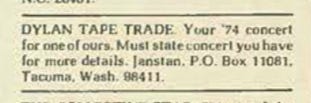
There was this ad in Rolling Stone magazine calling for everybody who was going to record the Dylan-Band tour to come together. “We’ll share everybody’s tapes so that everybody gets every show.” These guys put it together and put people in touch with people.
So now I was a serious collector. I was into open reel tapes, because of the higher quality, as opposed to cassettes. I made it a point early on that if I came up with somebody who recorded a show, I wanted to get as close to the master as possible. Especially in those days of cassettes and bad dubs and all this.
How did your own ’74 tapes turn out?
Oh, they were horrible. Thank God they have since been replaced by much better quality.
What does taping in 1974 look like? What gear are you bringing? Are you having to sneak it in? Does no one care?
Yeah, you snuck it in, but they weren’t really looking for stuff at that point. It was a portable white cassette recorder with a top-load mechanism. So you push a button, the cover would flip up, you put the cassette in. It was a handheld microphone, mono.
That was like a life-changing thing. Not only was I making my own recordings, even though they were crap, but I was in touch with other people who were doing the same. I quickly got the whole tour.
Then ’75 comes. Rolling Thunder. Sandy gave me good equipment to use. So I saw four Rolling Thunder shows. I saw the two in New Haven, I saw Night of the Hurricane at the Garden, I saw North Dartmouth, Massachusetts. And I did not tape that show.
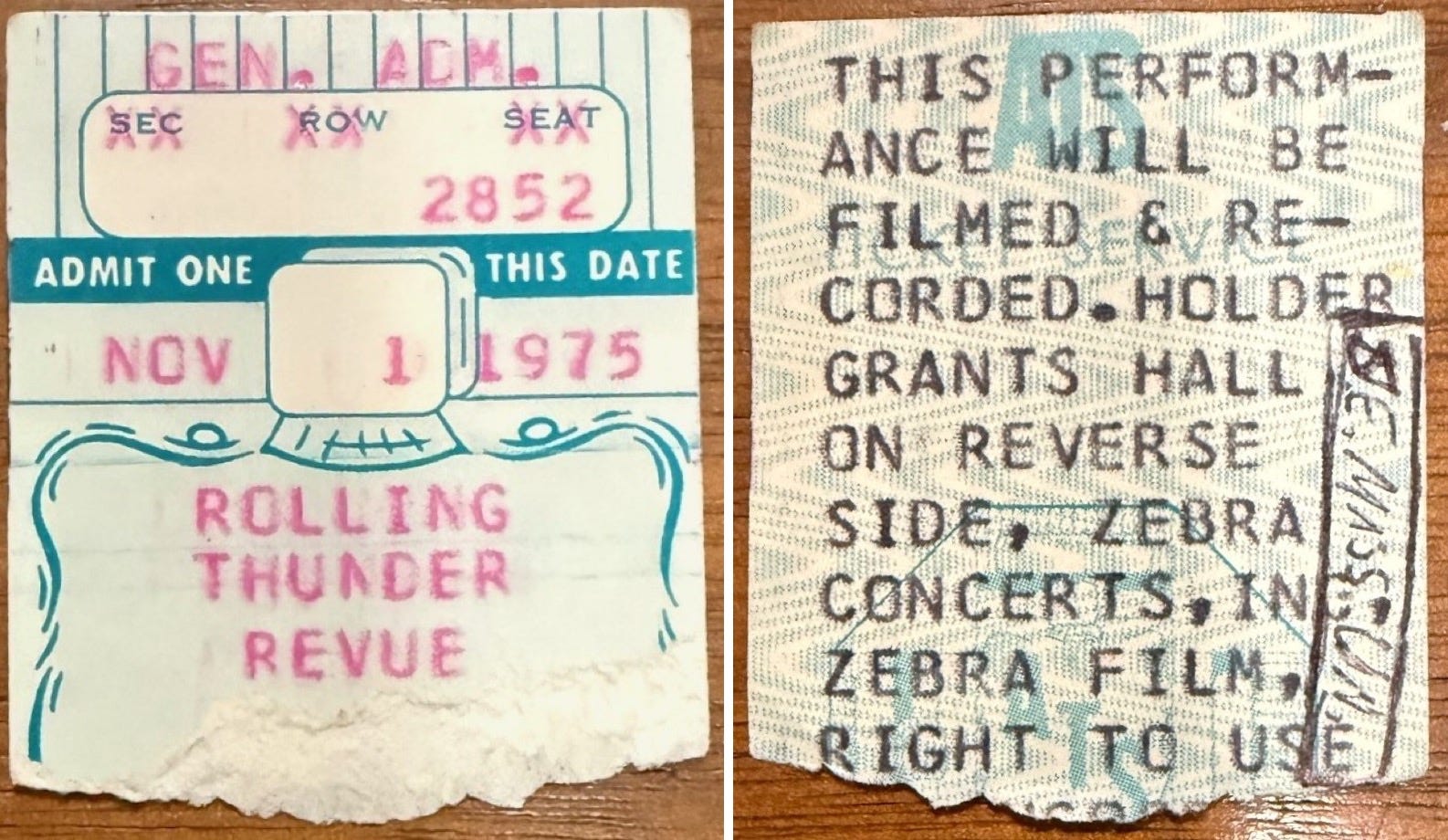
Isn’t that one that no one taped?
No one taped it and it remains lost. It was the third show, and I was there, sitting in the sixth row. I don’t know why I didn’t tape it, but it serves me right.
Learned a lesson.
I learned a fucking lesson, man.
I must have been a freshman in college at this point. My friend Bruce was booking concerts at Brooklyn College, and he knew I was a Dylan nut. He said to me, “I just got the weirdest phone call that I might get offered this Bob Dylan-Roger McGuinn show.” I’m like, “What?“ Nothing made sense, right? He said to me, “And this friend of mine got offered this show, he works at Dartmouth.”
I was in the student union building where his office was. I went around the corner to a phone booth. I plug in the coins, I get the student from Dartmouth who books shows. I said, “Do you have a Bob Dylan-Roger McGuinn show coming up?” He’s like, “Are you fucking crazy? No.”
So I go back to Bruce. “The guy didn’t know what you were talking about.” He goes, “No, no, no. It’s North Dartmouth, Massachusetts.” So I go back. I don’t remember how I found the phone number. because it’s like this small college, right? I get the guy on the phone.
I go, “Do you have a Bob Dylan-Roger McGuinn concert?” He goes, “No, we don’t. But we have a Bob Dylan-Joan Baez concert.” That’s exactly what he said to me. And it was that Saturday.
They always announced them on short notice.
Every night was a rumor: Was this really happening? So I borrowed my mother’s car and I went up there with my friend. We got up there at like one, two in the afternoon. There was already a little line of people and students, and it was sold out. I’m like, let’s see what happens.
So we’re maybe the 40th or 50th people on line, getting friendly, and they’re listening to the college radio station. They announce, “We have extra tickets for the Bob Dylan-Joan Baez concert.” So we walked around the corner to the box office, paid $7.50 a ticket, got back in line with our new friends, and that’s how we sat in the sixth row.
So of all these tapes you’re making, how many of them are still the tapes we listen to today?
My New Haven shows were pretty good, but I think somebody bettered those. My Night of the Hurricane was really good, but we got a soundboard from that.
I’m just going to do this chronologically. ’76 was not me. ’78, absolutely. I saw the first few [U.S.] shows. I did my road trip; I was young and wild. Augusta, Portland, New Haven, Boston, Syracuse, Rochester, Binghamton. Uniondale, New York. To my knowledge, those are all my tapes.
Sandy gave me for that tour a really beautiful Sony portable cassette [recorder] with a handheld mono microphone. So those early tapes in ’78 are mono, but they sound great.
When you say handheld, are you literally having to hold this thing in the air the whole show?
I literally had to hold it.
’78 is monumental because that’s really when for me the community of other tapers comes together. You’ve got all these guys in Europe that we’re starting to get friendly with. My good friend John Bauldie, God bless his soul, he wasn’t a taper, but he put us in touch. They already had their own society there. It was like a mirror world, because you had all these nuts like us here in the U.S. and Canada.
The European guys and the UK guys were phenomenal. They did beautiful tapes. I mean, their quality was so far past ours, because they were using these microphones that I actually still use today, which are the Sennheiser binaural microphones. I put them on top of my glasses and I’m hands-free.
’78 was a good tour. Also, I recorded some of those soundchecks.
How did you get the soundchecks?
Standing outside of the building. You could hear it through the crack in the door. If you listen to those soundchecks you can hear the cars going by.
“Hazel” in a 1978 soundcheck in New Haven, CT. The song wasn’t ever played on the actual tour.
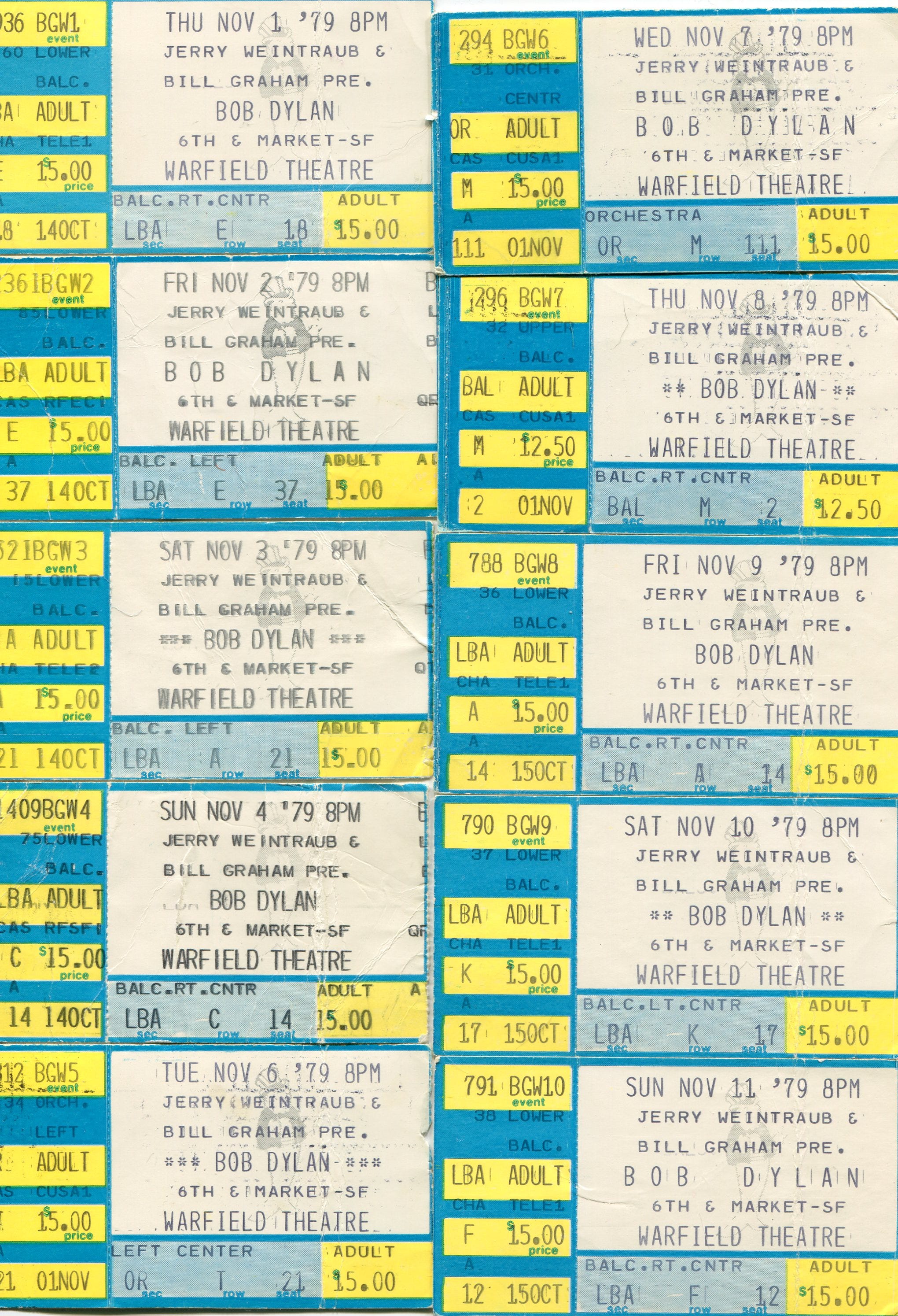
So that was ’78. Now we get to ’79. You asked about tapes that are still out there that are mine. So I go to San Francisco. I stayed with a friend in Oakland, and I taped November 1st through the 10th. All those tapes were mine. At this point, I’m using a handheld stereo mic with a smaller portable [recorder]. That was my own machine for the first time.
At this point I’m friends with [Bill] Pagel. I met this other guy, Dan, who was a friend of Bill’s, and he was a taper. Him and Bill did all the Tempe, San Diego, Albuquerque and Tucson shows in ’79. Some other guy in California came up with the Santa Monica shows. You know, we were like covering it like crazy.
Are you coordinating with all these people in advance of a tour, to make sure someone’s going to be at every show?
We’re talking about it. It’s not as fine-tuned as one would hope.
I’m just looking through the tours here. ’81 was Europe only, I believe, so all the European guys covered at, especially Christian and this crazy guy, Jacques Van Son.
We had nicknames for everybody. Jacques Von Son was an orthopedic surgeon, so he was known as Jacques the Doc. Pagel we always called The Bagel, but he doesn’t know that.
What was your nickname?
They called me The Tyrant.
Were you that tyrannical?
Yeah, I was fucking nuts.
In terms of the early collecting, there’s a lot of people that deserve credit. I always mention Sandy because he was my mentor, but there were a lot of people in Europe that turned up stuff. Ian Woodward was really important to connecting that stuff. John Bauldie, as I mentioned. And of course the actual tapers: Serge in France, Michael in Denmark, Christian in Germany, Jacques in The Netherlands. In New York, there was a guy named John Overall. Marty Katz. Mitch [Blank], obviously. I was very close with the great Simon Montgomery who I also met originally through Sandy.
In terms of the collections, it’s really a team effort. A lot of people want to stay under the radar. I’m not going to mention any real names because I know them, and you probably do too, but regardless, these people deserve a lot of credit: Spot, soomlos, Hide (in Japan), Iron Chef, Mani, TK, Nightly Moth, Bach, RCM…
So how long do you keep taping for? Are you doing it for decades? Does it trail off at some point?
There’s pockets where I might not have been able to do a particular leg of a tour, and then there’s pockets where I go nuts, like in ’88, ’89, ’90, that era.
I’m still taping to this day, except that for just for personal reasons the last shows I taped were the Fort Lauderdale shows in ’23. He opened up a leg of a tour.
That’s the famous show where you hear some woman in the audience being like, “Play something we know!” and then he busts out that crazy “Masterpiece.”
I am not bullshitting when I tell you she was sitting three seats away from me. Same row, to my right. She was a fucking nut, right? She was yelling out, “Play us something we know.” And she was doing that from her seat, where there’s no way he could have heard her. There’s just no way.
Then at some point towards the end of the show, and it was after “Masterpiece,” she runs up to the stage and yells something. I can’t hear her because I’m sitting in my seat. Then she comes back to the row, she takes her boyfriend, and they leave.
That’s what happened. So there’s no way he heard her, and there’s no way that he reacted in any way with “Masterpiece.”
I mean they’d rehearsed that, clearly, but it was funny timing. She’s so audible on the tape. Is that your tape?
I don’t think that’s my tape, because I had an issue with one of the channels on that and so did not circulate it.
So even once you became sort of “official” in some capacity with the Dylan office, you kept your taping hat on?
Oh, absolutely.
Are you able to share anything about your method or is that on the dl? You put the mics on your glasses, you said.
The whole thing for me is just getting through security. It makes me a nervous wreck. Once I’m through the door, you would never know in a million years.
We’re sort of jumping around here, but how do you become a semi-official person in the Dylan office? I don’t know if you have a title at the archives.
Years of being an acquaintance, not bothering anyone as a lot of people tend to do, not being a threat in any way, assisting effortlessly when asked, either for information and/or memorabilia and ephemera and never hassling anyone.
Understand it’s two separate things. It’s the office, and then it’s the archives. What I do is I transfer analog source material into high res digital files and I annotate them. A lot of times they don’t know what they have. It’s two separate things, and not everything goes to Tulsa.
One day I’m up at the Dylan office with Mitch [Blank], and we’re just shooting the breeze admiring the Self-Portrait and Big Pink paintings. They’d had somebody transfer something on cassette, and are like, “This thing sounds horrible.” And I saw my opening, “You should give me a shot.”
So they gave me some tapes. I transferred them and I sent it back. They go, “This is amazing. How did you get it to sound so great?” I’m like, “This is what I’ve been doing since I’m in high school.”
So that’s how it started. It’s all about trust, honesty and discretion.
The other side is you as a collector. All we’ve talked about so far is tapes. Is that your main focus, or are you like more like Mitch, who collects a million different things?
I’m all about the music. That’s what counts.
I mean, I’m a vinyl collector. I got like a really insane Bob vinyl collection. 45 picture sleeves as well as twelve-inches. Not acetates and stuff like that. That’s way above my pay grade.
So you’re looking at pressings in different countries, a single that was released in Scotland.
I have the 45s because I just love that stuff. I always bought that stuff when they came out. It was cheap. So I have like this crazy collection of 45 picture sleeves.


And then my vinyl collection is fairly complete in terms of all the rarities. Like I have two copies of the Freewheelin’ with the timing strip, but not with the songs unfortunately. But I’ve got the first album promo copy with the “New Star on Columbia.” I’ve got some weird test pressings.
The things that I don’t have are the Freewheelin’ with the songs, and I don’t have an original test pressing of Blood on the Tracks. I basically have everything else.
In terms of stuff that isn’t released or circulating that you have, are you getting at from some other collector who has some rare studio thing? Are you doing the Mitch thing of finding people who have stuff they don’t even know they have?
Mitch and I are like partners in that respect. We work together. We’re working on a project now that we’re going to be traveling to get to. I can’t mention what it is, but hopefully we’ll be successful and everybody will benefit.
Myself personally, what I’ve done is the recordings. It’s studio stuff, it’s rehearsals, it’s live shows, it’s soundchecks, it’s interviews, it’s everything.
Do you have any good stories of tracking some of this stuff down?
So I have a listing of the upcoming Bootleg Series [Through the Open Window], and I provided a lot of those recordings. I went through it today. I was curious to see how many of those recordings we—and when I say we, I mean, all the collectors—are responsible for unearthing. Because I’ve always had this feeling that we in the trenches never really have gotten enough credit from the official world. There’s so much shit that nobody would even know about if we didn’t do all this work years and years and years ago. And now it’s in this clean, pristine building in Tulsa, Oklahoma. If we didn’t do the work, the audio archives would have half, if not less, in them.
So I went through this list, and I got to tell you, it’s about 50%-60% of the stuff on there we’re somehow responsible for. Not just me, not just Mitch, but many people from all over the world who unearthed recordings and shared them.
You mean people who are not Bob Dylan himself keeping track of this stuff, or his office.
The collectors. Even something like the Town Hall concert. Obviously, you could say, well, that’s officially recorded by Columbia. Or the Carnegie Hall show, whatever it was. But the thing is, we had those tapes 30 years ago.
Do you remember how you got them?
Each tape has its own story.
I think this is a good example. There’s a single tune that they’re putting out, a version of “Hattie Carroll.” Here’s how that came about, that I got the tape and I gave it to the office years and years ago, and they’re using it for this set.
I’m reading The Blues Who’s Who by Sheldon Harris. It’s an incredible book. And there’s this reference to Barbara Dane in the book. She mentions something about that folk songs TV show that she was on [Folk Songs and More Folk Songs]. That’s what I was after, because there was no video or anything of that at that time. So I find Barbara Dane, and she couldn’t have been nicer. She was like, “Well, I don’t have a video of that, but I do have this other tape.”
She had this recording. It was done in some friend of hers’ house in ’63. She sent me a CD of it, as she promised. I gave it to the office. Everybody was happy. I wound up giving her a copy of the Folk Songs TV show when it surfaced.
So that’s a great example of following the breadcrumbs.
I would imagine that you are credited in the fine print of a lot of these Bootleg Series.
I’ve been credited since the Witmark demos box.
What was your involvement with the Witmark demos?
I had some better-quality recordings of what they had.
How do you have better ones than the Dylan office?
I got all those Witmark demos through Sandy. Sandy taught me, you gotta go for the best quality. This guy’s got a copy? “Where’d you get that from?” Go to the next person. “Where’d you get that from?” And search back. In those pre-digital days, it made a huge difference.
As in, every time somebody copied the tape--
It got worse.
From all your taping days, any times you got busted?
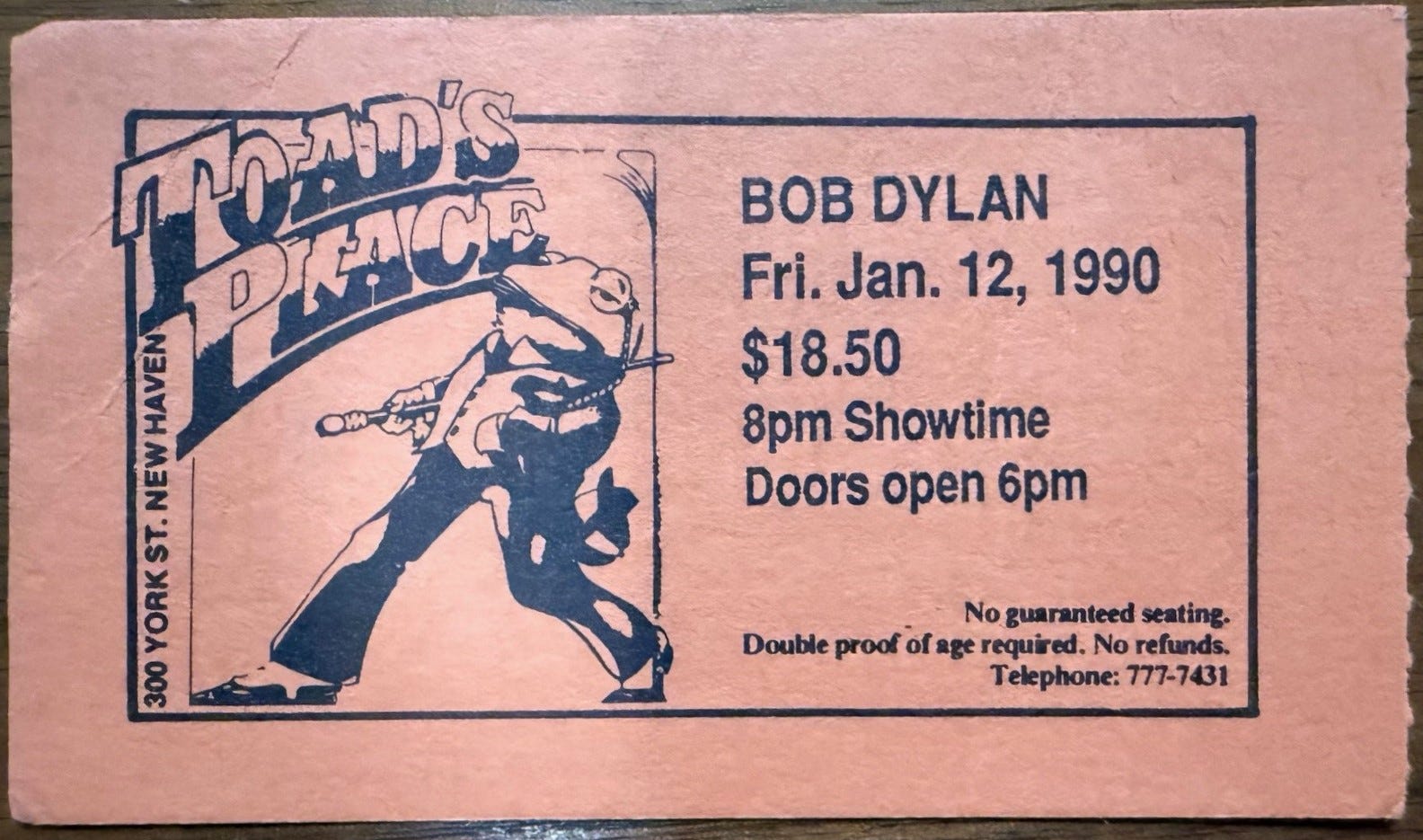
Oh, yeah. Let’s talk about another famous tape that everybody listens to. Let’s talk about Toad’s Place.
The show.
I got busted going into Toad’s Place. In those days, I had a small recorder. It was in the small of my back, and a [security] guy just happened to run his hand down my back. He said, “What’s this?” He pulled my shirt up, saw all the wires, like, “What the-?”
You know, I got an honest face. I’m like, “Jesus, who the hell put that on my back?” No.
Nice try.
What wound up happening—and I had to use this two other times I got busted, and it worked every time—was I talked them into taking my batteries. But I always carry extra batteries.
So they didn’t find the spares?
Correct.
So Toad’s Place is you, that tape?
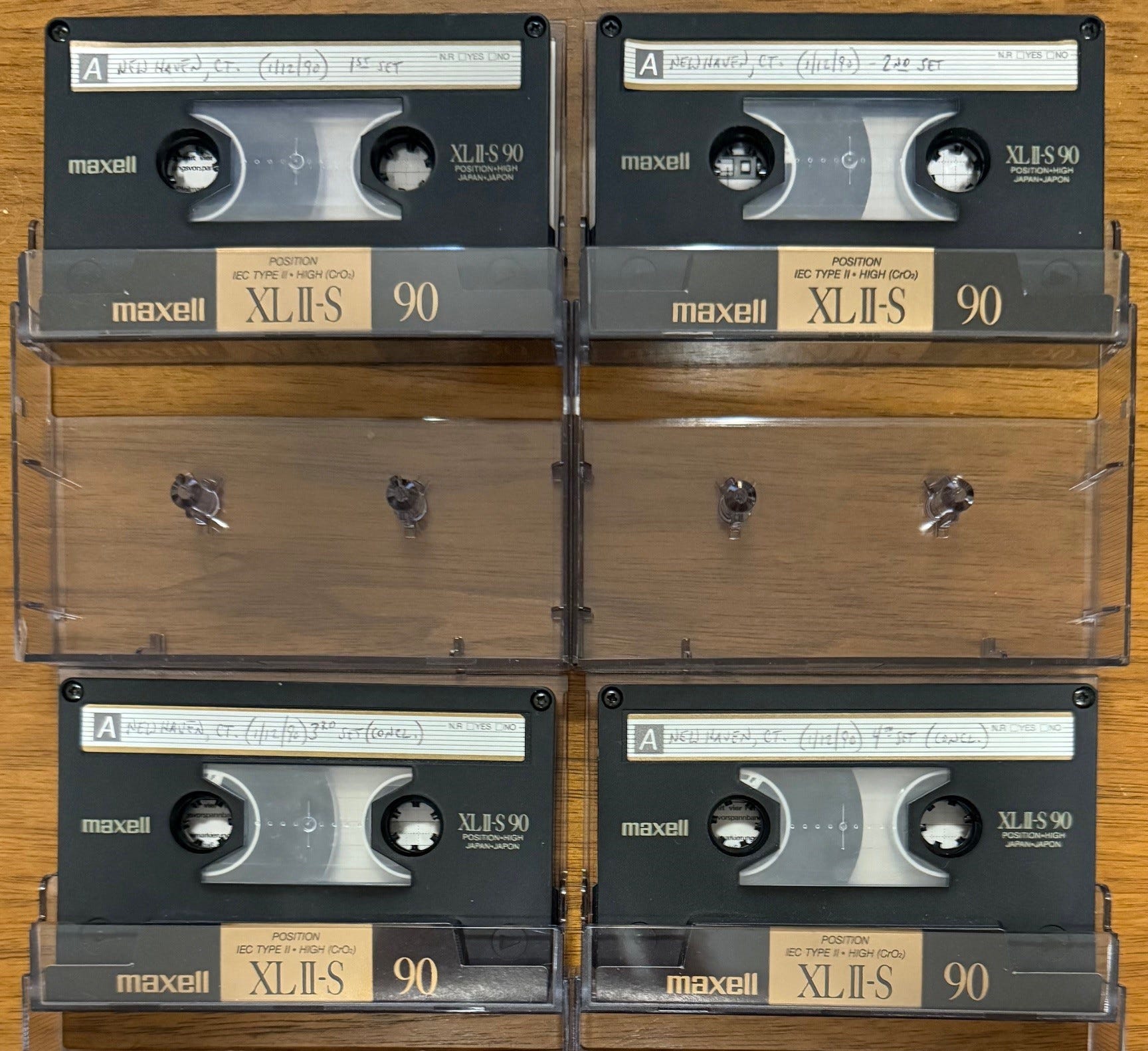
Yeah. I don’t know how many there are, I’ve heard maybe one or two, but I did the complete show. All four sets. And I’m not bragging, I don’t like to pump my chest, but I know that my recordings are by far the best. I was really on top of my game in those days.
This isn’t taping-specific, but Toad’s Place is a legendary show. What do you expect going in? What was it like when he just kept going?
So here’s a story. I went with a good friend of mine who lived in Connecticut. He was taping also. We get in there, and the first set comes. It’s amazing, it’s so intimate, they sound phenomenal. This is after I got busted, but everything’s working good.
They go, “Ladies and gentlemen, after a short intermission, we’ll be back for a second set.” And everybody’s like, Yeah!” You know, because [the first set] was like an hour long or something. 40, 50 minutes. So I got my other cassette tape, I pop that in, I get ready.
I don’t know what possessed me, but I brought extra cassettes. I never, ever do that. I brought four cassettes with me. I don’t know why, but I did it.
After the second set, they made the same announcement, “Ladies and gentlemen, after a brief intermission, we’ll be back with the next set.” Now people are flipping out, right? It’s unheard of.
I turned to the person I was with. He goes, “I’m out of tape.” I go, “I got extra. But if my batteries run out, I need your batteries.” He goes, “Of course.” He’s done, right? He’s got his two tapes.
After the third set, I turned to him, and I said, “I still got one tape left, but I don’t know where this is going. If I need a tape, you better give me your fucking tape.” And he’s like, “No.” I’m like, “What?“ He goes, “I recorded it. I want my recordings.” I go, “Yeah, but just in case–” “No.”
As it turns out, we didn’t need it, but I was in shock. I would have taken one for the team, you know? Especially knowing that there was [other] recordings already.
So that’s why you got the full show and other people didn’t, is people just ran out of either tape or batteries after the first couple sets?
I guess so. I still have my cassette masters. I should do a high-res of that one day.
Do you have other wild taping stories?
There’s the story of the Trocadero club in Philadelphia, where I got busted. The guy walked me out of the building, and on the way, he showed me to every security guy. He said, “Whatever you do, don’t let this guy back in.”
So Mitch and I went around the corner to like a K-Mart. It was raining, and I bought a Philadelphia Flyers poncho. Took my glasses off, so I couldn’t see anything, put the poncho over my head and went back into the show.
Are you still as active?
I’m not even close to as active as I used to be. There’s just no way. But there are a lot of people who are very, very active and they deserve a lot of credit, especially the European guys. There’s never a concern that we’re going to miss a European show, but there’s always a concern we’re going to miss a U.S. show.
I mean, the Outlaw show is tough because a lot of people, myself included, didn’t really want to sit through a whole bunch of bands that you don’t want to see for a truncated Bob concert—but not as short as I think we originally thought it would be.
What I don’t like from a quality point of view is that everybody’s doing shit on their phones or they’re using a recorder with internal microphones, which are not nearly as good as the stuff that I and some other tapers will use. The quality is important, but now you’re getting these iWatch recordings, and they’re like, aw geez.
Back to the collecting side, do you have things you’re looking for that are like holy grails?
I’ve always had the holy grail list. For many, many years, it was that Academy of Music Rock of Ages show. I’m so happy that that came out, and it’s better than I remembered.
It’s funny, because I didn’t remember whether he did “Don’t Ya Tell Henry” or “Please, Mrs. Henry.” Because my memory—I was like 15 years old, totally stoned. I remembered “Rolling Stone” and I remembered “Down in the Flood,” but I didn’t remember the Henry song. I didn’t know it that well at that time. I didn’t know what the song was until it came out. He doesn’t really do anything on that song, but still.
I think it’s the only time he’s ever performed it in any capacity.
That third Rolling Thunder show is definitely my number one holy grail, because I was there, and it’s missing, and I was an idiot for not taping.
A lot of the missing holy grails are special appearances, like the Joni Mitchell [sit-in in Austin] where he does the two songs, one of hers and “Girl from the North Country.” Another one is that Edwardsville, Illinois concert with The Band. There’s like one blurry photo that exists, and that’s it.
The other holy grail is Bob shows up at the Bitter End for a John Prine show in like ’72 and plays a few songs with him. That’s a missing one. I saw Prine really early. Before I started taping shows, I was photographing them, and I have these great John Prine black and white contact sheets.
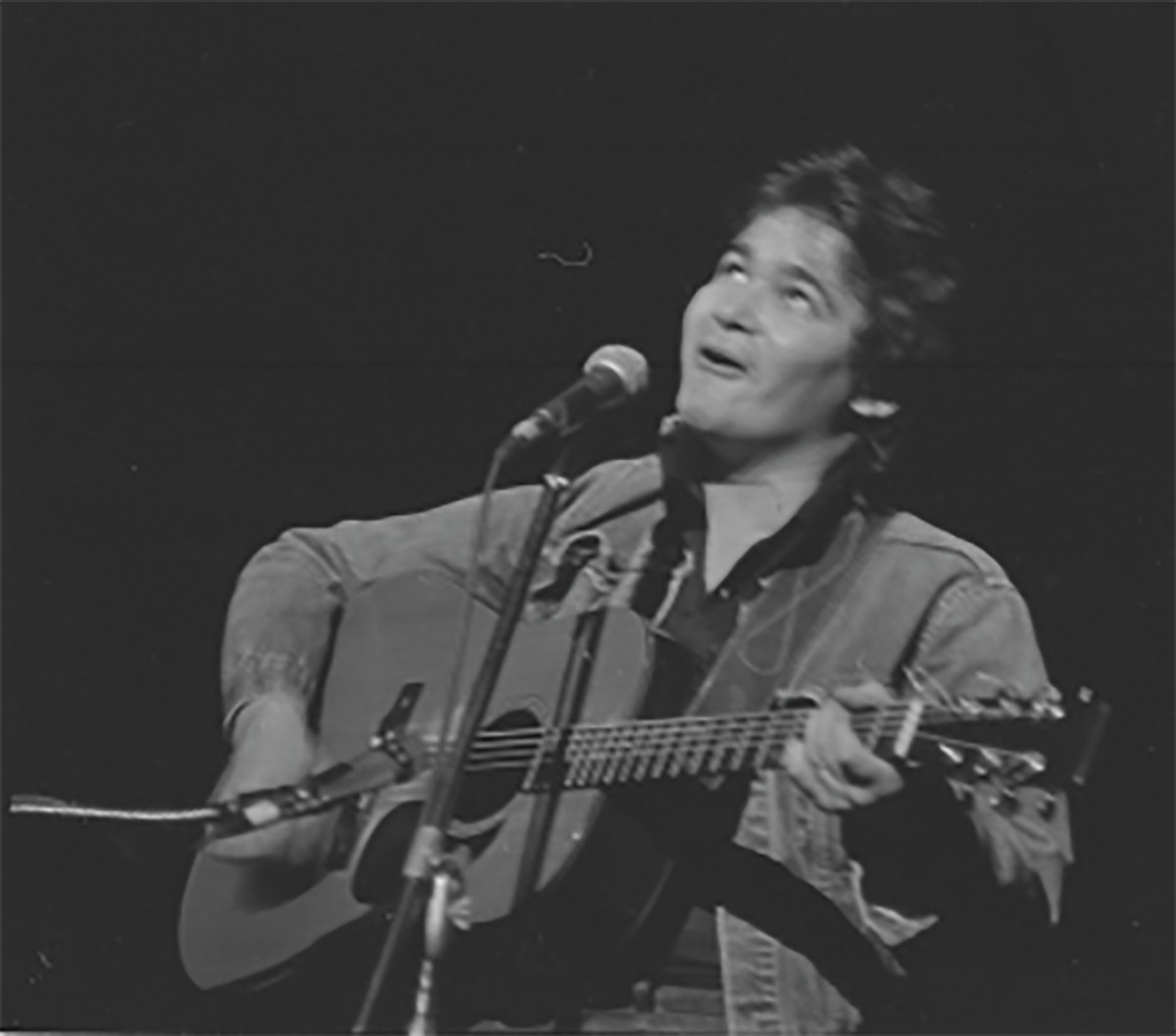
In fact, that’s the first time I saw Leon Redbone. I saw John Prine at the Alice Tully Hall. He came out and says, “I got this guy, his name’s Leon Redbone, just let him take you where he’s gonna take you or something like that.” Nobody knew what to expect. It was like, Holy moly, what the hell is this?
How much of your taping and collecting is non-Dylan artists?
I’m a musical archivist, and I’ve been doing that for non-Dylan stuff for a long time now. So I have worked with the Tom Verlaine estate. I’ve done the Doc Pomus stuff. Mitch and I did Billy Faier years ago. I’ve done the Bob Fass stuff.
When you say “done,” what are you doing?
I’m taking analog tapes and digitizing them and annotating them, so they know what they have.
John Hammond Sr. is another one that I’ve worked on, though there wasn’t a lot of stuff there because it was basically everything that was left in his office at the time of his passing. I had gotten friendly with one of his sons—not John Hammond Jr., but the other son, Jason. The eventual goal was to find Dylan stuff that might not have surfaced, but he didn’t have anything.
Do you still do that level of digitizing for the Dylan people, or has that shifted to the Archives folks?
No, I do that. I know the archives do it [too], but I’ve been doing that steady for over ten years now.
Thanks Jeff! If you liked this, check out my earlier conversation with his collecting compatriot Mitch Blank.
Thank you! Brilliant interview. Jeff was open and candid - I have seen the name and it is great to find out what he did/does and how he did/does it. I am very ignorant about the whole taping thing but I have always been grateful for those who did it and curated the tapes.
Saw the Bob at the Trocadero show in Philly. J/I/C you didn't know, the Troc in the 602-70s was the best Burlesque House in Phila.