
Flagging Down the Double E’s is an email newsletter exploring Bob Dylan performances throughout history. Some installments are free, some are for paid subscribers only. Sign up here:
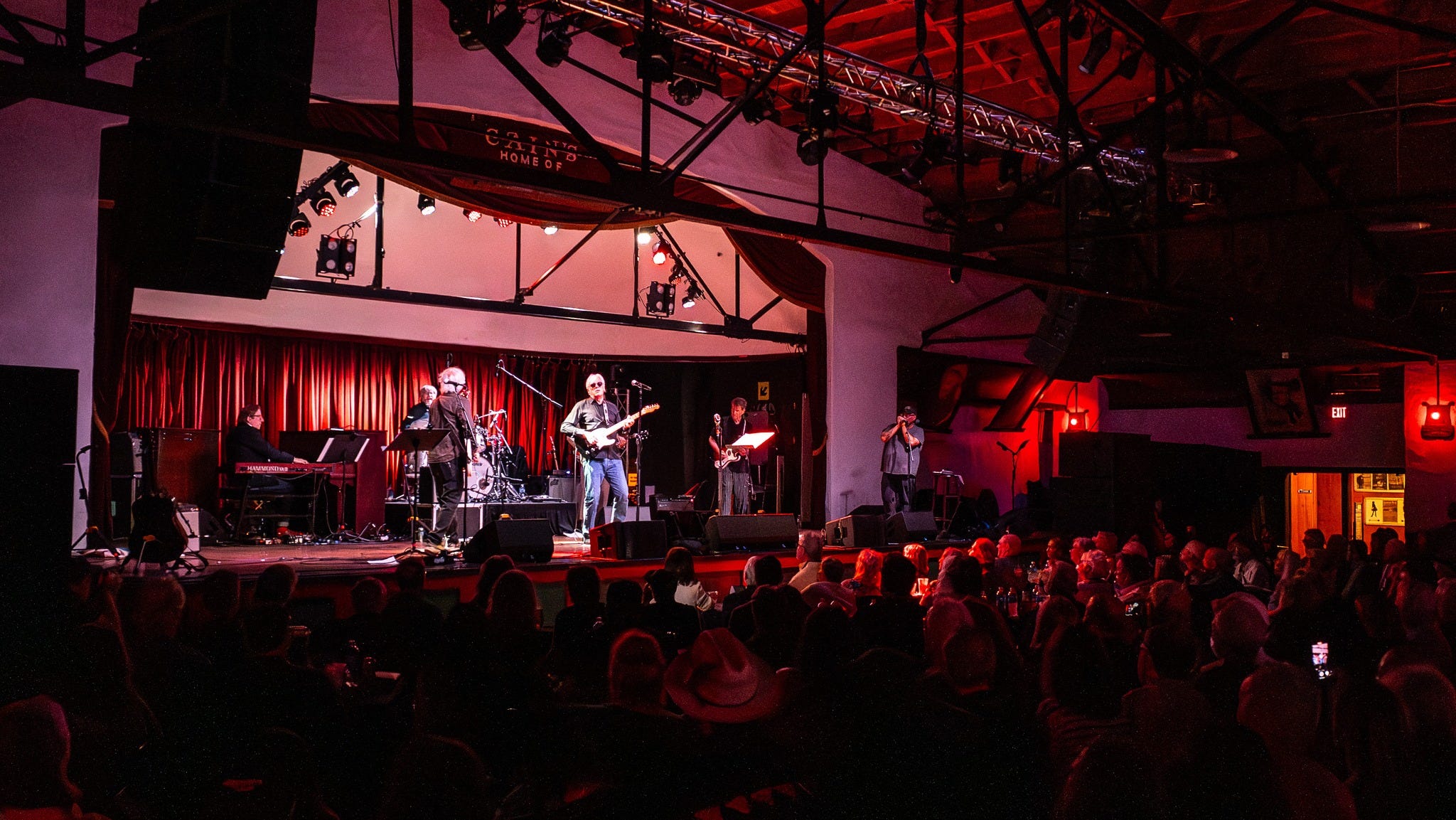
Today, my final (very belated) backstage convo from the Bob Dylan Center’s “Going Electric” last summer. Since we spoke, Robyn Hitchcock covered all of John Wesley Harding in Woodstock, which looked like a very fun show! But last summer, we were chatting about the two songs he was performing at Cain’s Ballroom that evening, “Desolation Row” and “Highway 61 Revisited.” “The whole human catastrophe is spelt out there in all its grotesque absurdity.”
All of these casual Bonus Track conversations backstage at the Bob Dylan Center’s “Going Electric” shows are archived here—and here’s the main piece I did from the shows
You may have covered more Dylan songs than anyone who will be on that stage tonight. Which leads me to ask: how did you pick the two you’re going to do tonight?
Well, the field was fairly narrow tonight. It was songs from what I call “the momentum years,” '63 to '66. No one had bagged “Desolation Row,” so I just bagged it.
Why that one?
Well, because it’s “Desolation Row,” you know?
I mean, the really big ones—“Sad-Eyed Lady,” I’m not sure that that would hold an audience. “Visions of Johanna” is fantastic, but Emma [Swift, Hitchcock’s wife] did that last time we were here. I’ve been doing that for centuries, but it’s kind of become Emma’s thing at the moment, so I’m happy to not play it. “It’s Alright Ma” is another great one, but the guitar’s quite intricate and I can’t remember all the verses. And “Gates of Eden” is pretty good, but, of its kind, “Desolation Row” is just the completely standout track.
It’s one of his old songs that he loves to reverse a car over at the moment. Anything he can do to deface it, he does. Maybe he’s jealous of his old talent or maybe he wants to give the public what they want, but not in a recognizable form. I think there’s a lot of perverse feelings in Dylan that come out in the way he covers those songs.
“You want a hit? I’ll give you a hit…”
But he knows that the faithful will take anything. And so, rather like Donald Trump, he can get away with what he wants.
“Desolation Row,” it’s just a magic song. It’s certainly one of his peaks. He wrote some great songs afterwards, after the crash, very emotionally intense songs, and still does sometimes, but he’s never produced anything like that. And nobody else has. I heard that when I was just turning 13, and it was one of the things that tipped me into doing what I’ve done.
That song specifically?
Specifically “Desolation Row,” yeah. Arguably it’s a bit long—or it couldn’t be long enough. It’s just a world that you can inhabit, really. As is “Sad-Eyed Lady,” but I think “Sad-Eyed Lady” would rely more on having the right sound. And again, Emma’s covered that one.
And then “Highway 61,” that’s your other one.
That was one I was offered that I particularly like. It’s very different. It’s like “From a Buick Six.” It’s that little window where Dylan was very exhilarating. He was complaining—you know, he’s always been a kvetch—but he was complaining in such an exciting way that it was almost a celebration. So you’ve got all these malfunctioning human scenarios and they’re all set on Highway 61. The whole human catastrophe is spelt out there in all its grotesque absurdity.
And it’s also so funny. I remember I just used to laugh when I heard it. Mack the Finger and Louie the King and stuff.
One of the things he’s really good at is putting dialogue in songs. Like the conversation in “Highlands” with the waitress.
Hard-boiled eggs. “Draw a picture of me”
Yeah, there’s about five minutes of great dialogue. There’s dialogue in “Ballad of a Thin Man,” there’s dialogue in “Highway 61.” You know, “God said, ‘No.’ Abe said, ‘What?’” You don’t get things like that in songs much. And he is so good at that.
Have you performed either of these songs before that you remember?
I don’t think I’ve sung “Highway 61” anywhere. It’s the kind of song which can very easily become a sort of colorless boogie. “Oh, it’s a 12-bar. Dun dundun dundun…”
How do you avoid that?
By having certain key ingredients, one of which is Lee [Ranaldo] has got that whatever that police siren is. The dentist drill. And then the keyboard is actually doing that figure that starts the whole thing off. That little flourish. And then Nels is playing slide, he’s playing like Bloomfield does. In fact, those three ingredients come in in the first three seconds of the song. The piano, the slide, and the siren.
Needless to say, when Dylan started to exhume it again, it didn’t sound anything like that. To me, the arrangements of both “Desolation Row” and “Highway 61” on the record are definitive. So if I do them live, I’m just trying to put them in that way. I’m not trying to do them in a new way. That’s for Dylan to mess up.
My role if I try and do Dylan songs is to do it as close to the feel of the original as possible. Like if you were playing a piece of classical music, you would try and get it right. Do it like Bach did it, or how we think Bach did it, rather than “Well, we’re taking the bones of this and then we’re reinterpreting it,” you know?
As you say, Dylan does that himself.
It’s his privilege, you know? They’re his songs. If he wants to mess ‘em up, so be it.
I know your first Dylan show, because you wrote about that for me a while ago, Isle of Wight. When’s the last time you saw a concert?
I saw him in 2014 with Emma in Sydney. She’s seen him since then. She’s seen the Rough and Rowdy Ways show.
The thing with his stuff is, it starts to melt after about five or six years. I don’t know if he even does it consciously, but I think the paint doesn’t dry on his compositions. He does them and then they just, like I said, melt really. It’s his bargain with time, is he makes no attempt to resist it. He’s happy to look his age. He just does that, but my role is more to try and freeze things in time at a good point.
You mean in terms of what you were saying about trying to recapture the original sound?
Yeah. I think, “Okay, this sounded great in October 1965. Let’s do that arrangement. It doesn’t need to change.”
But I’m the listener and the fan, and Dylan’s the originator. One of the many perverse deals that Dylan makes with his public, or you make with Dylan, is that he can do what he wants to those songs.
So I saw him in 2014, and it was the most clearly he’d articulated in ages. I saw a few shows in the late ’90s. I saw the Tom Petty show in ’87 and I saw him in ’90 and ’97 and 2000.
What’d you think of the Petty show?
I thought it was terrible. He seemed like a soul in torment. He was just standing there wailing away in his leather trousers. The vibe I got off him was just misery, wretchedness. He seemed like an absolute lost soul.
That’s kind of how he writes about that period in Chronicles.
Well, then I got it right. [laughs]
Something happened to him in the ’90s. He got cleaned up, or something bottomed out, and he also began to take more care over himself [and] his shows. He looked better and began to sing more clearly. I remember seeing him in 2000. He was already sounding like an ancient, but he was lit from behind at one point. My old sound guy, Joel, was doing his lighting for a few years.
Joel Reiff. I’ve interviewed him.
Yeah. Dylan was there in silhouette and he suddenly looked like he had 40 years before, with electric hair and all the rest of it. He did a fantastic version of “Cold Irons Bound.” That was exhilarating. It was like he came alive.
Thanks Robyn! Catch him on tour this spring. And catch up with all my Going Electric conversations (John Doe! Nels Cline! Emma Swift! Lee Ranaldo! etc) here.
Thanks, but Dylan does not "deface" Desolation Row live, come on. Listen to London 10/6 2000, for example, holy smokes!
We're lucky Bob doesn't tell himself "let's play it like in October '65." We'd be bored to death. Instead reinvention is part of Bob's genius.
This was one of the best interviews with Robyn that I have read