
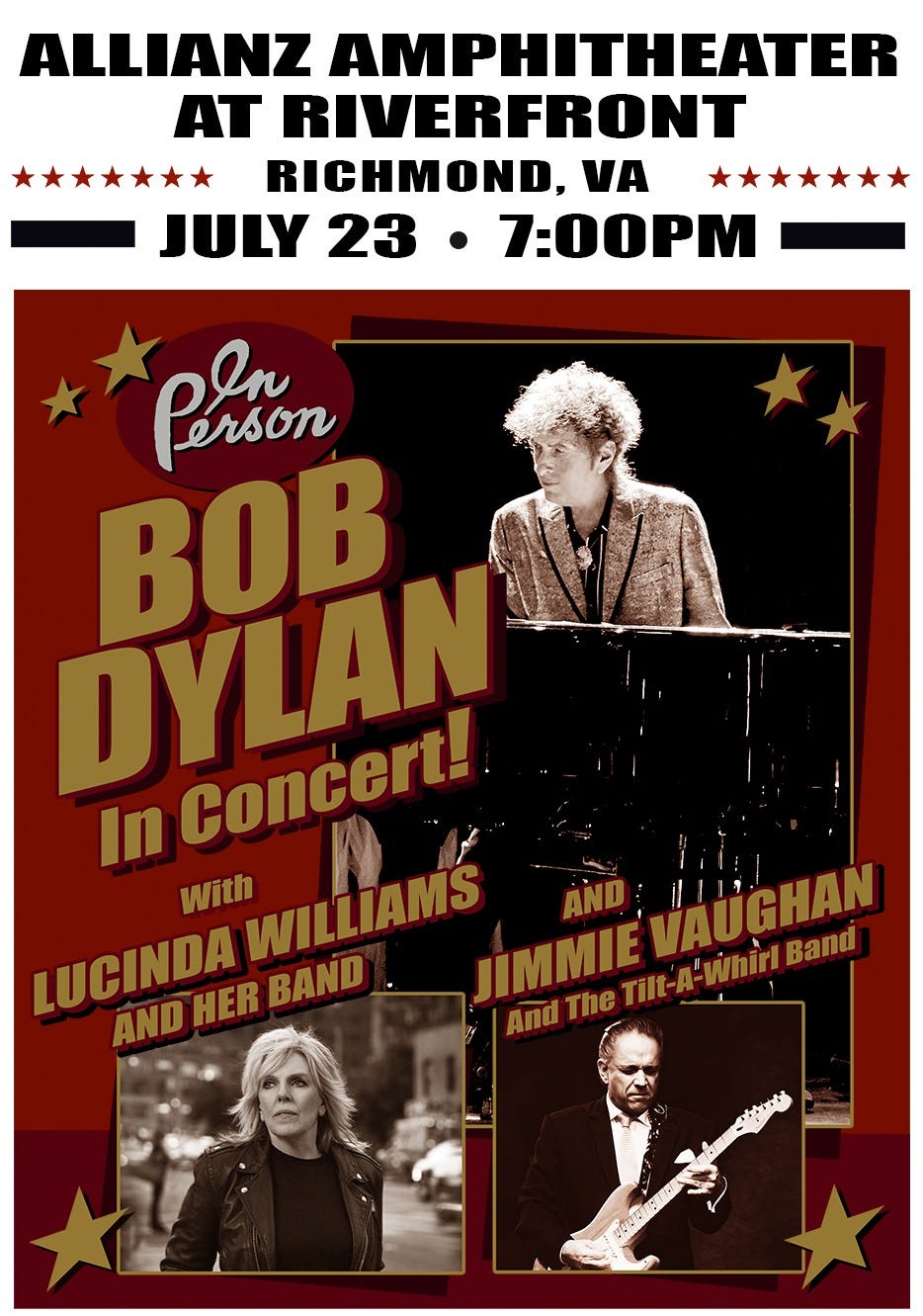
Last night, Bob Dylan brought the Long Hot Summer Tour to Richmond, Virginia. Scholar and writer Anne Margaret Daniel was on hand to tell us about the show, and about the city’s importance in Dylan’s—and the country’s—history. Here’s Anne Margaret Daniel reporting in from Richmond:
Among its other names, they call my hometown of Richmond, Virginia the River City—or to be more accurate, Rivah City, since that’s how we say it. Richmond was named for Richmond upon Thames, since the aspect of it from the bluffs on the north side of town overlooking the James River is similar. It has other nicknames, many based on its time as the capital of the Confederacy from 1861 to 1865. In 2021, Richmond was in the news as protests following the 2020 murder of George Floyd in Minneapolis resulted in the removal at last of a row of Confederate generals along Monument Avenue, installed there from the 1890s and long towering over the broad street with its parklike mall down the center. The statues and their plinths are gone now, with the space where they stood either paved, or occupied by grass and flowers. But the names on the land remain, all over Richmond’s history and all over town: Davis, Stuart, Jackson, Lee, Maury… Faulkner knew it all too well, and had a character say it in Requiem for a Nun (1919): “The past is never dead. It’s not even past.” Bob Dylan, not a mere Civil War buff but, as we know from Chronicles and from many interviews and songs, a scholar of America’s darkest war, has made the city a regular stop on his tours since 1966.
Back then, my parents went to hear him and his traveling band at the old Mosque, now called the Altria Theater, though no one in Richmond calls it anything but the Mosque. It looks like one, with its domes and minarets, and Jazz-Age gorgeousness and superb construction (the Mosque was finished in 1927, just before the crash). When I took Mother and Papa to hear him and Willie Nelson at our local minor league ballpark in 2004, there was a little rain delay. During it, they entertained surrounding fans with stories of that earlier gig. Papa: “he sounded all right at first, when he was on his own. I couldn’t hear much but noise later.” Mother: “What nice looking young men they all were! I liked the bass player. And very enthusiastic about playing. Noisy, yes.” We danced together that night to the umpteenth time I’d heard “Like A Rolling Stone.” Papa’s favorite song of the night was “Blind Willie McTell,” and Mother’s was “Country Pie.”
When I heard Dylan play the Mosque in 1990, he and the band started off with “Dixie.” Not so at the Allianz, which is literally built on the bones of war. This new outdoor venue, just open for a year, abuts the ruins of the 19th-century Tredegar Iron Works, and the American Civil War Museum. Tredegar made most of the Confederacy’s cannon and other arms during the Civil War, and was destroyed when the Union army captured, or liberated, Richmond in the spring of 1865. “May the tenth, Richmond had fell / It’s a time I remember oh so well” is how Levon sang it, though the town burned in early April. President Abraham Lincoln visited Richmond on April 4-5, and his son Tad brought home to Washington a Confederate battle flag now in the museum.
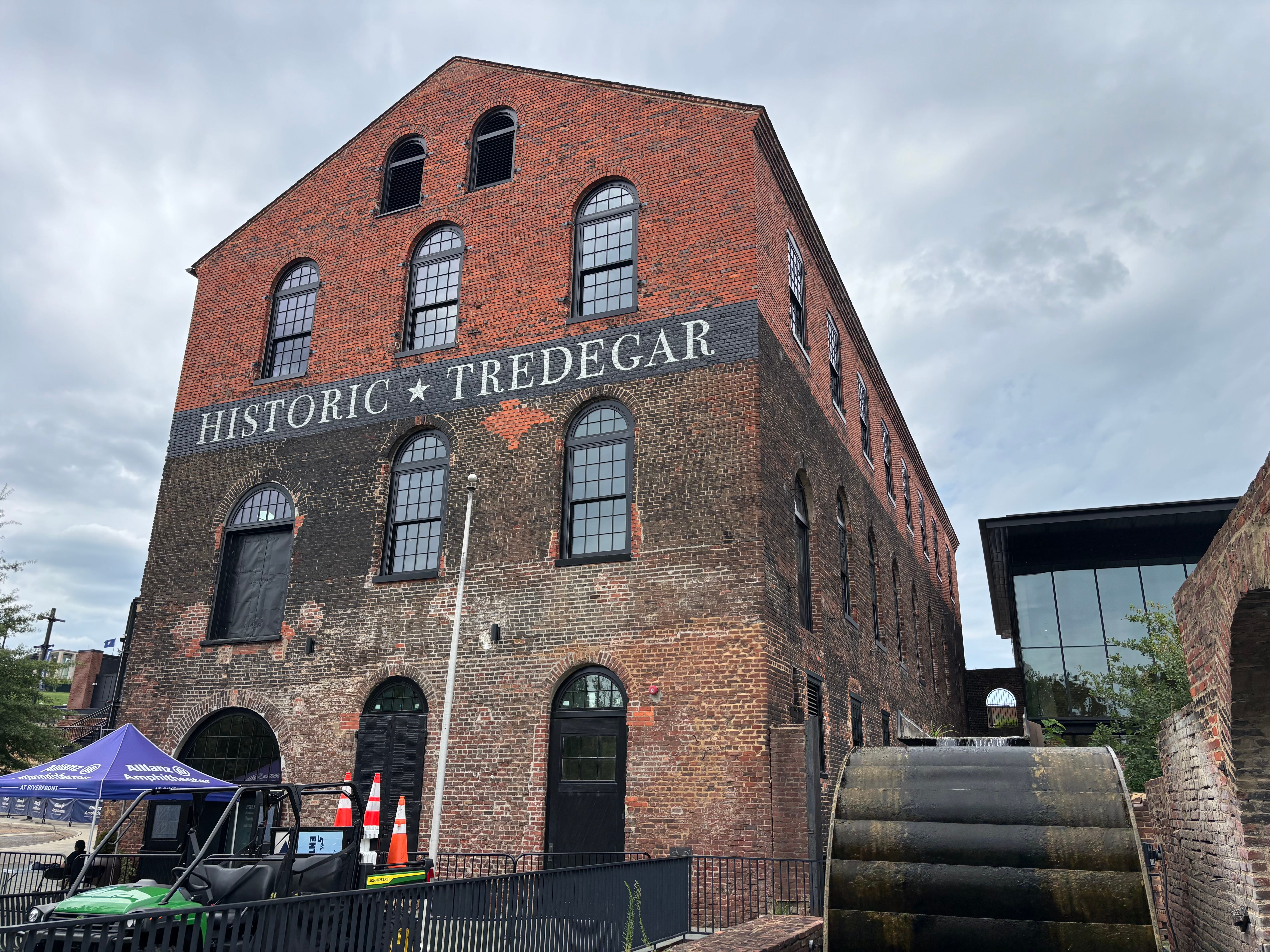
Before the show, many fans—and, according to the museum’s employees, musicians and road crew members—walked through the well organized and moving exhibitions commemorating those who fought, those who were enslaved, those who died, and those who survived. May our country never know another civil war, I thought, as I walked along the second story above the now-preserved crumbling brick walls of old Tredegar. When I left the museum, I paused to sit for a moment in the anchor of the CSS Virginia, formerly the Merrimack, known for its celebrated “ironclads” battle against the Monitor in the Chesapeake Bay at Hampton Roads on March 9, 1862. Over my shoulder, twin streamlined black-and-brown buses I recognized were parked side by side in the upper parking lot, snug among the ruins.