
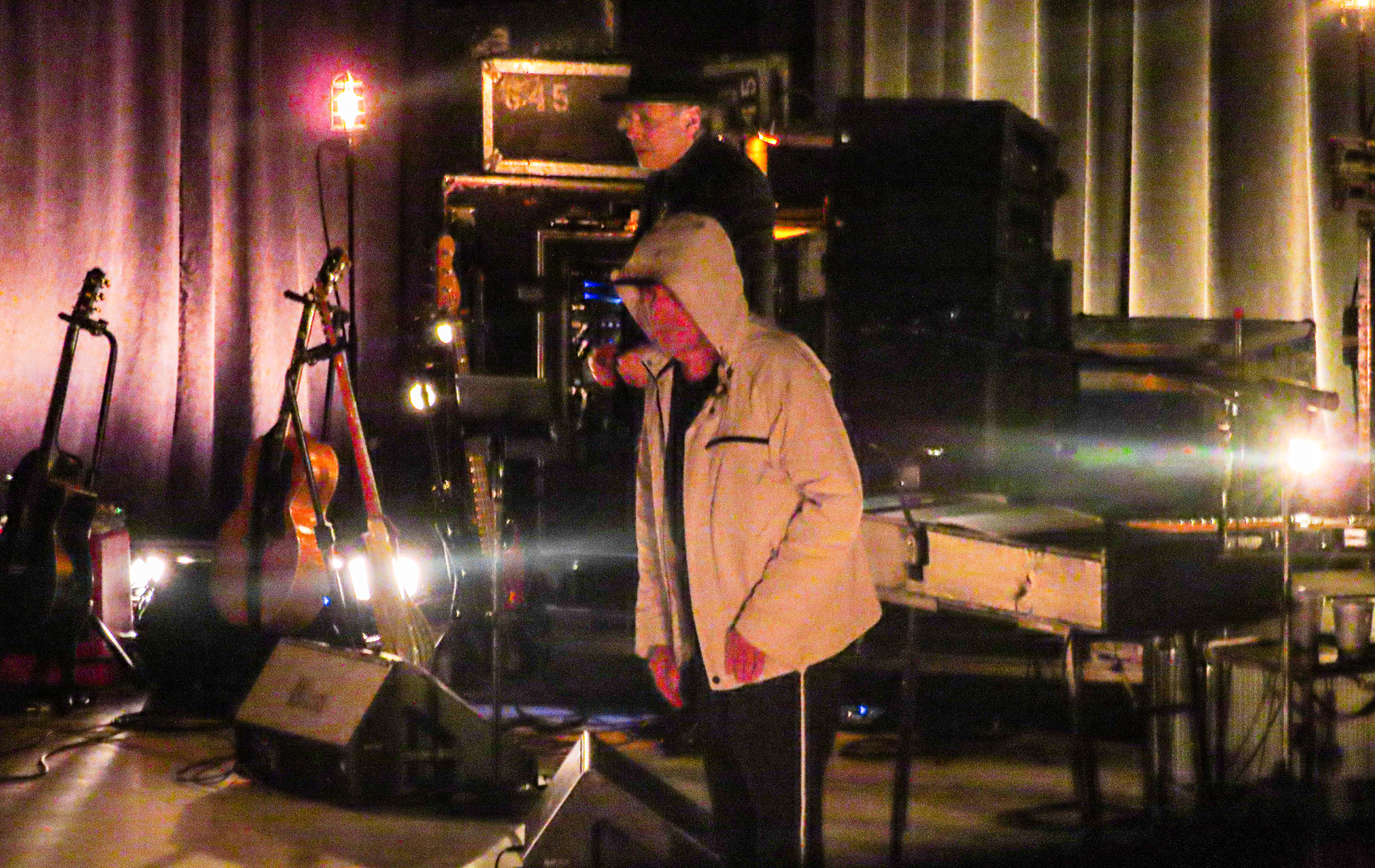
Last night, Bob Dylan played his third show ever in Macon, Georgia. Macon is, as you know he knows, the home of Little Richard. And that’s only the start of the city’s musical story. Below, scholar and writer Anne Margaret Daniel reports on the Dylan concert—but first she takes us on a virtual walking tour through Macon’s musical history. Here’s Anne Margaret Daniel:
A Rambling Man Passes Through Town: Bob Dylan and Macon Music
On Wednesday, April 22—Earth Day—it was close to ninety degrees in Macon, Georgia—summer heat already, on top of a longtime drought that has the huge old magnolia trees already in full bloom, and the red clay ground baked bricklike in all the city’s green open spaces, from parks to cemeteries. After a terrible winter in the Northeast, the hot sun and fragrant air were twin benedictions to me. I roved around town in a sundress, espadrilles, and a straw picture hat, happy and grateful that Bob Dylan had brought me here.
Macon is a completely unique place for a musician to perform, and for a music lover to come and hear that performance. For its size—a population of around 70,000 in the 1960s—Macon is the birthplace of a great number of musicians, including Mildred Bryant Jones, Lucille Hegamin, Veronica “Randy” Crawford, Richard “Little Richard” Penniman, and Jason Aldean. Other musicians gravitated to the town young, and remained there, now claimed lovingly by the town as native sons: Bill Berry, Otis Redding, and the Allman Brothers Band.
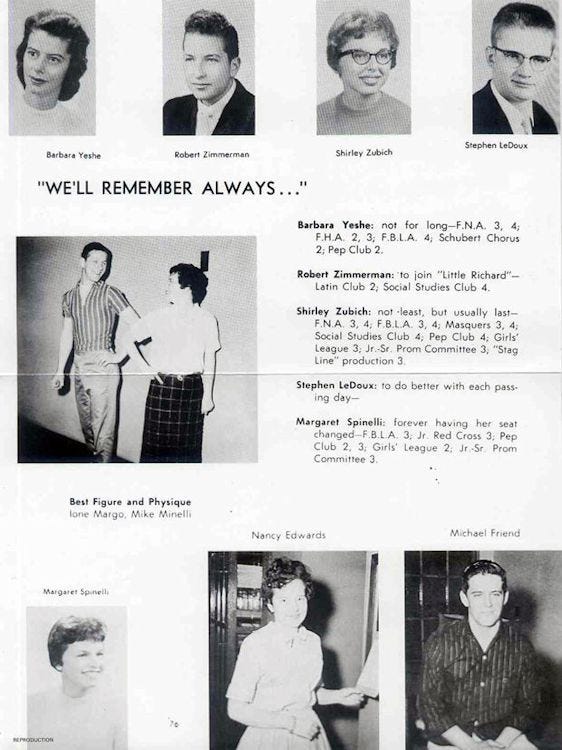
Back in 1958, Bob Zimmerman styled his hair in a wild curly pompadour, and the following year the Hibbing High Hematite yearbook predicted Bob’s future: “to join Little Richard.”
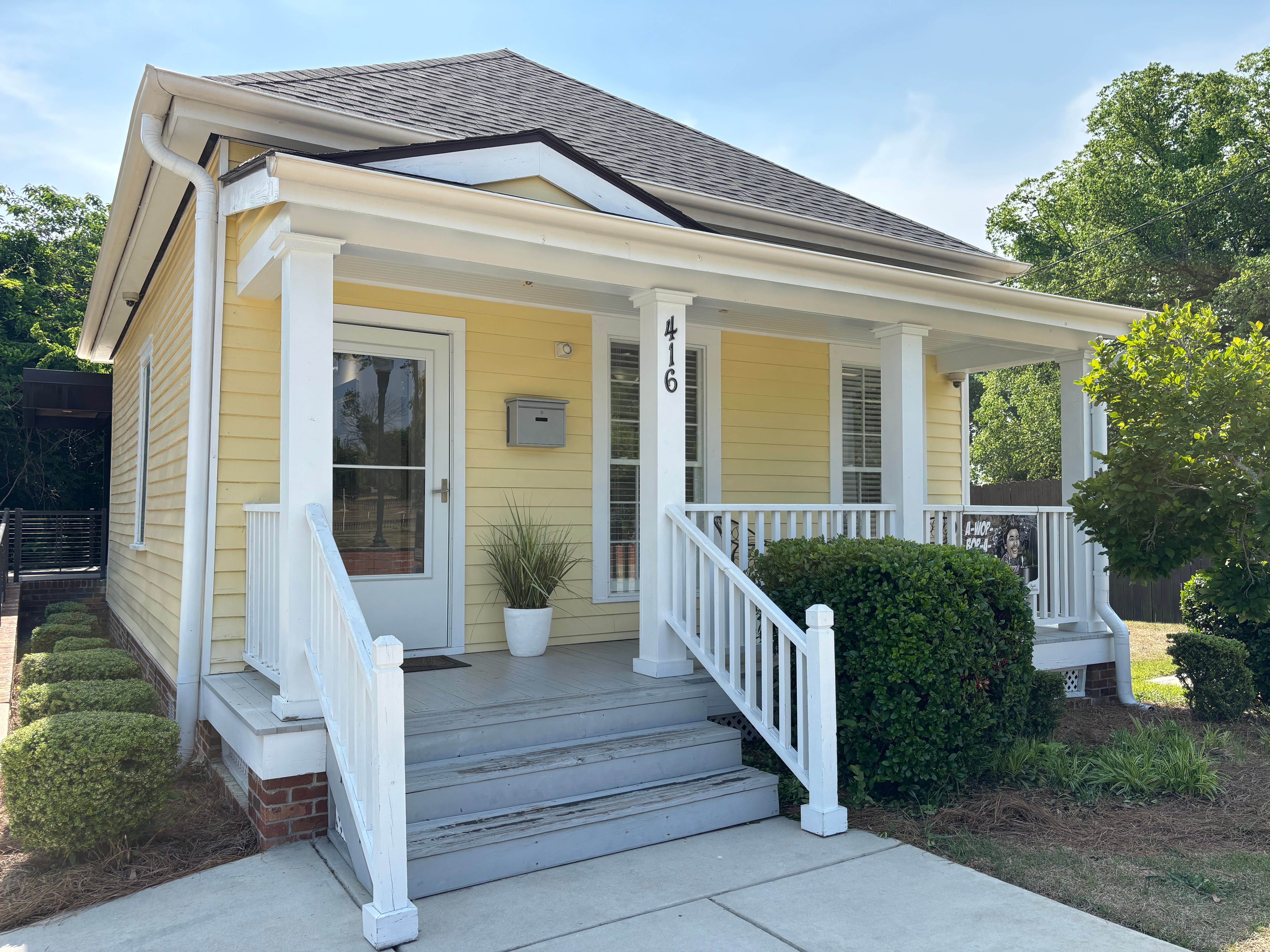
Richard (whose name was meant to be Ricardo, but his birth certificate erred) Wayne Penniman was the third of twelve children born to Leva Mae and Bud Penniman. As a little boy in Macon in the 1940s, Richard was known for singing loudly in local churches, and on the porch steps of his family’s two-rooms-and-a-hallway shotgun home. When his idol Sister Rosetta Tharpe played the City Auditorium in 1947, she invited the fourteen-year-old to open for her after hearing him singing her songs outside the venue.
The Penniman home place, moved to the historic and aptly named Pleasant Hill neighborhood when threatened by highway expansion, is now a local treasure: Little Richard House and Resource Center. The skinny hallway with its pine plank floorboards is where Richard slept in bunk beds with his host of brothers and sisters. The piano he played when Mercer University awarded him an honorary Doctorate in Humanities is on the back patio, and you can play it, too, if you dare. When you go, ask for Rose Hunt-Person to give you the tour—this elegant lady knows all about Little Richard and his career, and the neighborhood and cultural events all across town.
Otis Redding was born in nearby Dawson—in 1941, just like Dylan—but grew up and began his musical career in Macon. As a teenager he played with Little Richard’s band The Upsetters. Redding was just 21 when he had his first hit single, “These Arms of Mine,” in 1962. His commitment to helping other young performers was already significant by 1967—he ran camps for kids at his brand-new ranch in Round Oak, Georgia, and sponsored college scholarships for local high schoolers. In December of that year, Redding was in his Beechcraft Model 18 when it crashed into a lake near Madison, Wisconsin, killing the singer and four members of his backing band the Bar-Kays; only trumpeter Ben Cauley survived. Redding’s funeral service was at the City Auditorium in Macon, and crowds filled Cherry Street and Cotton Avenue outside as the 3,000-seat space overflowed. The next month, “(Sittin’ On) The Dock of the Bay” went to number one on the Billboard charts.
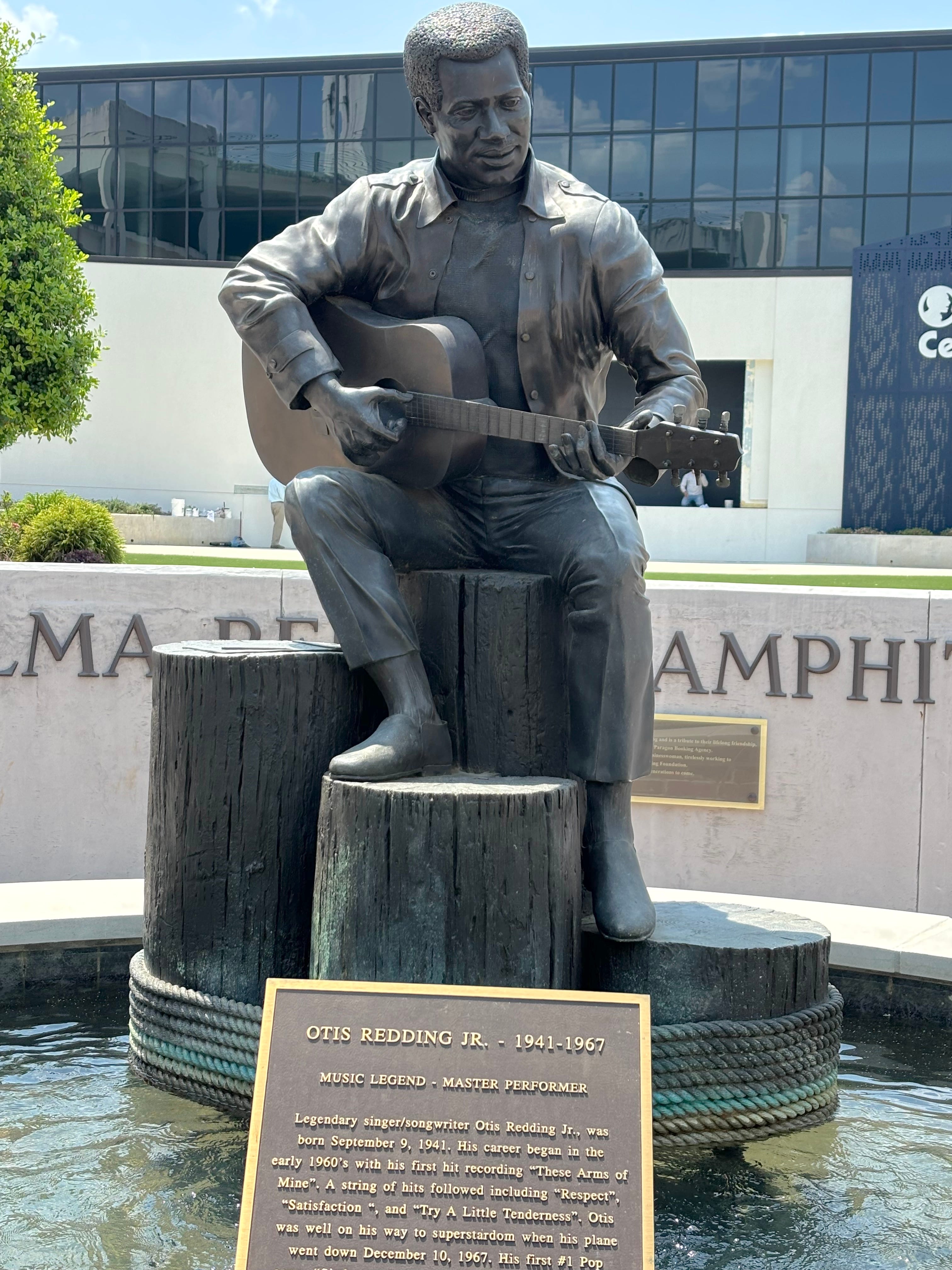
Today there is a beautiful sculpture of Redding, sitting on rope-bound dock pilings, with a pencil and paper atop one, holding a guitar and working out the song he wrote with Steve Cropper. It’s surrounded by water that bubbles gently and constantly. The sculpture stands in front of the Otis Redding Center, a magnificent building that opened in March 2025 for central Georgia’s school-age students (5-18) interested in all aspects of music, from performance and composition to graphic design, stage sets, entertainment law, and planning a tour.
In the spring of 1969, a group of newly-named musicians moved from Florida to Macon, following their manager Phil Walden and his label Capricorn Records, and settled into a huge Tudor house on a hilltop in town. The Allman Brothers Band ate for free when they were broke at H&H Soul Food on Forsyth Avenue, thanks to its legendary owner Mama Louise, and hung out in Rose Hill Cemetery, which covers the entire hilltop adjacent to their “Big House” and was a favorite place for the men to write songs.
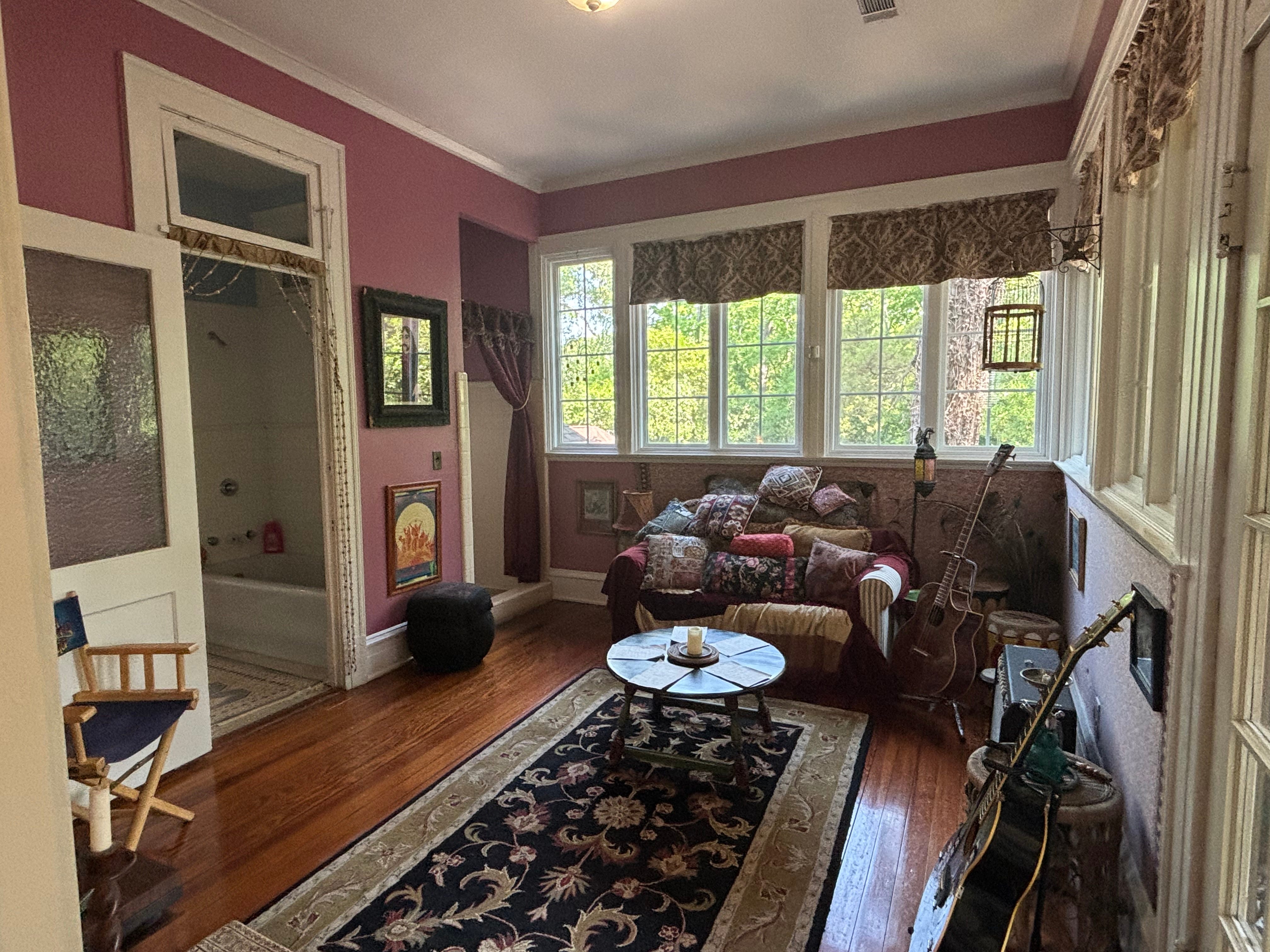
Their lives are celebrated today in the Big House Museum, where their former residence is stuffed full of musical instruments, stage-worn clothes, and other memorabilia, and the men’s upstairs bedrooms and bathrooms and lounging-around rooms look as if they’ve just walked out for a moment: heavy old oak bedsteads, dozens of needlepoint pillows, blue-jean and velvet jackets on pegs, and Khalil Gibran volumes on the mantelpieces.
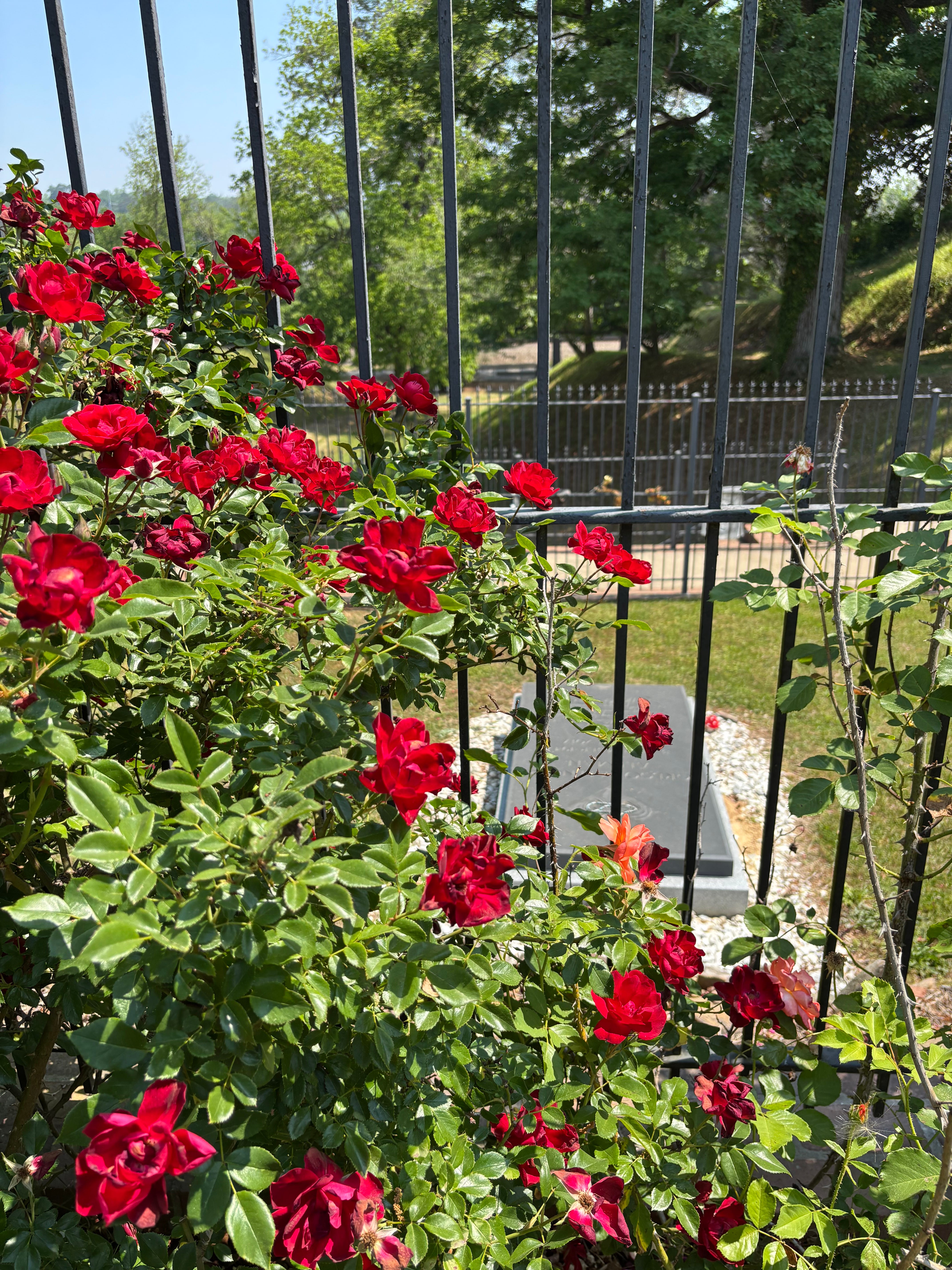
In 1970, their careers on the rise, the Allmans decided to rent a studio space down in Lizella, about ten miles from Macon, and dubbed their little cabin “Idlewild South.” Their second album, named for the cabin, was the Allman Brothers’ breakout record, and Macon remained their base as fame took them in fast and mad directions. 24-year-old Duane Allman wrecked his Harley-Davidson at the quiet intersection of Hillcrest Avenue and Bartlett Street on October 29, 1971, and died that afternoon at the Middle Georgia Medical Center. The following year, Berry Oakley, 24, was on his motorcycle when he skidded into a bus, and died that night of a fractured skull. Gregg Allman and Butch Trucks, lost to us in more recent years after legendary lives as artists, now lie in Rose Hill Cemetery with Duane and Berry. The peaceful plot is adjacent to graves of hundreds of Confederate soldiers from all states who died in Georgia, and of those of local families. It overlooks a lonesome stretch of railroad tracks where travelers and freight are always moving on. On April 22, all the soldiers’ graves bore small flags; the fourth Monday in April is no longer Confederate Memorial Day, but remains a paid state holiday in Georgia. The musical brothers’ graves are planted roundabout with roses of all colors in full bloom, and marked with tributes from fans left at the cemetery fence: a harmonica, glass slides, bandanas, flowers, notes, drumsticks, picks.
A quiet guitar player was performing Dylan’s songs and some old folk tunes right next to the Auditorium yesterday afternoon, next to the row of tour buses. He did not open last night’s show. He did, however, set the tone for the evening to come: one of gentle grace.
The whole Dylan concert was just that, a beautiful thing of gentle grace. From the lack of a shouting marquee—the City Auditorium announces only itself—to the early-arriving and slowly walking crowd of people of all ages, to the orderly long merch lines and soft conversation in the dimly lit oval of the concert hall, an almost unsettling calm prevailed. When Dylan and the band came on stage at 8:05, the audience stood and cheered in welcome, but quickly subsided and paid attention. Happy applause and whistles and the occasional Southern yee-haa after every song, but quiet and enjoying (except for the two chatty Chi O sorority sisters right in front of me, who departed at “False Prophet” and did not return, hurrah). The keyboard he’s using hardly hides Dylan from his audience: he sat last night front and center, with his pale hooded jacket over his top half. Instead of fussing with his hair, now he likes to adjust the cap under its hood. Occasionally he sips a drink, leaning to his left.
“To Be Alone with You” and “Man in the Long Black Coat” set the tone for the rest of the show. I struggle for the right word, but reassuring is somehow correct. Folks recognized the first song, and were intrigued by the second as one fewer of them knew. It took awhile for the lights to go down at the start of the show, and Dylan seemed to be liking this, looking out at the crowd and into faces, up at the balcony and to the back, while he sang the first song. The expectation for “All Along the Watchtower” is, since Hendrix’s searing cover, for a rocking conflagration; on the current tour, it’s spooky and silent, waiting for the storm. Dylan drew out that last “howl” in a way that made me think of the grief of King Lear, carrying Cordelia onto the stage. The fadeaway felt like it would echo in my mind forever.
Four more quiet songs in a row, of which “False Prophet” has previously rollicked and now seems a series of statements of fact. Its ominous ugliness has become more of a heartfelt caution, and the line that really stood out, enunciated so clearly (as is the case, really, with all Dylan’s lyrics these days), was “I’m the enemy of the unlived meaningless life.” Looking at all the smiling faces around me, people so glad they’d come to Georgia’s music town, or that they’d come to hear the show, I thought: he really is. I don’t know what he’d say about it, but it seems to me Dylan hates waste, of all kinds; and in so many past interviews has commended others who live meaningful lives.
Similarly, “Black Rider” has never sounded so much like a condemnation of a leader or politician as it does right now. Men his age who have been on the job too long, beware: Dylan’s game is still on, and he’s holding those whose isn’t accountable. “Goodbye Jimmy Reed” is no longer a jump-up-and-dance tune, which I confess I miss; in fact the only danceable song in the set is Eddie Cochran’s “Nervous Breakdown,” which Dylan performed brilliantly. We needed that jitter after the lilting, never-prettier “Soon After Midnight,” which last night made harlotry seem mellow and Slim’s fate not so savage. “Every Grain of Sand” was benedictory, and the final long harmonica solo gratefully received. Dylan came out from behind the keyboard and smiled, and briefly applauded back at the audience, before putting his right hand over his heart for a moment. Then he turned and walked away, while the cheers continued through the Auditorium. The whole night was like a warm, genuine hug: decent and comprehending and comforting.
By the time the lights came on again, Dylan and the band were on the bus to Alabama, heading along Macon’s downtown streets with the wheels rolling over the puddles of painted pink cherry blossoms at every corner. Tonight it’s Dothan; and Saturday, Jackson, Mississippi. How I hate to leave the South and head back to where it’s still cold, and the food I love best is harder to find. I am always thankful to hear Dylan play a show, but for this one, my 447th and his many, many thousandth, I am grateful. Much has been written about Dylan’s days on tour, and much more will be. But my gratitude to him for bringing me to Macon for the first time in decades, and for such a rich and lovely visit, will keep me happy, and the memory of the show will keep me warm, for a long time. Let’s see more thanks to the man for the places he goes, and brings us along with him. To the ramblin’ ladies, Katherine and Nancy, and dear Sue, safe trails and smooth sails to you—and see you soon, again, on the road. To my traveling pal Janet, who at the last minute couldn’t come: this one’s for you.
Thanks Anne Margaret! Anne Margaret Daniel teaches literature at the New School. She’s published on Fitzgerald and Modernism, and written extensively about Dylan. You can find many of her Dylan articles at Hot Press, most recently her deep dive into last year’s ‘Through the Open Window’ Bootleg Series.
That fulsome survey of Macon and its music omitted another of its contributions. As an adolescent, Blind Willie McTell was much helped by attending the Georgia Academy for the Blind in Macon: an institution that had been there since 1852. While there Willie took part in a Christmas play of Little Red Riding Hood. He was the woodcutter who saved the title character from the wolf. We know this because of the late Sister Fleeta Mitchell, who had played the title role and who I managed to interview in the early C21 about these Macon events from the earliest years of the 1920s, when she had arrived at the Blind School at age 8. [the story is in my book "Hand Me My Travelin' Shoes: In Search of Blind Willie Mctell".]
Beautifully written, thank you.