
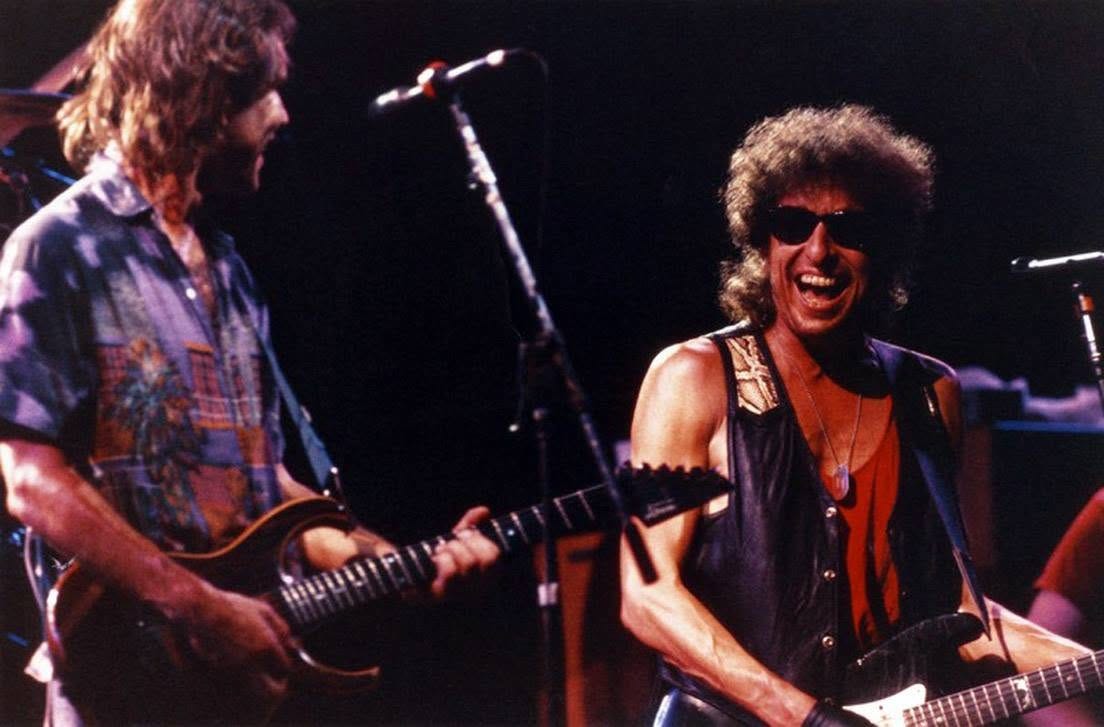
Forty years ago today, Bob Dylan and the Grateful Dead completed their first short tour together. A test-run, of sorts, for when they’d team up properly the next summer. Dylan was still backed by Tom Petty & The Heartbreakers, but once again sat in for a few songs with the Dead.
All week, writer Jesse Jarnow has been exploring these Dylan & The Dead ’86 shows in a short mini-series, and he completes his look back today covering the two final shows at giant RFK Stadium in Washington, DC.
Catch up on Jarnow’s full four-part Dylan & The Dead ’86 series, plus my earlier entries on the first Dylan/Heartbreakers tour, right here.
Dylan and the Dead ‘86: R.F.K. Stadium, July 6th & 7th
by Jesse Jarnow
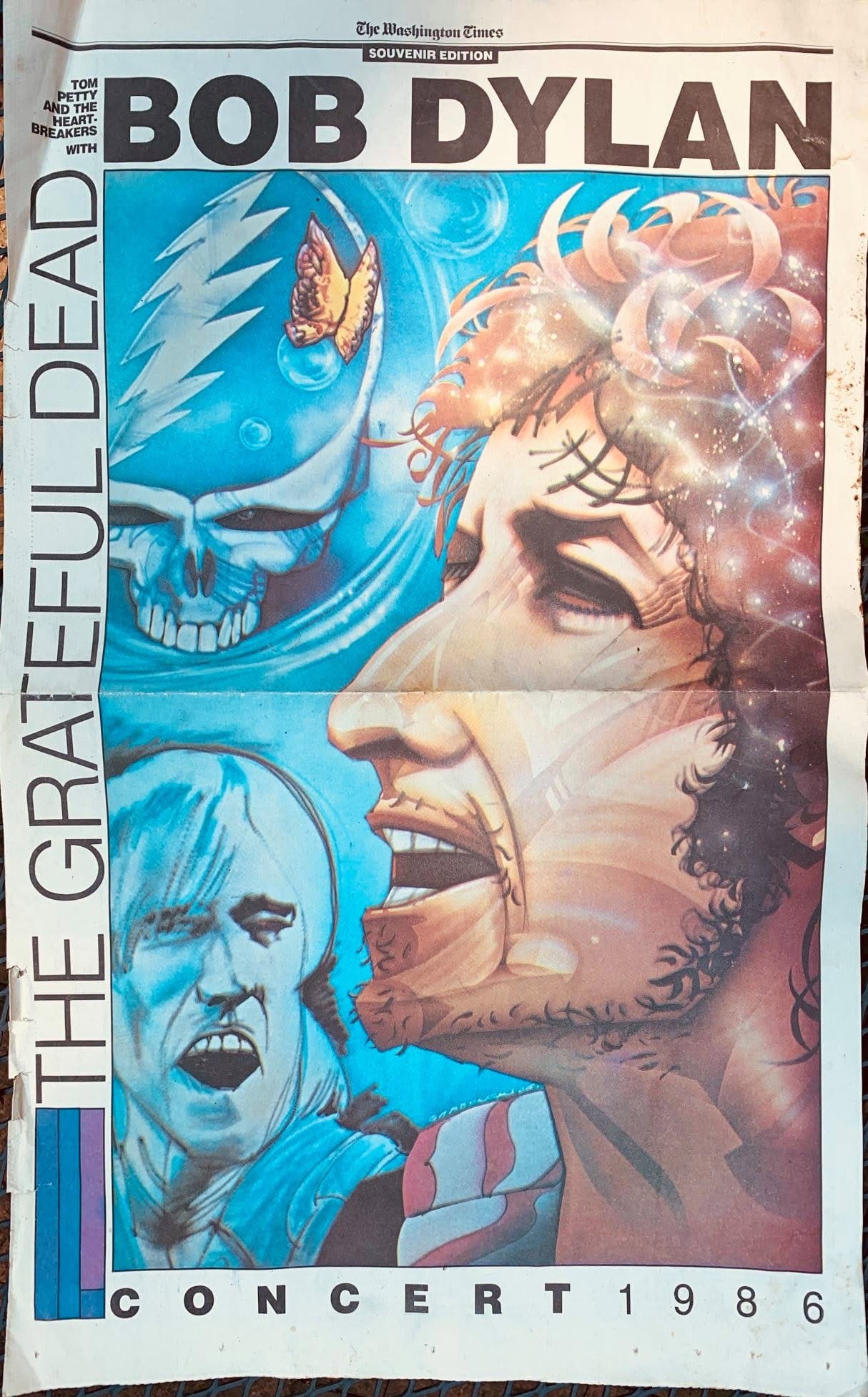
July 6th
It’s brutally hot and hotter still in D.C., another afternoon show with a 2pm ticket time. Once again, Dylan, his leather pants, and the Heartbreakers are up first. There’ll be plenty of Beltway print coverage of this particular Big Deal—or the first day’s worth of it, anyway—but all of it misses the real breaking news: that Bob Dylan invents yet another new way to get booed.
It happens late in the set, which has been, you know, fine. Dylan finds a nice melodic turn on “It Ain’t Me Babe” during the acoustic portion and the Heartbreakers do a wicked fun “I Fought the Law” during one of their segments. “Across the Borderline” hits a relaxed roll that feels new to this set of tapes.
But then comes the baffling Bob talk, as crews spray off the sweltering crowd with hoses. “Where I come from water is precious, meant to be used,” Dylan declaims. “I think that’s a waste of water.” Boos. “You like to be hot, right? I know I do.” (You and Jonathan Richman, Bob.) A sympathetic audience tape, at least, if no longer a sympathetic audience.
I’m certainly more sympathetic to the sound of ’86 than I was previously, but some of it’s difficult listening. Paul Williams, who attended most of the Dylan/Heartbreakers tour, became one of my favorite music writers because of the way he was not only able to find glorious wonders in one of Dylan’s least-revered periods, but challenged the reader to do the same, laying out a radical kind of uncritical listening.
“To be a good listener and viewer, I suggest, requires a degree of abandon,” he writes. “One must surrender judgement and other critical faculties, suspend disbelief, and be (as much as possible) completely present with the performance. This is the responsibility of the listener, and it is just as holy as the performer’s responsibility. We create this art together.” Okay, Paul, I get it, it’s my fault.
Williams doesn’t offer a show-by-show breakdown of his tour, and doesn’t talk much about the Dylan/Dead shows specifically. Still, it’s inspiring to try to hear the music through his ears. “I Want You” from July 17th, for example: “Now the muse descends in fact, and makes a mockery of all brilliant celebrations of her memory.” Aspirational.
(Accidentally anticipating Williams, Grateful Dead archivist Dick Latvala—Dick of the Picks—came to the same place sometime in the mid-1970s: “The feeling I always had about the Grateful Dead is that these guys were so special that it was on me to come to where they were to get that mind-blowing thing, and to have the attitude of ‘oh, shit, they’re going downhill’ is to miss out on the love that they’re sharing at that moment.”)
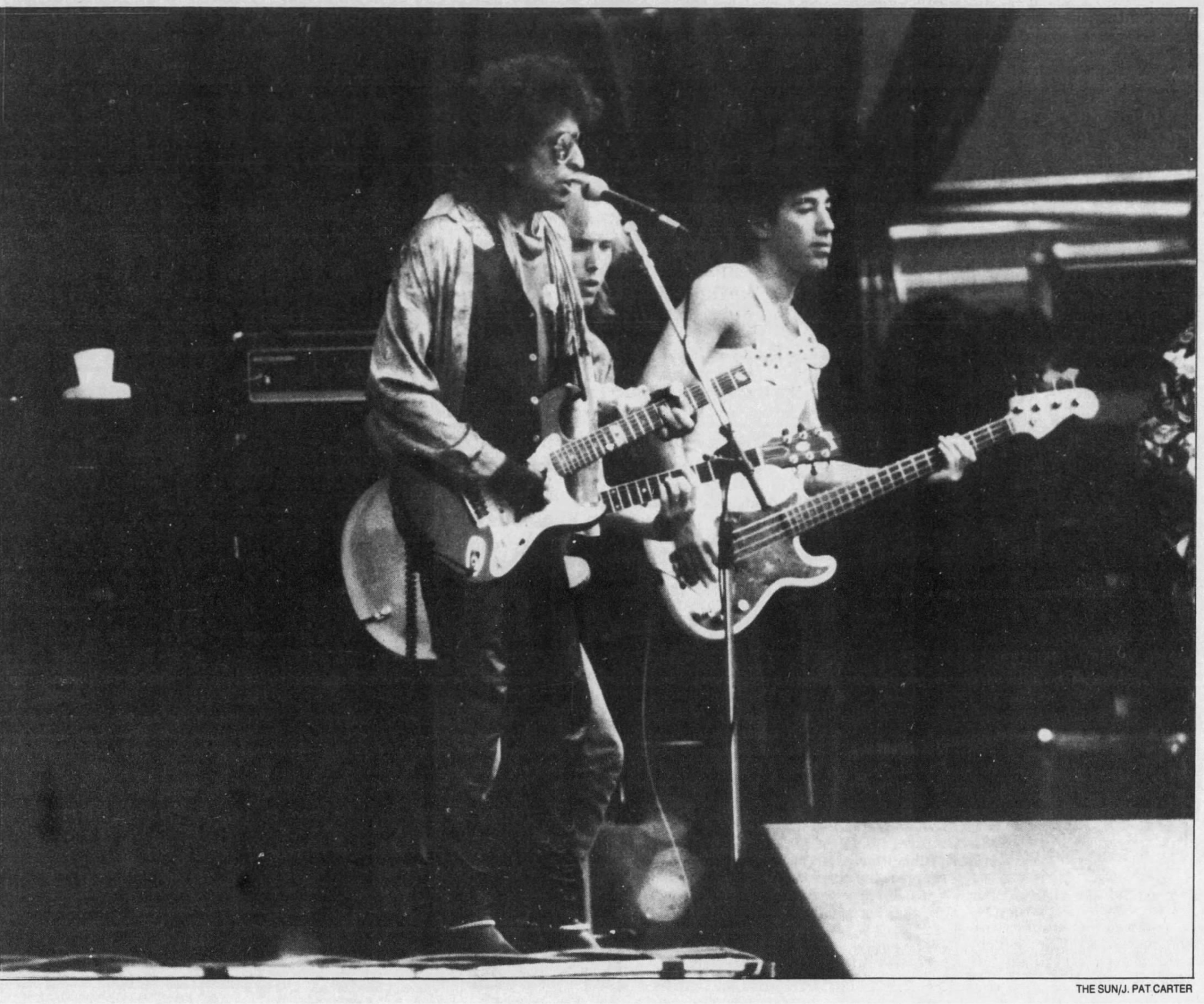
The Buffalo tape I found was missing the encore, so the first night at R.F.K. is the only version of “Rock ‘Em Dead” on this set of tapes, one of my single favorite pieces from the True Confessions era, a fun tune with an untidy little Dylan-shaped mystery about it. Like, it might be a cover of Warren Smith’s 1958 song “Uranium Rock” (much cooler title!) with a mostly new set of Dylan lyrics? Maybe because of the same ambiguity, it feels loose in a way that not many parts of the set do.
“Rock ‘Em Dead” [7/6/86]
The Dead have their shit together more on the inside first set songs like “Sugaree,” Johnny Cash’s “Big River,” and a multi-gear “Let It Grow.” By the second set, everything’s sounding a bit deflated, almost literally. It’s possible to hear “Stella Blue” as haunted. It’s also possible to hear it as Garcia running out of breath.
July 7th
The final Big Deal in our subset of Big Deals went a little under the radar, relatively speaking, the Monday after a holiday weekend, the second night at the same venue, and no less miserable heat-wise. The papers had better things to cover, anyway.
Dylan goes on first again, but shows up during the Dead’s set again, too, capping off the five shows with another absurdist guest appearance. And, as has been (and will again be) mentioned, Jerry Garcia will come very, very close to dying a few days later.
But the big news of the happy recap (at least over here) is that Dylan’s set connects with me, or at least enough individual songs do to make it a quorum. And it’s hard to tell at first if it’s the particular quality of the crunchy, compressed soundboard or something about the performance itself. The set adds Bobby Sharp’s “Unchain My Heart” to the tape pile, as well as Hank Snow’s “Movin’ On,” the last live version until ’93.
It could be a quality of the tape, well-balanced but also distorted enough to smear the ’80s-ness of the sound a little bit, blunting Dylan’s voice some, and putting the Queens of Rhythm also further in the background than elsewhere. But Dylan’s vocals feel like he’s right there in the Heartbreakers’ pocket for once, spitting out lyrics, inside the busy-ness instead of staying at arm’s length. It carries over to “Emotionally Yours,” too. “Shot of Love” has some wordless vocalizations during Mike Campbell’s slide guitar solo that grab my ears, as did the whole performance for that matter.
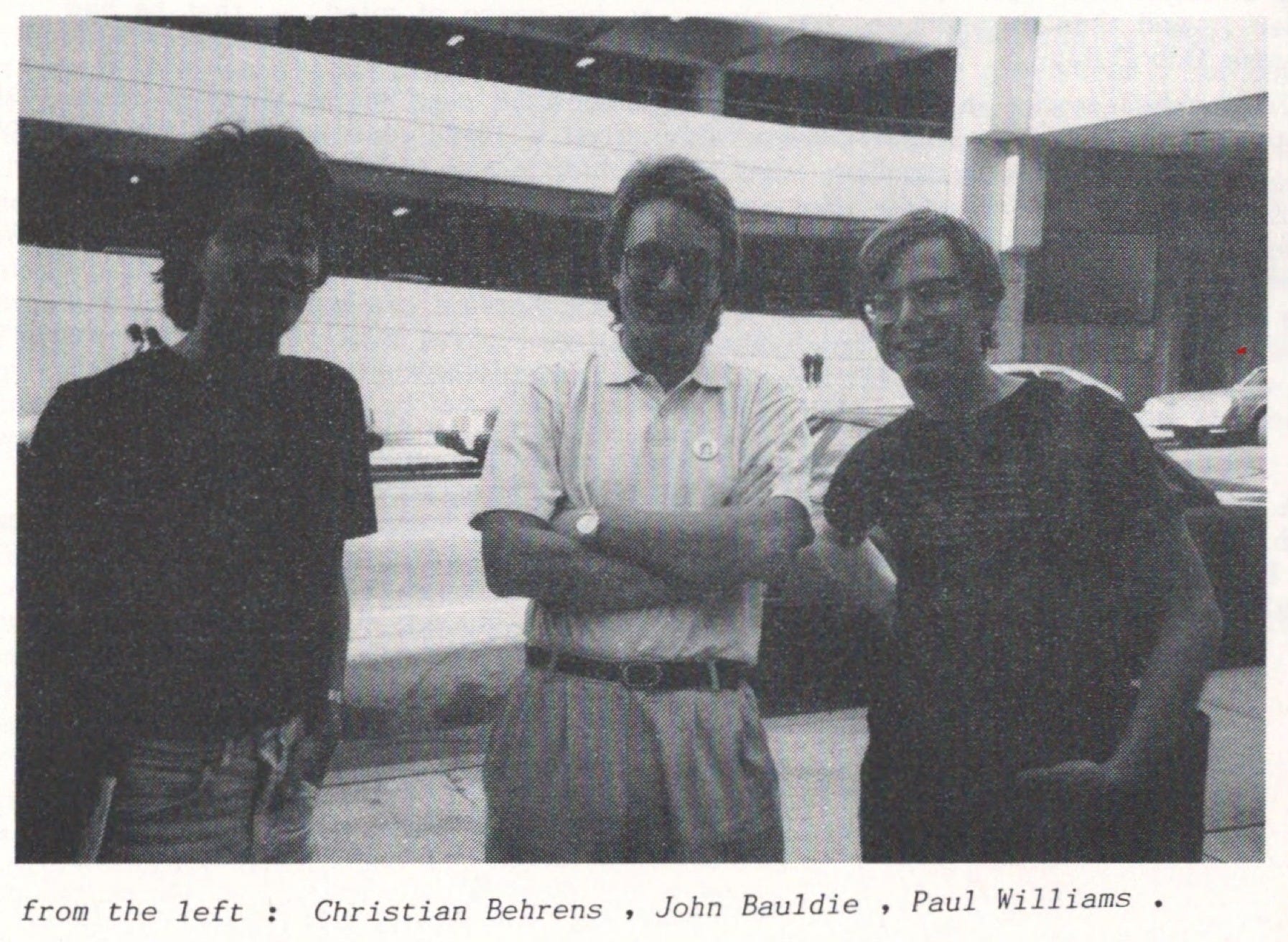
I didn’t think to check Paul Williams’ notes on the tour until after I’d already listened through the tapes, and I’m glad I waited. Of the five shows I focused on, the July 7th show is the only one that Williams calls out in Performing Artist, 1974-1986, specifically the first part of the show. He hears it taking off during “Shot of Love,” getting to it in the most Paul Williams’ manner possible.
“And then suddenly with a rush of adrenaline that can be heard surging through each musician and singer separately (and together), Dylan and crew let loose with ‘Shot of Love’ the way it’s always wanted to sound, pure unadulterated 130% take-no-prisoners raucous rock and roll.” He spends almost a full page on it. It’s pure unadulterated 130% take-no-prisoners Williams. “The first verse offers a brilliant, mystifying example of Dylan’s technique,” he asserts. Dylan misspeaks a line and then transforms it, “and instead of backing off he seizes on the power of these strange words and just lets them come through, speaking in tongues, pure spirit at the end of the third line, propelling the song forward into unknown realms, fourth line more nonsense but dummy lyric technique takes over from holy babble, maintaining momentum while holding song structure in place. Conscious/unconscious, accident/intention, skill/sloppiness/inspiration.”
I’m delighted that Paul Williams loved this part of the set, because I did, too. But I’m also delighted because it’s a passage that I failed to underline and have been trying to find again for years, only remembered in paraphrase: the part where Williams finds utter genius in the way Dylan forgets the words. And he’s not wrong.
“Shot Of Love” [7/7/86]
There are lots of other moments in the set. There are a number of funny asides to the last “Just Like A Woman” until 1988 (“oh, you oughta see the things she does” “oh, so anyway”). I’m even feeling the Heartbreakers’ “Masters of War” here, Petty and Campbell’s guitar stabs alternating like ominous machinery with Benmont Tench’s piano, giving it propulsion that’s not captured on other tapes.
“Masters of War” [7/7/86]
The magic doesn’t quite last. The crunchiness remains enjoyable, but that palpable feeling of Dylan catching a wave dissipates. At the very least, it makes me want to check out Paul Williams’ other picks. See below for the full list.
The Dead’s first set is pretty short, seemingly in a hurry to get to Dylan’s appearance. Garcia is notably out of breath on “It Must Have Been the Roses.” Dehydrated and exhausted from the miserably hot gigs, Garcia will fall into a diabetic coma three days later, after which he will have to relearn to play guitar before miraculously returning to the stage with a renewed vigor later in the year. But he’s clearly going through some shit on this tape.
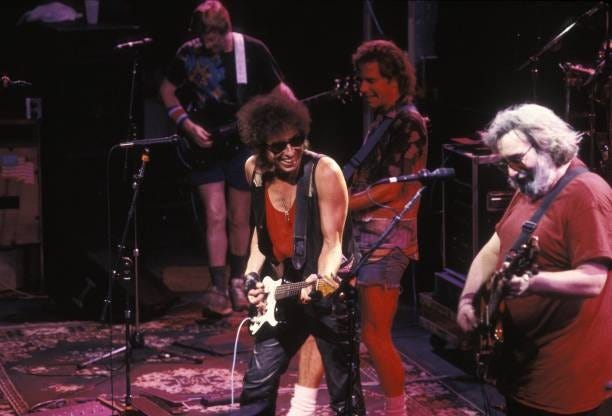
The righteous Rob Mitchum wrote a perfectly titled piece about the July 7th sit-in for this newsletter a few years back, and I’m here to plus-one everything he said, but also add a little bit of love for this kind of unsettling tape.
They go right for “It’s All Over Now, Baby Blue” this time, but Dylan pops a string almost instantly. Weir hands him a guitar and goes off to look for another, and Dylan finally starts singing at full shout about halfway through. Which, oof. It’s not quite as musically charming as the Akron version, except as an example of Dylan and Garcia finding each other in the weird ‘80s at a time when it probably meant a lot to both. There are some uncharacteristically sweet Phil Lesh vocals for a flash at the very end, too. It’s even less of a keeper than the previous “Baby Blue,” except as a moment between Dylan and the Dead, not exactly a contact low, but not a high either. More like a contact WTF.
Considered as a final product, nothing on the tape easily suggests what made Dylan want to book a tour with them as his backing band. Clearly, the Heartbreakers were the more competent of the two bands. But, as Paul Williams astutely noted, tapes are hardly the full picture.
Playing with the Heartbreakers was probably pretty fun, no doubt, but I think playing with the Dead was probably fun, more like making music, and less like performing music. The Dead never worked with a setlist, letting the evening dictate the songs they played and calling the music from the air around them however it chose to be called that night. Dylan and the Dead would rehearse extensively in the spring of ‘87, but when they hit the stage, Dylan would still–to the Dead’s shock–start playing songs they’d never even discussed. He was ready for change. When Dylan returned to the road with the Heartbreakers in fall ’87, the stable setlist went out the window.
Finishing Dylan’s second ’86 sit-in, Bob Weir starts into “Desolation Row,” a regular song in the Dead’s rotation starting that year, but only played by Dylan twice since the ’60s, once in 1974 and once in ’84. As Garcia later recounted, “So Weir says, ‘Are you sure you’ll remember all the words.’ And Dylan says, ‘I’ll remember the important ones.’”
It’s fully ridiculous. Weir gets the words. Dylan dances between incoherence and a surprisingly nice vocal blend with Weir (“it takes one to know one she smiles”) for whole seconds a time, anyway. Once the Bobs find their space, Garcia switches into upper-register guitar squiggly mode, and the whole thing achieves at least partial lift-off (again, for a few seconds at a time, a flying saucer struggling to get off the ground). Dylan leans back and skronks. Occasionally, they trade lines. There’s laughter, too. Not that laughter always implies comfort or even fun. But I choose to think the Bobs are having fun together, even if they never tried it again like this. Why would they? They already did it.
“Desolation Row” [7/7/86 Grateful Dead with Bob Dylan]
1986-07-06, RFK Stadium, Washington, DC [Dylan set]
1986-07-06, RFK Stadium, Washington, DC [Dead set, archive.org]
1986-07-07, RFK Stadium, Washington, DC [Dylan set]
1986-07-07, RFK Stadium, Washington, DC [Dead set, archive.org]
Thanks Jesse! Jesse Jarnow co-hosts the official Good Ol’ Grateful Deadcast, and is the author of Heads: A Biography of Psychedelic America, Wasn’t That A Time: The Weavers, the Blacklist, and the Battle For the Soul of America, and Big Day Coming: Yo La Tengo and the Rise of Indie Rock. The Invisible Hit Parade: A Taper’s History of Music will be published next year. The Frow Show can be heard every Tuesday on WFMU (including Bobsday celebrations).
BONUS: A PAUL WILLIAMS SUMMER 1986 DIY MIXTAPE
Update: Download here! Thanks to George Rothe for compiling
Set 1:
Unchain My Heart (July 9)
All Along the Watchtower (July 19)
Positively 4th Street (July 9)
Clean Cut Kid (July 9)
I’ll Remember You (July 9)
Shot Of Love (July 7)
We Had It All (July 7)
Masters of War (July 7)
Set 2:
Mr. Tambourine Man (July 17)
One Too Many Mornings (July 17)
A Hard Rain’s A-Gonna Fall (July 8)
I Want You (July 17)
Band of the Hand (July 17)
Union Sundown (July 13)
When the Night Comes Falling From the Sky (July 17)
Lonesome Town (July 17)
Ballad of a Thin Man (July 17)
Set 3:
Rainy Day Women #12 & 35 (July 17)
Gotta Serve Somebody (August 5)
Seeing the Real You At Last (July 17)
Across the Borderline (July 17)
I and I (July 17)
Like A Rolling Stone (July 17)
In the Garden (July 17)
Encore:
Blowin’ in the Wind (July 17)
Shake A Hand (July 17)
House of the Risin’ Sun (July 17)
Listening to Desolation Row, about 30 seconds in when Dylan keeps screaming the words he can remember, I frantically searched for my Paul Williams mask. I found something and put it on and heard a mirror crack in the distance.
Those Dylan smiles are more important to me after all of these years, really. I hope he still has a few in reserve when just the grandkids are around.
Man LOOK at that SMILE on his face in that opening shot!!! So good to see him so happy, to know it’s possible! I always loved Dylan and the Dead despite so much that has been thought and said. Thanks for bringing it back to life.